A two-story red brick house with black shutters and a dark roof stands on a green lawn behind a dry stone wall, framed by large deciduous trees under an overcast sky.

Mini Split Installation in Utica, NY

Tell us about the job

Takes about a minute. No obligation.

New system or replacementMini-splitOneida County, NY
Step 1 of 2

What ZIP code is the job in?

Gas heats most homes here

Utility gas heats 57.3% of homes in Oneida County. Fuel oil accounts for another 13.5%, and electricity 16.4%. A mini split here is usually going in alongside a furnace or boiler, not replacing the only source of heat in the house.

That changes what you're buying

If your home already has gas or oil heat, a mini split is most likely there to cover a room the furnace doesn't reach well, or to add cooling without ductwork. Sizing it means looking at that one space, not the whole house load.

9 months
September through May, your system heats
2 months
July through August, it cools
15°F
the average winter night it heats against
78°F
the average summer afternoon it cools against
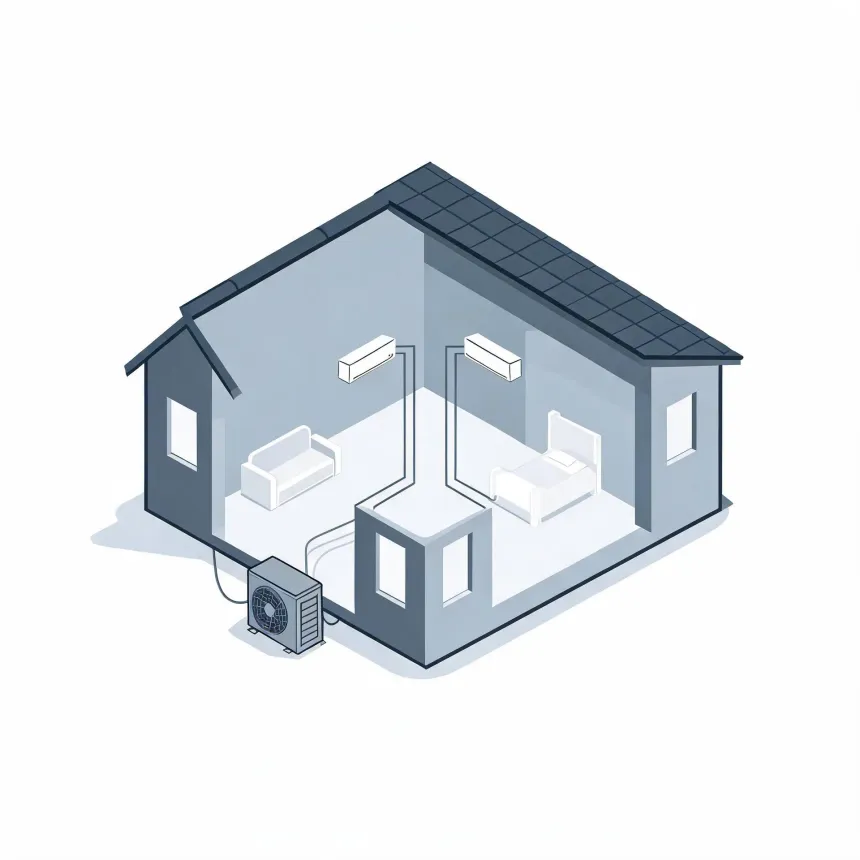
Isometric cutaway illustration of a small house showing two wall-mounted indoor air conditioning units connected by lines to a single outdoor condenser unit beside the building, with a sofa in one room and a bed in another.
Your system heats September through May and cools July through August.

NOAA nClimDiv, 1991–2020 normals

Cooling only runs about two months a year here, July and August.

A mini split in Utica isn't working hard most of the year, so a mid-range system holds up fine.

A standard mini split is the right call here, not an upgrade

Power costs 24.43 cents a kWh statewide
Climate zone 6A
Cooling runs July through August

Oneida County gets its share of rough weather, wind mostly, with some winter storms mixed in. None of that changes what a mini split needs to be here. A standard unit meeting the federal minimum handles wind and a hard freeze the same way it would anywhere else in zone 6A. The one thing worth asking about is backup power, since a mini split, like any electric heat pump, doesn't run without it. If the condenser sits somewhere exposed, make sure it's mounted and anchored the way the manufacturer specifies. That part doesn't change county to county either.

Half the homes here were built in 1958 or earlier. Size the mini split for the one you have.

An older house doesn't always have a layout that matches its age on paper, additions, converted attics, a room that got finished in a way the original plan didn't account for. A mini split sized off a general rule can miss on a house like that. Whoever installs it should size the unit to the room it's actually heating and cooling, not a number pulled from the square footage alone.

Find a contractor
A man in a tan jacket, cap, and work boots carries a canvas tool bag up wooden porch steps toward a dark green front door of a house with light horizontal siding and a potted shrub.
A white mini-split air conditioner outdoor condenser unit mounted on metal brackets against a beige stucco exterior wall, with a blue sky and scattered clouds in the background.

Get it in before June

Cooling here only runs from July through August. Install before June and the system is in place and tested before it has a single hot day to deal with. Wait until July to start calling around and you're scheduling around whatever openings are left, not your own timeline.

The line set and the wall matter more than the unit

Running refrigerant line from the outdoor condenser to the indoor head takes a hole through the wall, a path for the line set, and a spot outside with room for the condenser to sit level and clear of snow and runoff. A straight run through a thin wall costs less labor than a long run around framing or up through a floor. The distance and the path, not the brand of unit, decide a lot of the labor time.

Electrical work is its own line item

A mini split needs its own dedicated circuit, and many installs call for a disconnect box mounted outside near the condenser. If the electrical panel has room for another breaker, that's a straightforward add. If it doesn't, the job includes upgrading the panel before the mini split goes in at all, and that's work separate from the unit itself.

If this mini split is going in where a window unit or electric baseboard used to be, that old equipment has to come out first, and that's its own small job. A window unit just comes out of the frame. Baseboard heaters are wired in, so removing one means capping or rerouting that circuit, not just unbolting it from the wall. Neither gets reused. The condenser and head going in are new equipment on their own mounts, so the old unit isn't adapted or tied into the new system in any way. If the baseboard was original to the room, ask the installer what happens to that wiring once it's disconnected, so it's not left live behind a wall with nothing on the other end of it.

Installation day starts with the outdoor condenser and the indoor head going up before any refrigerant touches the line set. The installer mounts the indoor unit first, level, with enough clearance above and below for air to move through it properly. Outside, the condenser goes on a pad or bracket, also level, since a tilted condenser drains wrong and wears its compressor unevenly over time. Once both are set, the line set gets run between them, connected, and the whole system is evacuated with a vacuum pump to pull out moisture and air before any refrigerant goes in. That step matters more than people expect. Any moisture left in the line can freeze or corrode the system from the inside over the following seasons. After charging the line, the installer checks refrigerant pressure against the manufacturer's spec for that line length, then runs the system in both heating and cooling to confirm it's pulling the right temperature split between the air going in and the air coming out.