




A white wall-mounted split air conditioning unit in a dimly lit modern room, with a full moon visible through the window at night.

Mini Split Installation in Spring Valley, NY

Tell us about the job

Takes about a minute. No obligation.

New system or replacementMini-splitRockland County, NY
Step 1 of 2

What ZIP code is the job in?

Electricity in New York runs 24.43 cents per kilowatt-hour, well above what most states pay. A mini split earns that cost back by using a compressor that ramps up and down instead of switching fully on and off. It only draws as much power as the room needs at that moment. Pick one with a high SEER2 rating and the difference shows up on every bill, all year, not just in the months you run it hardest.

8 months
October through May, your system heats
3 months
June through August, it cools
23°F
the average winter night it heats against
82°F
the average summer afternoon it cools against
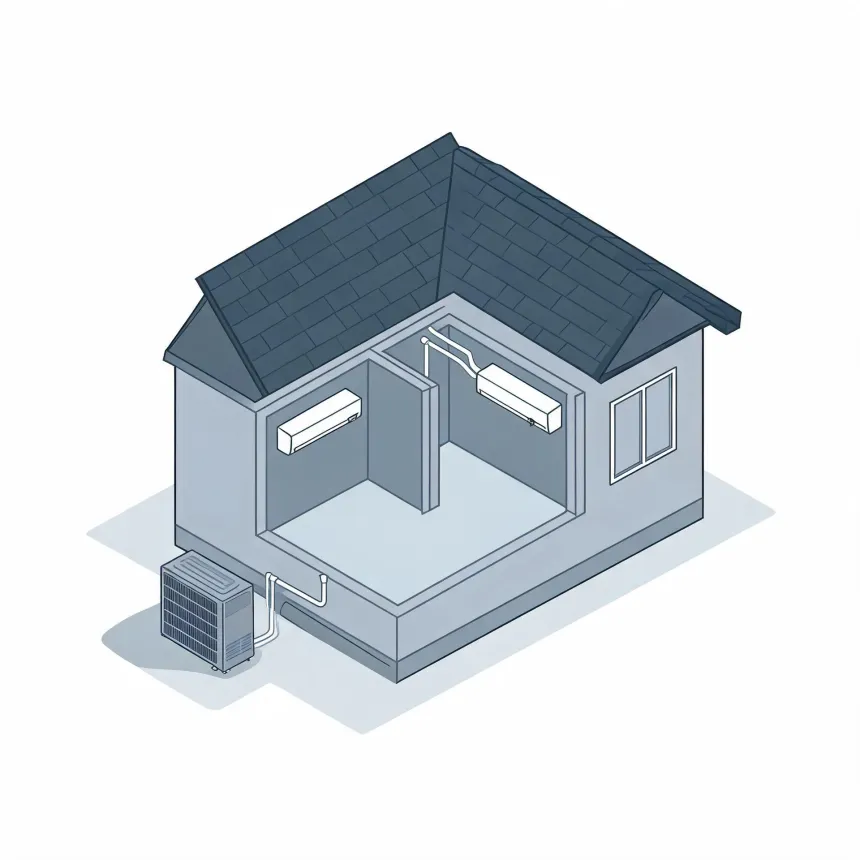
Isometric line illustration of a cutaway house with a shingled gable roof, showing two wall-mounted indoor air conditioning units connected by piping to an outdoor condenser unit on the ground outside.
Your system heats October through May and cools June through August.

NOAA nClimDiv, 1991–2020 normals

Gas heats 84.2% of homes in Rockland County.

A mini split works alongside that furnace instead of replacing it, covering the rooms where ductwork doesn't reach.

Three months of cooling a year is not a hard life for a mini split

Cooling runs June through August
Summer afternoons average 82°F
42 damaging wind events from 2015 to 2024
May is the month to put it inCooling here runs June through August. Get it installed before June and it's ready on day one.

When you're comparing units, check the SEER2 number before anything else. Two systems can cost about the same to install and run very differently once they're in your home, because the rating tells you how much electricity the compressor uses to do the same job. At New York's rates, that gap doesn't stay small. Ask the installer to show you the SEER2 rating in writing, not just the brand name, and size the unit to the room instead of buying bigger than you need.

Sized for the house you have, not a newer one

Half the homes in Rockland County were built in 1971 or earlier. A mini split doesn't need ductwork, which is what makes it work in a house that old. Whoever installs it still has to size the unit and place the lines to match the rooms you actually have, not a standard layout. Get that part right and the system fits the house instead of the other way around.

Find a contractor
A white mini-split air conditioner outdoor condenser unit mounted on metal brackets against a beige stucco exterior wall, with a blue sky and scattered clouds in the background.

Ask what happens after install day, not just what it costs

Ask what happens if the system needs service after it's in. Some installers stand behind their own labor for a set number of years. The manufacturer's warranty on parts is separate from that, and it usually requires registration soon after install or it defaults to a shorter term. Ask who you call first if the unit stops cooling, the installer or the manufacturer. Ask how far the line set runs from the outdoor unit to the head, because a longer run can lower performance even with a good SEER2 rating. Ask how loud the outdoor compressor is at night, since that unit usually sits near a window or a patio. None of this shows up on the spec sheet. It shows up after the installer leaves.

The number is a ratio, not a size

SEER2 tells you how much cooling a unit produces for the electricity it draws over a season of use. It says nothing about how big a space the unit can handle or how fast it cools a room. A unit with a high SEER2 rating still runs poorly if it is too big or too small for the room it serves. Sizing and efficiency are separate jobs. Both have to be right.
The rating only holds if the install matches it

A SEER2 number comes from lab testing done under set conditions, with the refrigerant charge correct and good airflow across the coil. A poorly charged line set or a badly placed outdoor unit pulls real efficiency below what the label promises. The label is a ceiling. The installer's work decides how close the finished system gets to it.

If this is replacing a window unit or an old mini split, the old equipment has to come out and the refrigerant in it has to be recovered, not vented. That's true of any system with a sealed refrigerant circuit. The outdoor unit, the indoor head, and the line set connecting them all come down together. If the old line set ran through a wall, the installer will tell you whether it can be reused or needs to be replaced. A reused line set has to be in good shape and sized right for the new unit, not just left in place because it's there.

Installation day starts with the outdoor unit and where it sits, on a pad or wall bracket with room for air to move across the coil. Inside, the installer mounts the head on the wall, then drills through for the line set, the wiring, and the drain line. Those lines connect the indoor head to the outdoor unit, and once they're joined the system gets evacuated with a vacuum pump to pull out air and moisture before any refrigerant moves. That step matters as much as any other part of the job, because moisture left in the line set causes problems long after the installer is gone. Once the system holds a vacuum, the refrigerant charge gets set and the installer runs the unit to check airflow, drainage, and temperature at the head. A mini split installed well is quiet enough that you forget it's running.