A modern bedroom with dark furnishings, a wall-mounted air conditioning unit, and a cat resting on a large bed.

Mini Split Installation in Rochester, NY

Tell us about the job

Takes about a minute. No obligation.

New system or replacementMini-splitMonroe County, NY
Step 1 of 2

What ZIP code is the job in?

Electricity here runs 21.61 cents a kilowatt-hour

Monroe County pays more for power than most of the country. A mini-split that runs efficiently matters more here than it would somewhere with cheaper electricity, because every hour it runs costs more to begin with.

Every hour on the clock costs more

A unit that's sized wrong or installed poorly doesn't just run badly in July and August. It runs badly whenever it runs, and at Monroe County's rates that shows up fast. Getting the installation right matters more here than in places where power is cheap.

8 months
October through May, your system heats
2 months
July through August, it cools
20°F
the average winter night it heats against
79°F
the average summer afternoon it cools against
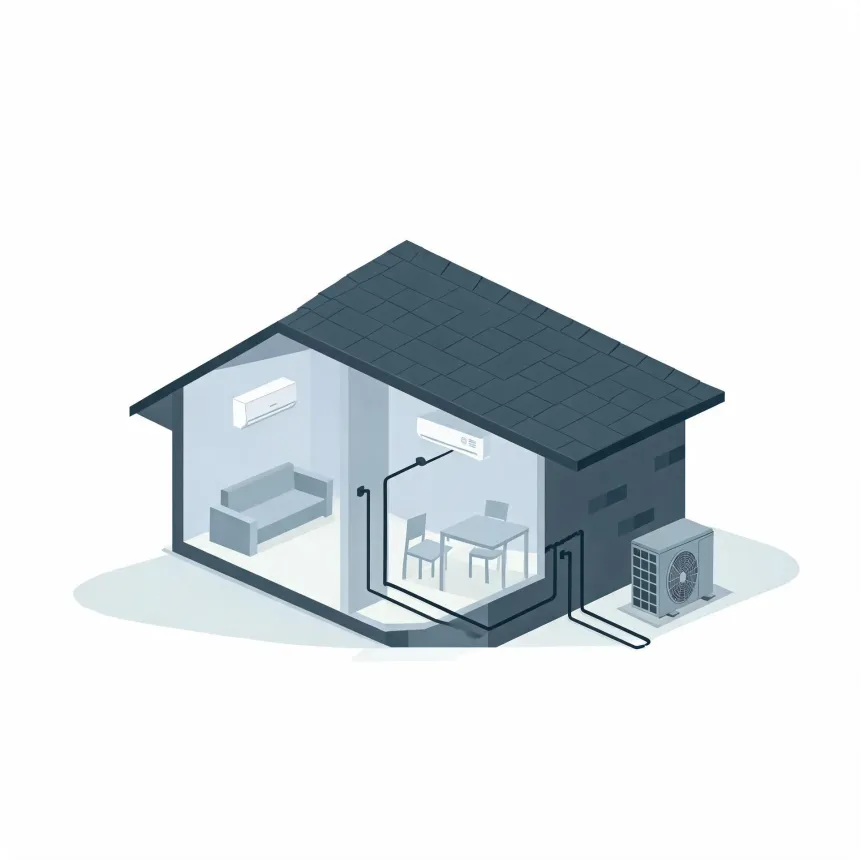
Isometric illustration of a cutaway single-story house showing two wall-mounted mini-split indoor units connected by line sets to an outdoor condenser beside the building, with a sofa, table and chairs inside.
Your system heats October through May and cools July through August.

NOAA nClimDiv, 1991–2020 normals

Gas heats 74.6% of homes in Monroe County.

A mini-split here usually goes in alongside the furnace, not in place of it.

Get it installed before July, and it's ready when you need it

Cooling runs July through August
Summer afternoons average 79°F
154 damaging wind events from 2015 to 2024

Monroe County sits in climate zone 5A, a cool zone where the heating load matters as much as cooling. Any split-system heat pump sold new, mini-splits included, has had to clear a federal minimum since January 2023: at least 14.3 Btu of cooling for every watt-hour it draws over the summer, and at least 7.5 Btu of heat for every watt-hour over the winter. That floor applies everywhere, not just here. A federal tax credit is available for qualifying installations, on top of meeting that standard.

Get the installation right, since you'll pay for it every time the system runs

Power here costs more than in most places, and a mini-split runs on it every time it cycles on. Get the sizing and installation right from the start, since that's what decides what it costs you to run from here on.

Find a contractor
A man in a dark long-sleeve shirt, tan pants, cap and work boots carries a canvas tool bag up gray porch steps toward a dark green front door, with a potted shrub beside the entry.
A white outdoor air conditioner condenser unit mounted on metal wall brackets against gray horizontal siding, with a blue sky and white clouds behind it.

An older house needs a system sized to it, not to a plan

Half the homes in Monroe County were built in 1965 or earlier. A house that age wasn't built with a mini-split in mind, and whatever heating and cooling it has now was likely added or replaced at some point after the place went up. That history matters when you're putting in a new system. Where the indoor units can go, how the lines get run, where the outdoor unit sits, all of that depends on the house you actually have, not a house built yesterday. The install has to work with what's there.

The old equipment doesn't have to come out

A mini-split can go in alongside a furnace or window units without any of it being removed first. If the old system still runs, it can stay as backup or keep handling a room the new lines don't reach. Removal only has to happen if the old unit is in the way of where the new lines or indoor heads need to go.

A window unit or old ductless head still has to go somewhere

If something is coming out, it has to be disposed of the right way. Refrigerant inside has to be recovered before the unit is scrapped, not vented, and that takes a licensed hand. A contractor pulling out old equipment should be handling that recovery as part of the job, not leaving a unit full of refrigerant at the curb.

The price of a mini-split job comes down to what the installer has to do to get refrigerant line from the outdoor unit to each indoor head, cleanly and correctly. A straight run through one exterior wall costs less than a job where the line has to travel through framing, around floor joists, or up through multiple levels to reach the right rooms. Every indoor head needs its own line set, its own drain for condensate, and its own spot on an exterior wall for the line to exit, so a system with more zones takes more material and more time than a single head. The outdoor unit needs a location with clearance on all sides and a path to run electrical to it, and if the electrical panel doesn't have room for a new circuit, that's its own piece of work before the mini-split goes in at all. None of this is guesswork on the installer's end. A good contractor walks the house, figures out where the lines can actually run, and prices the job around that, not around a number pulled from a catalog.

If your house was built in 1965 or earlier, ask the contractor what they found behind your walls and in your panel before you let them price the job. That's the piece a catalog number can't tell you. A walkthrough is how the installer finds out where a line set can actually run and whether the panel has room for a new circuit, and that's what the quote should be built on. A system routed for your actual house runs less than one sized off a plan, and at Monroe County's rates that difference shows up on the bill.