Oil heats most homes here
Fuel oil or kerosene heats 37.3% of occupied homes in Clinton County, more than any other fuel. Electricity comes next at 34.5%, with gas well behind.
Takes about a minute. No obligation.
Fuel oil or kerosene heats 37.3% of occupied homes in Clinton County, more than any other fuel. Electricity comes next at 34.5%, with gas well behind.
A mini split runs on electricity, so it doesn't compete with an oil furnace or boiler for fuel. Many homeowners here add one for a room that never holds heat well, or for cooling in summer, while the oil system stays as backup.
NOAA nClimDiv, 1991–2020 normals
Cooling in Clinton County runs one month a year, July.
June is the month to get a mini split installed, before the only month it needs to work.




Clinton County is in climate zone 6A, rated a cold climate with a long winter. A ductless mini-split counts as a split-system heat pump under the federal standard, so any unit made from 2023 onward has to hit at least 14.3 SEER2 for cooling and 7.5 HSPF2 for heating. That's the floor, not a looser rule because it skips ducts. A federal tax credit is available on top of that for equipment that qualifies. What you're really comparing when you shop is how far above that 14.3 and 7.5 a given unit runs.
A standard mini split, at the federal minimum or a little above it, covers a Plattsburgh home without a bigger unit or a higher tier to chase. Electricity here runs 24.43 cents per kilowatthour, and a right-sized system is what keeps that cost in line, especially running on a backup basis alongside an oil furnace or boiler.
Find a contractorOne month of cooling a year doesn't wear out a compressor. The rest of the year, a mini split here is doing heating alongside the oil system, cycling on and off as the room needs it, not fighting a long stretch of extreme heat. That's an easier life than this equipment gets in most places it's installed. A standard unit built to the federal minimum holds up fine under that kind of use. When something does go wrong years out, it's more likely a sign of age or a skipped filter cleaning than a sign the unit was undersized for the work.
A single indoor head paired with one outdoor unit costs less than a multi-zone system feeding several rooms. Each added indoor head means another line set, another spot for a crew to mount a unit, and a larger outdoor condenser to run them all. Someone installing one head in a single room is pricing a different job than someone trying to cover a whole house.
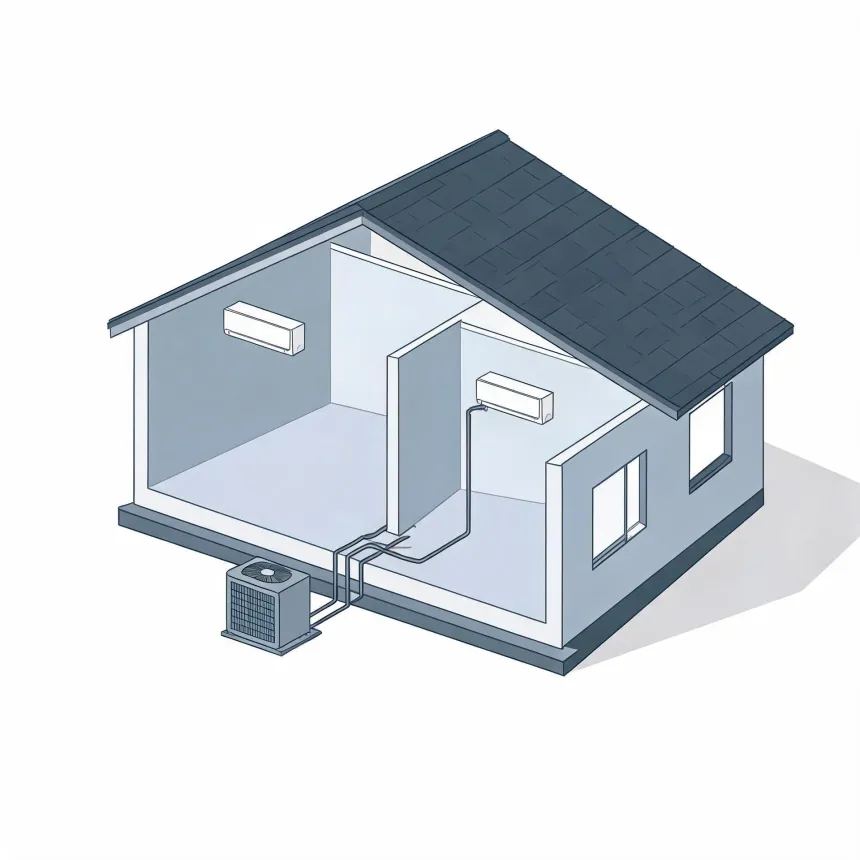
The indoor and outdoor units connect through refrigerant lines that have to be run through a wall and routed to wherever the outdoor unit sits. A short, straight run through an exterior wall is quick work. A run that has to go up a floor, across an attic, or around the outside of a house takes more time, more material, and more care to insulate and seal properly, and that shows up in the labor cost before the equipment is even factored in.
Every mini split quote lists a SEER2 and HSPF2 number, and that's where to start, not where to stop. Ask what the unit actually does at low outdoor temperatures, since a heat pump's rated output and its real output in a cold snap aren't the same number, and some compressors hold their capacity in the cold far better than others. Ask what sound rating the outdoor unit carries, because some run loud enough to notice from a bedroom window. Ask what the warranty covers on the compressor versus the parts, since those are often different lengths. And ask who's doing the vacuum and charge on the line set, because a mini split that isn't evacuated and charged correctly will run worse than the spec sheet promises, no matter how good the equipment is.
Installation day starts outside, not in. The crew picks a spot for the outdoor unit with room for air to move around it, away from where snow slides off a roof or piles up against a wall. Inside, the indoor head goes high on a wall, over a spot where the line set can run straight through to the outside with the shortest path available. A hole gets drilled through the wall, just big enough for the refrigerant lines, a drain line, and the electrical whip to pass through together. Once both units are mounted, the lines get connected, and the whole system gets pulled down to a vacuum to clear out any moisture and air before refrigerant ever enters it. Skip that step or rush it, and the system runs on a charge it was never designed for, no matter how well the rest of the job was done.