Gas heats most of Oswego County
Utility gas heats 41% of occupied homes in Oswego County, more than any other fuel. Propane and fuel oil account for a good share too, so most houses here already have a furnace or boiler handling winter.
Takes about a minute. No obligation.
Utility gas heats 41% of occupied homes in Oswego County, more than any other fuel. Propane and fuel oil account for a good share too, so most houses here already have a furnace or boiler handling winter.
Where a mini split goes in, it usually handles cooling, or takes the load off the furnace during the milder months. It runs on electricity, so it doesn't replace the gas or oil system already there. It works alongside it.
NOAA nClimDiv, 1991–2020 normals
Cooling here runs July through August.
June is the month to get a mini split installed, before the first hot stretch hits.



Cooling here only runs about two months, July and August, with afternoon highs averaging 78 degrees. That's not a long season, and it's not brutal heat either. A mini split in this area isn't working against triple-digit days or months on end of strain. With a mild load like that, a mid-range unit holds up fine. There's no case for paying more for a system built to handle heat this area rarely sees.
Replace it before the season starts, so it happens on your schedule, not in a hurry.
Find a contractorWhat drives the price of one of these jobs is mostly hidden once the covers go back on. The condenser has a compressor in it, and that part alone is a big share of the cost of the unit. Beyond the equipment, the labor is in the line set run, the wall penetration, the vacuum and charge, and how many zones the contractor is tying into one outdoor unit. A single zone is a simpler job than a multi-zone setup feeding several rooms from one condenser. Line set length matters too. A short, direct run from indoor head to outdoor unit costs less to install than one that has to snake through framing or cross a longer wall. None of this shows up in a quick look at the equipment. It shows up in how the job gets done.
If a window unit or an older ductless head is getting replaced, there's no tank to drain and no line to cap off like a water heater job. A contractor disconnects the electrical, recovers the refrigerant from the lines, and removes the indoor and outdoor pieces. The refrigerant has to be recovered properly, not vented, so factor that step into the job.
A mini split doesn't touch the existing heating system. Nothing gets capped, disconnected, or rerouted. The furnace or boiler keeps running the same way it always has, and the mini split just adds a second way to handle temperature in the space it covers.
Sizing a mini split isn't like picking a furnace off a chart by square footage alone. A contractor works out the heat load for the actual room or zone it's covering, counting windows, insulation, ceiling height, what's on the other side of the walls. Too big and the unit short cycles, running a few minutes at a time, never long enough to pull moisture out of the air before it shuts off. That leaves a room that feels cold and clammy at once. Too small and it runs flat out on the hottest days and still can't keep up. The right size runs longer, steadier stretches at a lower output, which is also where these units are most efficient. Bigger isn't a safety margin here. It's the thing that causes the problem.
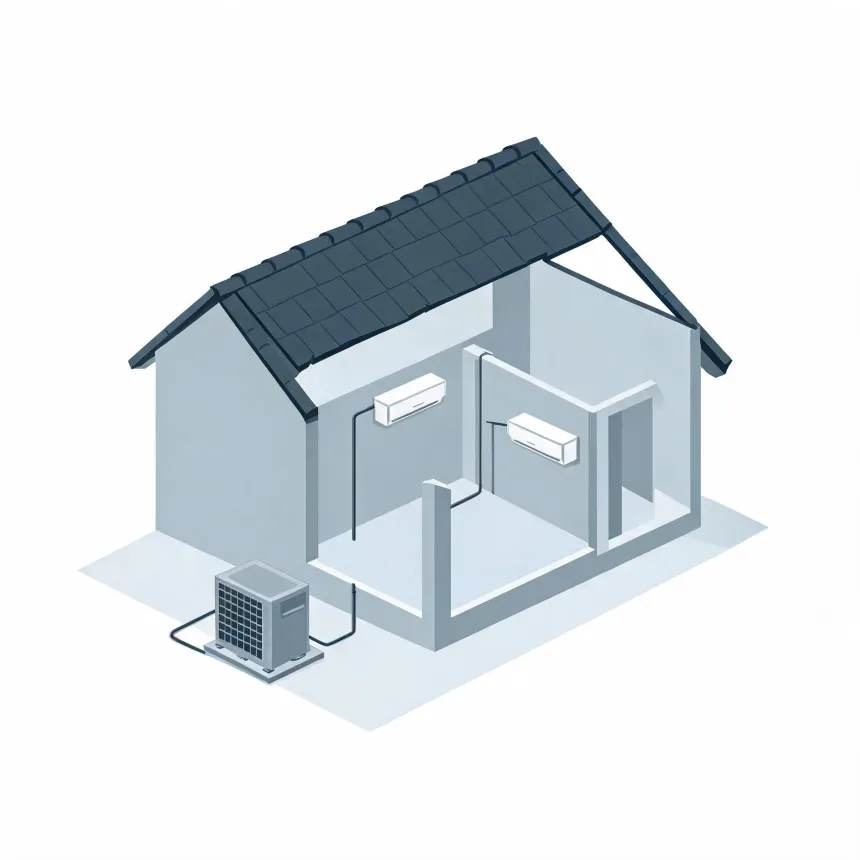
Installation day starts outside with the condenser. It needs a flat, level pad with clear space around it for airflow, so the contractor picks that spot before anything else happens. Inside, mounting the indoor head means finding a wall stud layout that works and a path back to the outside wall for the line set. That line set, the refrigerant lines, power, and condensate drain, has to pass through a hole drilled in the wall, so there's a point where the wall gets opened up. Once the lines are run, the contractor connects them to both the indoor and outdoor units, pulls a vacuum on the line set to clear out air and moisture, then checks the charge. A system with moisture or air left in the lines won't run right no matter how well everything else was done.