Gas is the common setup here
Utility gas heats 41.2% of homes in Madison County, more than any other fuel. Fuel oil and LP gas cover another third between them, and electric heat sits at 14.5%.

Takes about a minute. No obligation.
Utility gas heats 41.2% of homes in Madison County, more than any other fuel. Fuel oil and LP gas cover another third between them, and electric heat sits at 14.5%.
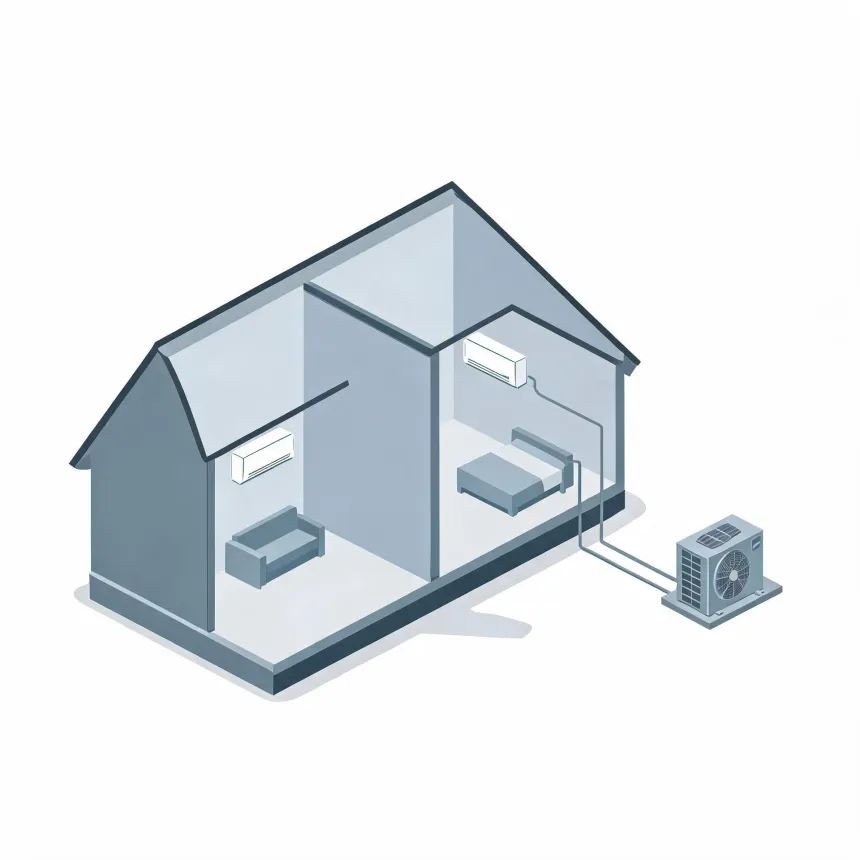
If your house runs on gas, oil or propane, a mini split usually goes in as a second system for a room or addition, not a replacement for the furnace. It gives you cooling and a backup heat source without touching the gas lines.
NOAA nClimDiv, 1991–2020 normals
Half the homes in Madison County were built in 1964 or earlier.
An install in a house that old has to work with the walls and rooms you have, not a layout drawn up for a mini split.



June is a good month to get a mini split installed here. Cooling starts in July and runs through August, so going in a few weeks ahead means it's commissioned and holding its charge before you need it. Call a contractor in the middle of July instead, and you're waiting on a schedule while the house sits warm. There's no rush fee for planning ahead, only for not having.
Afternoon highs here average 77°F across June, July and August, and the season closes out at the end of August. A mini split here isn't running hard enough, often enough, to justify paying for the highest efficiency tier on the shelf. A standard unit sized right for the room will hold up fine under this kind of load.
Find a contractorCooling runs July through August here, then the unit sits idle the rest of the year. That's light duty for a compressor. Years from now, if something does go wrong, it's more likely to be a part that sat unused than one worn out from hard running. A standard unit handles that load fine. Put the money saved on the efficiency tier toward a line set that's sized and charged right at install. That's what decides how long the system lasts, not the tier on the shelf.
Since a mini split is usually adding cooling or backup heat rather than replacing the furnace, whatever you're using now in that room can often stay put as a backup or come out on its own schedule. There's no gas line or ductwork tie-in to undo.
If the room's been cooled by a window unit, pulling it after the mini split goes in means sealing up that opening for good. That's one less draft and one less thing to wrestle in and out every year.
A few questions tell you more than the spec sheet does. Ask how many indoor heads the outdoor unit is rated to run, and whether this install is using all of that capacity or leaving room to add a head later. Ask what line set length the quote is based on, since a longer run between indoor and outdoor units changes how the system needs to be charged. Ask what happens to the old thermostat wiring or window unit bracket, and whether that's included or extra. And ask who sets the refrigerant charge and how they confirm it's right, because a system charged slightly off will run louder and cost more to operate than one set correctly from the start, no matter what tier it is.
Install day starts outside with the condenser location and the line set path, since where that unit sits and how far the lines have to run decides a good part of the labor. Indoors, the crew mounts the head on the wall, usually high up where it can throw air across the room, then drills a single hole through the wall for the line set, the condensate drain and the electrical whip. Those lines get connected at both ends, the system gets pulled into a vacuum to clear out air and moisture, and then the refrigerant valve opens to set the charge. A good installer checks that charge against the line set length rather than just cracking the valve and walking away. Once it's running, they'll check the head is pulling air correctly, the drain line isn't pooling anywhere, and the outdoor unit isn't vibrating against the wall or pad it sits on.