






White colonial houses with lit windows and dark shutters line a tree-lined street at dusk, bordered by dry-stacked stone walls.

Mini Split Installation in Olean, NY

Tell us about the job

Takes about a minute. No obligation.

New system or replacementMini-splitCattaraugus County, NY
Step 1 of 2

What ZIP code is the job in?

Just over half of homes in Cattaraugus County heat with utility gas, and most of the rest run on propane or electricity. A mini split does not replace that system. It works alongside it, covering the shoulder months and any room the furnace does not reach well. For a house on gas or propane heat, the furnace carries the cold stretch and the mini split handles cooling plus the mild weeks in spring and fall. For a home already heating with electricity, a mini split can take on more of the job directly, since both systems run on the same fuel.

9 months
September through May, your system heats
1 months
July through July, it cools
17°F
the average winter night it heats against
77°F
the average summer afternoon it cools against
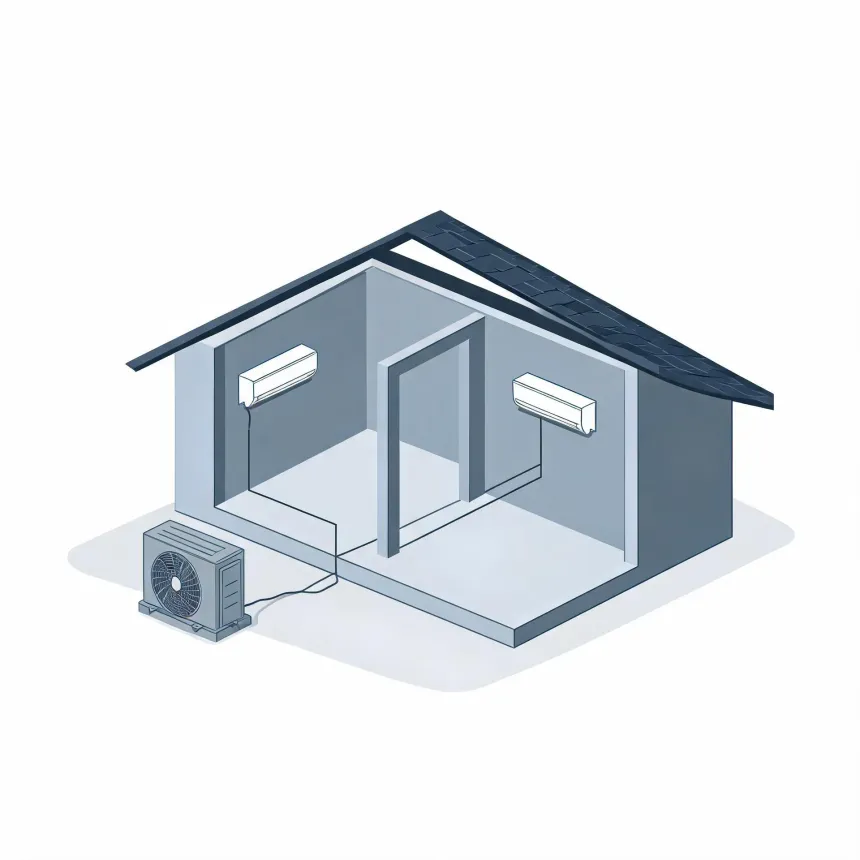
Isometric illustration of a cutaway house showing two wall-mounted indoor air conditioning units connected by lines to a single outdoor condenser unit on the ground outside.
Your system heats September through May and cools July through July.

NOAA nClimDiv, 1991–2020 normals

A mini split's rated capacity doesn't need to stretch to cover this house.

Standard sizing is built for electricity priced like New York's 24.43 cents a kilowatt-hour, so there's no case here for paying more to chase a higher efficiency number.

Olean sees its share of wind and winter storms, but nothing here changes what size mini split you need

247 severe weather events from 2015 to 2024
11% of homes statewide lost power a day or more in 2024
219 damaging wind events from 2015 to 2024
Cooling runs in July hereJune is the month to get a mini split installed, before the heat shows up.

Cattaraugus County is zone 5A, a cool climate where heating is the bigger job for any system here. A ductless mini split still counts as a split-system heat pump under the federal rule, so it has to meet the same minimums as any other heat pump sold here. Units built from 2023 on need to hit 14.3 SEER2 for cooling and 7.5 HSPF2 for heating. There's no lower bar for ductless systems because they're ductless. A federal tax credit is available for equipment that qualifies, on top of whatever the unit already has to meet.

A mini split here works one easy month a year, so fit matters more than horsepower

One month of real cooling, with afternoons averaging 77 degrees, is not hard duty for a mini split. The heating load here falls mostly to the furnace or whatever already heats the house. That light work is why a standard, reliably built unit is the right call, not a higher-efficiency model this system will rarely be pushed to earn back.

Find a contractor
A man in a dark shirt and tan pants, seen from behind, climbs porch steps toward a dark green paneled door while carrying a worn canvas tool bag, with a potted shrub beside the entry.
A white outdoor air conditioner condenser unit mounted on metal wall brackets against gray horizontal siding, with a blue sky and white clouds behind it.

The house decides where this goes, not the catalog

Half the homes in Cattaraugus County were built in 1960 or earlier. A mini split doesn't care what year a house went up, but the install does. Older homes weren't built with a spot already wired and sleeved for a condenser line, so the installer is figuring out where the line set runs and where it penetrates the wall, not just mounting a head where it's easiest. If your system came with the house, the mini split is one more thing going in, not a wall it has to match.

Where the line set runs costs more than the unit itself

A straight shot through an exterior wall with a short distance to the condenser is the easiest install there is. Every foot the line set has to travel beyond that, every stud bay it has to snake through, every floor it has to cross, adds labor before the system ever gets charged. Identical mini splits in different houses can take very different amounts of work depending on where the condenser can actually sit.
The electrical panel either has room or it doesn't

A condenser needs its own circuit, and that circuit has to come from somewhere. A panel with open breaker slots and enough spare capacity is a short job. A panel that's already full means an electrician is adding a subpanel or upgrading service before the mini split install can finish, and that work stands apart from mounting the heads and running the lines.

Most of the time, nothing happens to it right away. If the old equipment still runs, it stays in the wall or the window and keeps doing its job until the mini split line set, condenser and head are in and tested. Once the new system is up, what happens next depends on what the old one was. A window unit comes out and the opening gets sealed up properly. An older through-the-wall system gets disconnected, and the refrigerant in it has to be recovered by a licensed technician rather than vented, that's the law, not a courtesy. If what's being replaced is a central system, the old condenser, the coil in the plenum and the line set all come out, and the refrigerant in that gets recovered the same way. None of this is something the homeowner needs to manage. It's part of a proper install, same as mounting the new head level and pulling a vacuum on the lines before the system gets charged.

Install day starts with the line set, not the head on the wall. The installer drills a single hole through the exterior wall, usually behind where the indoor unit will hang, and runs the refrigerant lines, the condensate drain and the electrical through it from inside to out. The indoor head mounts on a bracket, level, with enough clearance above and below to pull air in and push it back out evenly. Outside, the condenser sits on a pad or wall bracket, away from anything that would block airflow across its coil. Once both ends are connected, the installer pulls a vacuum on the line set to clear out moisture and air before any refrigerant moves through it. Skip that step and the system can develop problems months later that have nothing to do with how well it was mounted.