A row of similar gray and white vinyl-sided houses behind a long white picket fence, with mown grass in the foreground and dense deciduous trees behind.

Mini Split Installation in Niagara Falls, NY

Tell us about the job

Takes about a minute. No obligation.

New system or replacementMini-splitNiagara County, NY
Step 1 of 2

What ZIP code is the job in?

Electricity here runs 24.43 cents a kilowatt-hour

New York homes paid that rate in 2024, well above what most states pay. A mini split pulling less power for the same heat or cool shows up on the bill every month, not just the coldest or hottest ones.

The efficiency rating is worth comparing on paper

Ask what SEER2 and HSPF2 a unit carries before you buy. At this price per kilowatt-hour, the gap between a mid-range system and a high-efficiency one adds up over the life of the equipment, not just the first year.

8 months
October through May, your system heats
2 months
July through August, it cools
21°F
the average winter night it heats against
79°F
the average summer afternoon it cools against
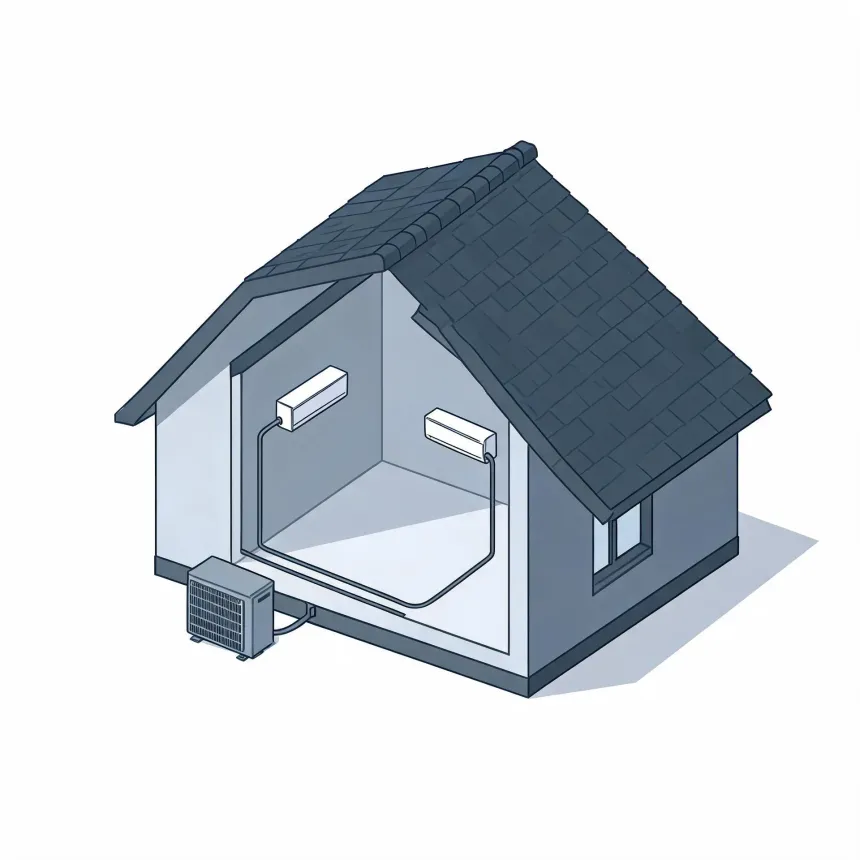
Isometric cutaway illustration of a small house with a shingled gable roof, showing two wall-mounted indoor air conditioning units connected by refrigerant lines to an outdoor condenser unit on the ground outside.
Your system heats October through May and cools July through August.

NOAA nClimDiv, 1991–2020 normals

Utility gas heats 76.2% of homes in Niagara County, far more than any other fuel.

Most houses here are set up for gas heat, so a mini split usually comes in as added cooling and shoulder season backup rather than the only system in the house.

Half the homes here were built by 1958, before anyone sized a system for a mini split

Half the homes here were built by 1958
Climate zone 5A
Power costs 24.43 cents a kWh statewide
Two months of work a yearCooling here runs July through August, with afternoon highs averaging 79°F.

Cooling in Niagara County runs July through August, two months a year. June is the month before that starts, and it's the better time to put in a mini split. An installer working in June isn't competing with every other homeowner whose system just quit in a heat wave. There's time to size the unit to the room and route the lines without rushing. Wait until July and you're scheduling around whatever's open, not what works best for the house.

Any mini split going in here has to clear 14.3 SEER2 and 7.5 HSPF2

Niagara County sits in zone 5A, a cool climate where heating does more of the work than cooling. Federal rules set the floor for what can go in. Any ductless heat pump manufactured from 2023 on has to hit at least 14.3 SEER2 and 7.5 HSPF2. That's the minimum, not a target. It's worth asking an installer what rating the unit you're considering actually carries. A federal tax credit is available on qualifying equipment, worth factoring into the comparison.

Find a contractor
A white mini-split air conditioner outdoor condenser unit mounted on metal brackets against a beige stucco exterior wall, with a blue sky and scattered clouds in the background.

Sized for the house, not the listing year

Half the homes in the county were built in 1958 or earlier. A mini split going into a house that old wasn't planned around when the house was built. It's planned around the walls and layout that are actually there now. Where the outdoor unit sits, how far the line set has to run, what it passes through to get from outside to inside head. That's work an installer figures out on site, not from a sale date.

One unit or several heads

A single zone cools or heats one room well. A multi-zone system runs several indoor heads off one outdoor unit, each with its own thermostat. Ask how many zones the outdoor unit can actually support before you add a fourth or fifth head to it, since pushing past what it's rated for leaves every zone running weaker.

What happens if one head fails

On a multi-zone system, ask whether the other rooms keep running if one indoor head needs a repair. Some systems isolate a failed head and let the rest of the house carry on. Others shut the whole outdoor unit down until it's fixed. That difference matters more than anything on the spec sheet once the system is a few years old.

If the house already has a system, something has to happen to it once the new one goes in. A central air condenser or furnace comes out as part of the job, along with its line set or ductwork connections. A window unit just gets unplugged and hauled off. Baseboard heaters or an old boiler can often stay in place as backup, since a mini split in a cold climate works alongside existing heat rather than replacing it outright. Ask what the installer does with the old equipment and whether removal is part of the quote or an extra line item. Refrigerant in an old condenser has to be recovered properly, not vented, so that part of the teardown isn't optional.

Installation day starts outside with the outdoor unit and the line set path, since everything else follows from that. The installer mounts the outdoor pad or bracket, then runs refrigerant lines, a condensate drain and electrical through a small hole drilled where the indoor and outdoor units line up best, not necessarily the most convenient wall. Once the lines are run, the system gets evacuated with a vacuum pump to pull air and moisture out before refrigerant ever enters it. Skip that step and moisture sits in the lines, where it corrodes components and keeps the system from running the way it's rated to. After charging the line set, the installer checks refrigerant pressure against what the manufacturer specifies for that line length, since a longer run needs more charge than a short one. The indoor head goes up last, gets tested for heating and cooling, and the installer walks through the remote or thermostat before leaving.