




A single-story light gray house with dark shutters and a gray gabled roof sits behind a mown lawn, framed by large deciduous trees and blurred green shrubs in the foreground under an overcast sky.

Mini Split Installation in Massena, NY

Tell us about the job

Takes about a minute. No obligation.

New system or replacementMini-splitSt. Lawrence County, NY
Step 1 of 2

What ZIP code is the job in?

Gas heats more homes in St. Lawrence County than anything else, but Massena has a lot of fuel oil and electric heat too, and neither of those pairs with ductwork the way a gas furnace does. A mini split doesn't care what fuel the rest of the house runs on. It runs on electricity, hangs on a wall or ceiling, and heats or cools just that room or zone without touching a duct system. That makes it a fit for an oil-heated house looking to add central air, or an electric-heated room that never gets enough from the baseboard. If your home doesn't have ducts, or has a room the main system never reaches, a mini split solves that directly instead of asking you to extend ductwork that was never there.

9 months
September through May, your system heats
2 months
July through August, it cools
11°F
the average winter night it heats against
77°F
the average summer afternoon it cools against
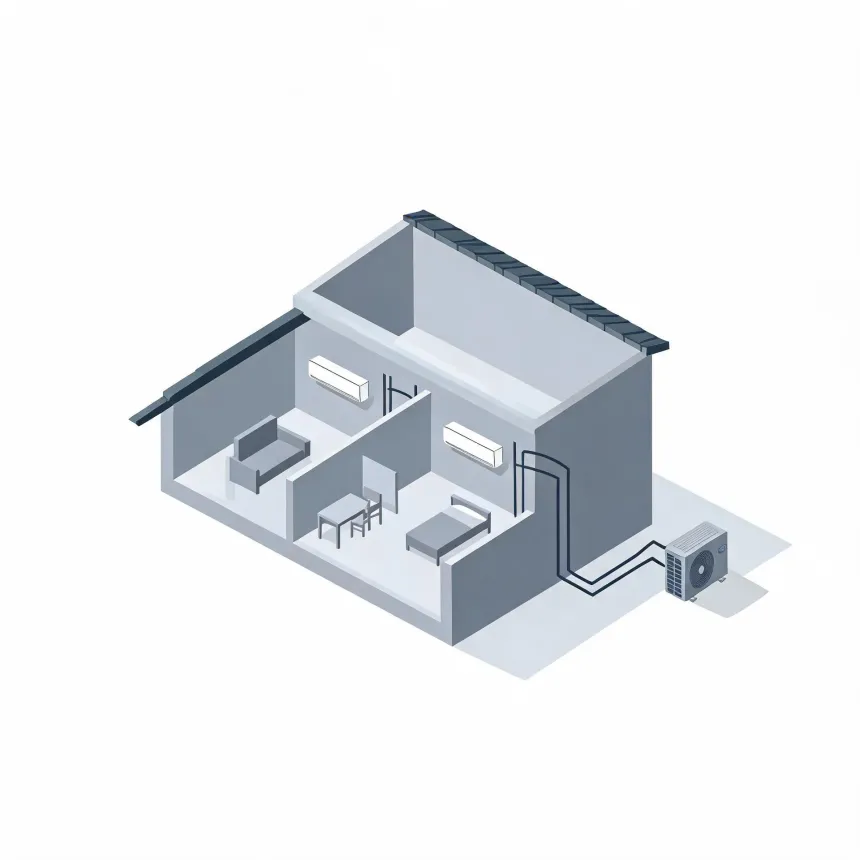
Isometric cutaway illustration of a gray house showing two wall-mounted indoor air conditioning units in separate rooms with furniture, connected by line sets to an outdoor condenser unit on a pad outside.
Your system heats September through May and cools July through August.

NOAA nClimDiv, 1991–2020 normals

July and August are the only months Massena cooling has to work hard, with afternoons averaging 77°F.

A mini split sized right for this place won't run under heavy load most of the year, so a solid mid-range unit is enough.

Storms here test the power supply, not the size of the unit

222 severe weather events from 2015 to 2024
11% of homes statewide lost power a day or more in 2024
136 damaging wind events from 2015 to 2024
Built for this houseHalf the homes in St. Lawrence County went up in 1964 or earlier

A mini split here doesn't need to be oversized or top of the line. Standard sizing covers the room or zone it's meant for, and standard efficiency keeps it running without strain. Electricity in New York runs 24.43 cents per kilowatt-hour, higher than a lot of the country, and that's the main reason efficiency rating matters more here than climate does. A unit with a better SEER2 number costs less to run every month it's on, winter or summer. That's a cost question, not a capacity one. Nothing about Massena's weather asks for a bigger unit than the room calls for.

Any mini split installed here has to clear 14.3 SEER2 and 7.5 HSPF2

St. Lawrence County falls in climate zone 6A, so a mini split going in here has to meet 14.3 SEER2 for cooling and 7.5 HSPF2 for heating at minimum. That's the federal floor for any split-system heat pump made from 2023 on, ductless included. A system meeting that standard also qualifies for the federal tax credit available on heat pump installations.

Find a contractor
A white outdoor air conditioner condenser unit mounted on metal wall brackets against gray horizontal siding, with a blue sky and white clouds behind it.

June is the month to get this done

Cooling in St. Lawrence County only runs two months a year, July and August. June is the month before that starts, and it's the month to get a mini split installed instead. A unit put in during June is running and tested before the first hot day asks anything of it. Wait until July and you're asking a contractor to fit you in during the two months everyone else with a cooling problem is calling too.

How many zones you're running

One outdoor unit can feed several indoor heads, but every added zone means another line set, another mounting job, and another indoor head to hang. A single room is a simpler job than a house running several zones off one compressor. Pricing follows the zone count more than almost anything else.
What the line set has to cross

The refrigerant lines run from the outdoor unit through the wall to each indoor head, and the harder that path is, the more labor it takes. A straight shot through an exterior wall is quick work. Running lines up through a second floor, along a long wall, or through finished space to reach a far room takes more time and more material, and that shows up in the price.

Sizing a mini split isn't about matching the room's square footage to a number on a chart. A unit too big for the room cools it fast, shuts off, and starts again a few minutes later, and that start-stop cycle is what leaves the room clammy instead of comfortable. It never runs long enough to pull moisture out of the air. A unit too small just runs constantly, working the whole time and still losing ground on the hottest afternoons. The right size comes from a load calculation, which weighs the room's dimensions against its windows, its insulation, and what's on the other side of its walls. A room with a lot of glass or an uninsulated attic above it calls for something different than one without, even if the floor space matches. Get the sizing right and the indoor head runs long, steady cycles that hold the room at one temperature instead of swinging around it.

Install day starts with the outdoor unit and the indoor head going up before any refrigerant moves. The indoor head gets mounted to a wall bracket or ceiling cassette frame, and the outdoor unit goes on a pad or wall bracket outside, placed where it has clear airflow on all sides. Then comes the line set, the refrigerant lines and wiring, run through a single hole drilled through the wall and sealed against weather on both sides. Once the lines connect at both ends, the system gets evacuated with a vacuum pump to pull out all air and moisture before refrigerant is ever released into it. That step matters more than almost anything else on the job. Any moisture left in the lines turns into acid once the system runs, and that shortens the life of the compressor. After the vacuum holds and refrigerant is charged, the unit gets powered on and tested, checking the temperature split between the air going in and the air coming out, and listening for anything that shouldn't be running.