
Electricity here runs 36.97 cents a kilowatt-hour
That's higher than what most of the country pays, and a mini-split runs on electricity alone. There's no gas line to shift the load to. Every hour of heating or cooling draws power at that rate.
Takes about a minute. No obligation.
That's higher than what most of the country pays, and a mini-split runs on electricity alone. There's no gas line to shift the load to. Every hour of heating or cooling draws power at that rate.
Two mini-splits can cool the same room and pull different amounts of power doing it. In a place where each kilowatt-hour costs this much, that difference shows up on the bill every month the system runs.
NOAA nClimDiv, 1991–2020 normals
Half the homes in Manhattan were built in 1951 or earlier.
A mini-split sized for a new building won't necessarily fit an apartment from that era.




New York County falls under climate zone 4A, a mixed zone with real heating load and enough humidity that cooling matters too. That's why the federal standard doesn't let just any unit through. A ductless mini-split counts as a split system heat pump under that standard, and any unit built from 2023 onward has to hit at least 14.3 on the cooling side and 7.5 on the heating side, measured in Btu of heat per watt-hour of electricity. Those are floors, not targets, so a system can clear them by a little or by a lot. A federal tax credit is available for qualifying systems, which gives you a reason to ask where a unit lands above the minimum, not just whether it passes.
Efficiency rating decides what this unit pulls from the meter every time it runs, all year. Picking a system with a strong rating over one that just clears the minimum is the one decision you make before installation that keeps showing up after it.
Find a contractorA mini-split built for a prewar apartment has to work with what's already there, not what a new building would give it. That means sizing the indoor units to the rooms as they're laid out, and finding a path for the line set and drain that doesn't involve tearing into walls you'd rather leave alone. The contractor doing the installation needs to see the specific apartment before any of that gets decided. A unit sized off a floor plan alone can end up wrong for the room it's actually cooling.
A mini-split that's too big for the room cools it fast, shuts off, then kicks back on a few minutes later. It never runs long enough to pull moisture out of the air, so the room feels cold and damp at the same time. One that's too small just runs and runs, straining to reach a setpoint it can't hold on the hottest or coldest days. Either way the compressor is cycling or working harder than it should, and that wear shows up over the life of the unit.
A contractor works out the load for each room separately: how big it is, which way it faces, how many windows it has, what's on the other side of its walls. A sunny room with lots of glass needs more capacity than an interior room the same size with none. Insulation and air leaks change the number too. This is why a unit picked by square footage alone, or matched to whatever was in the last house, so often ends up wrong for the one it's actually heating and cooling.
The rating on the label is measured two ways, one for cooling and one for heating, because the system is doing different work in each direction. Inside that unit is a compressor running on a variable speed drive, so it can throttle down once a room reaches its setpoint instead of just switching off. A compressor that idles along at low speed holds a room steady on mild days and only has to push hard when the weather is extreme. That matters more than the peak number on the spec sheet, because a unit spends most of its life somewhere below peak, not at it. The rating reflects performance across a range of conditions, not just the hottest or coldest day of the year, so two units with the same peak capacity can still pull apart once you look at how they behave the rest of the time. A higher rated unit isn't working any less hard physically. It's moving the same heat with less electricity doing it.
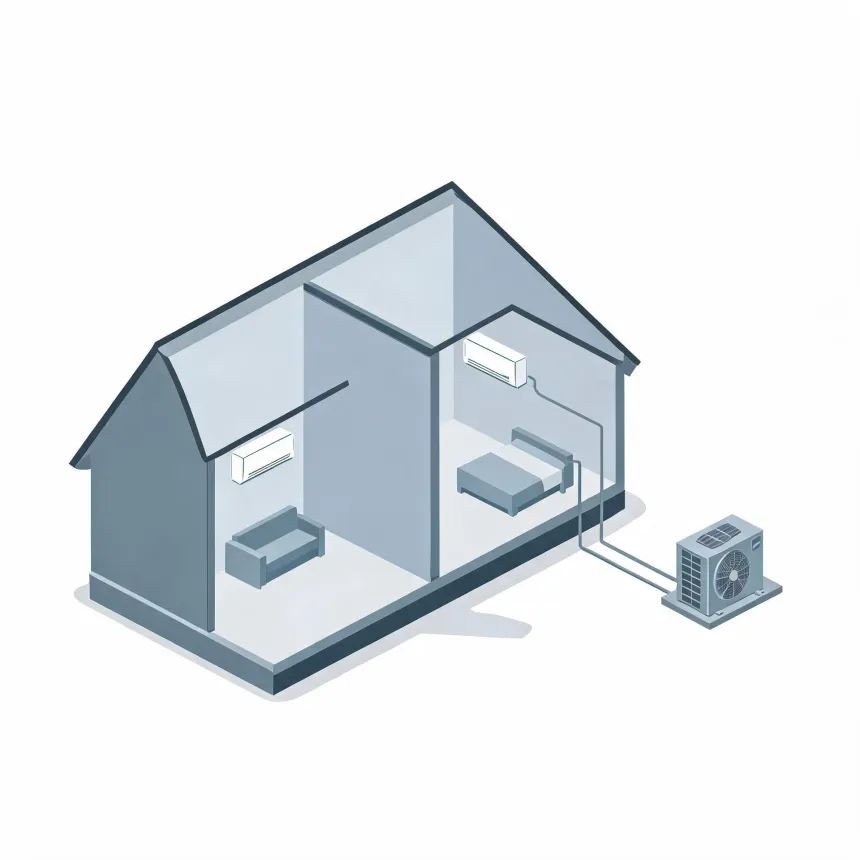
Installation day starts with the outdoor unit and the indoor head going up, but most of the day is the line set between them. That's the refrigerant piping, and it runs from the compressor outside to each indoor unit, usually through a hole drilled where the wall lets it pass cleanly. The line set gets connected, then the whole system is pulled down to a vacuum before any refrigerant moves through it. That step pulls out moisture and air that don't belong in a sealed refrigerant line. Skip it or rush it, and you get a system that loses capacity or trips faults months later, not on day one. Once the vacuum holds, the tech charges the line, powers up the system, and runs it through both heating and cooling to check that each indoor head is doing what it's supposed to before calling the job done.