A two-story red brick house with black shutters and a columned entry sits behind a mown lawn, framed by two large deciduous trees, with a long dry-stacked stone wall across the foreground.

Mini Split Installation in Kiryas Joel, NY

Tell us about the job

Takes about a minute. No obligation.

New system or replacementMini-splitOrange County, NY
Step 1 of 2

What ZIP code is the job in?

Electricity here runs 26.96 cents a kilowatt-hour

Orange County homes pay more for power than most of the country. A mini-split that runs efficiently matters more here than it would somewhere with cheaper electricity, because every kilowatt it pulls costs more to begin with.

A poor installation costs you on every hour it runs

A mini-split sized wrong or installed with a sloppy line set will draw more power than it should, no matter how few months it runs. In a county with some of the highest electric rates around, that shows up fast on the bill.

8 months
October through May, your system heats
3 months
June through August, it cools
21°F
the average winter night it heats against
81°F
the average summer afternoon it cools against
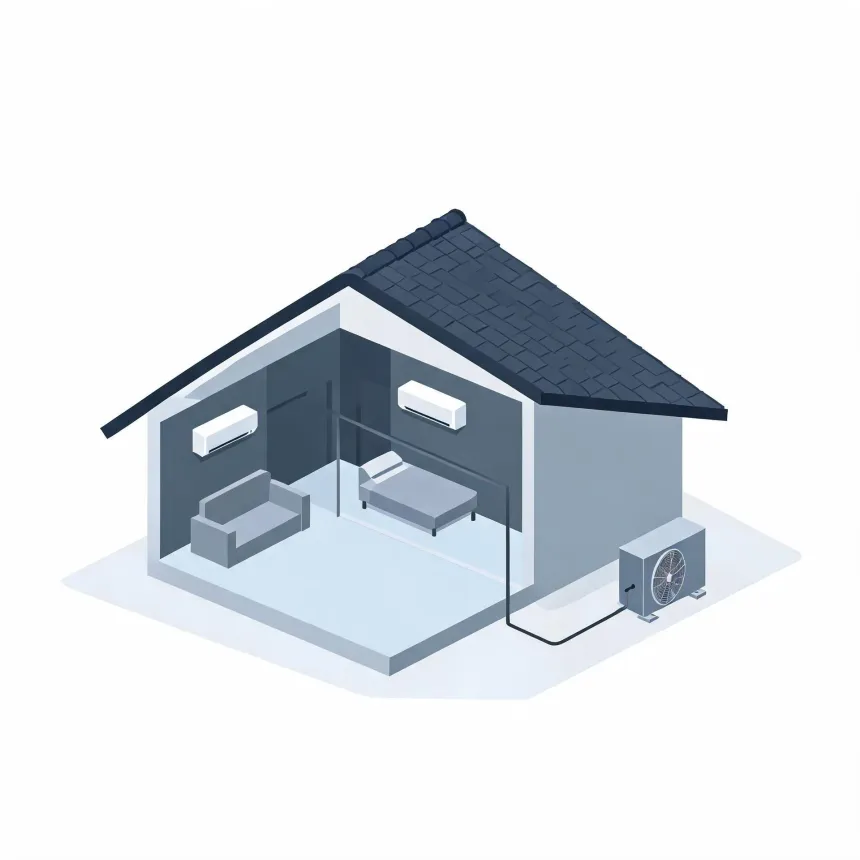
Isometric illustration of a cutaway house showing two wall-mounted indoor air conditioning units connected by a line to an outdoor condenser unit beside the building, with a sofa and bed inside.
Your system heats October through May and cools June through August.

NOAA nClimDiv, 1991–2020 normals

Two mini-splits with the same listed efficiency can pull different amounts of power doing the same job.

Ask what size and brand each quote is based on, not just the price, since that's what decides what it draws to run.

Most of this county heats with gas, which is why a mini-split usually joins a gas furnace instead of replacing it

47.6% of homes heat with gas
Cooling runs June through August
Summer afternoons average 81°F
Get It In Before JuneCooling runs June through August here, so May is the month to get it installed.

Orange County sits in climate zone 5A, a cool zone where a home needs more heat in winter than cooling in summer. Any mini-split installed here, ductless or not, has to meet the same federal minimum as other split-system heat pumps: at least 14.3 Btu of cooling for every watt-hour it draws, and at least 7.5 Btu of heat for every watt-hour over the winter. That floor applies to units manufactured from January 1, 2023 on, so it's worth asking the manufacture date of any system you're quoted. The standard sets no separate, lower bar for ductless equipment. A system that just clears that minimum will cost more to run here than one built past it, given what power costs in this county. A federal tax credit is available on qualifying equipment, which is worth asking about before you settle on a unit.

Get it installed right and it pays you back every month

Ask what you're being quoted before you decide. Sizing it right and running the line set clean is what keeps the draw down once it's installed, and in a county paying this much for power, that's what shows up on the bill.

Find a contractor
A man in a cap, gray long-sleeve shirt and tan work pants carries a canvas tool bag up concrete steps toward a dark green paneled front door, with a potted shrub to the right.
A white mini-split air conditioner outdoor condenser unit mounted on metal brackets against a beige stucco exterior wall, with a blue sky and scattered clouds in the background.

Sized right, it runs steady. Sized wrong, it never stops working for it.

A mini-split that's too big will cool the room fast, shut off, and start again a few minutes later. That cycling is harder on the compressor than running a steady stretch, and it leaves the place feeling clammy because the system never runs long enough to pull moisture out of the air. One that's too small just runs and runs, never quite catching up on the hottest or coldest days, and straining the whole time it tries. Either mistake costs you for as long as the system is in the wall. Sizing it right starts with a load calculation, not a guess based on square footage. A tech measures the room: the windows, which way they face, how much insulation is behind the walls, what else is already heating or cooling the space. That math gives a number in Btu, and the indoor and outdoor units get matched to it. Skip that step and even a well-built system runs wrong from the day it's installed.

The rating is measured, not guaranteed

The efficiency number on a mini-split's label comes from lab testing under set conditions, with the refrigerant charge correct and the lines run the way the manufacturer specifies. That number is the ceiling, not a promise. Install the line set too long, leave the charge off, or skip the vacuum that pulls moisture and air out of the lines, and the system runs below what the label says. The rating tells you what the equipment can do, not what it will do in your wall.

A higher rating means less heat moves the compressor

The compressor is what uses power in this system, and a unit with a better rating moves the same amount of heat while asking less of it. Over a long run, that lighter load means less wear on the compressor itself, which is the most expensive part to replace. A system working harder than it needs to, whether from a low rating or a bad install, puts more hours of strain on that one part every time it cycles on.

If this is replacing a window unit or an older system, that equipment doesn't need to come out before the new one goes in, but most installers will haul it away as part of the job rather than leave you to deal with disposal. A mini-split being added alongside an existing gas furnace doesn't retire anything. The furnace keeps running for the coldest stretch, and the new unit takes over the rest of the load. If an old central air system is being replaced, ask what happens to the outdoor condenser and the line set already running through the wall. Old line sets are usually not reused. The refrigerant in an older system has to be recovered properly rather than vented, so a contractor pulling out an old unit should be handling that as a matter of course, not something you need to request.

Installation starts outside, with the spot for the outdoor unit. It needs clearance on all sides for airflow and a line of sight or a short, clean path to where the indoor head goes on the other side of the wall. The tech drills one hole through that wall for the line set, the refrigerant lines, power cable, and condensate drain bundled together and run through a sleeve. Inside, the mounting plate goes up first, level, before the indoor unit hangs on it. Once both ends are set and the lines are connected, the real work is a vacuum: pulling air and moisture out of the line set with a vacuum pump before any refrigerant moves through it. Skip that step or rush it and moisture sits in the lines, which causes problems well after the crew is gone. Only after the system holds vacuum does the refrigerant valve open and the charge move in. The last part is running the system through both modes, heat and cool, checking the line set connections for leaks, and confirming the drain actually clears water instead of letting it back up into the wall.