





A golden retriever sleeps on a neatly made bed in a minimalist bedroom equipped with a wall-mounted air conditioning unit.

Mini Split Installation in Kingston, NY

Tell us about the job

Takes about a minute. No obligation.

New system or replacementMini-splitUlster County, NY
Step 1 of 2

What ZIP code is the job in?

The efficiency number on a mini split tells you how much heat it moves for the electricity it uses. A higher rating means it gets more out of every bit of power it draws. That shows up most in the mild weeks of spring and fall, when the system barely has to work to hold the room where you want it. On the coldest or hottest days every unit has to work harder no matter what the label says, so the rating is not a promise about those days. It is also a lab number, measured under set conditions, so the same unit can perform differently from one home to the next depending on how well the place holds heat or lets it go. A unit sized right for the room it serves will do more for comfort than chasing the highest number on the shelf.

8 months
October through May, your system heats
2 months
July through August, it cools
18°F
the average winter night it heats against
79°F
the average summer afternoon it cools against
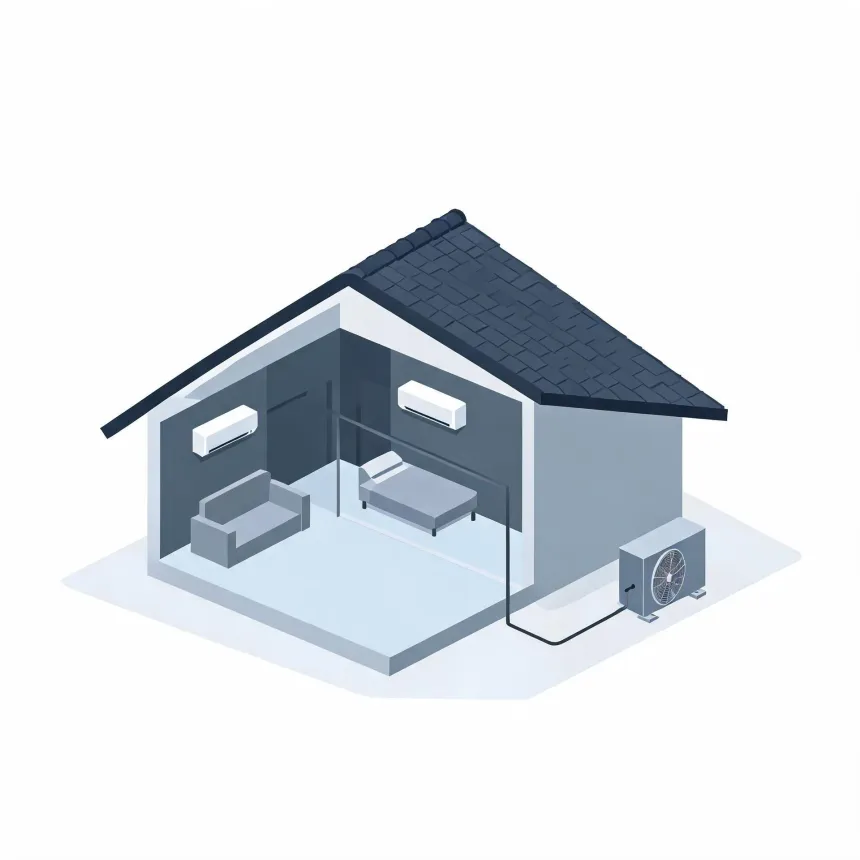
Isometric illustration of a cutaway house showing two wall-mounted indoor air conditioning units connected by a line to an outdoor condenser unit beside the building, with a sofa and bed inside.
Your system heats October through May and cools July through August.

NOAA nClimDiv, 1991–2020 normals

Every quote should say how many zones it covers and what size each indoor head is.

A unit sized wrong for the room runs longer, wears sooner, and never holds the temperature steady.

Get it installed before July, while it's a quiet job instead of an emergency one

Cooling runs July through August
Climate zone 6A
Power costs 24.43 cents a kWh statewide

Half the homes in Kingston were built in 1966 or earlier. A house that old was built with no mini split in mind, so the install is working with what's already there, not against a blank slate. That means the installer has to find a real path for the line set and a spot for the condenser that doesn't fight the house's layout. It also means the walls were built to hold heat a certain way, and a system sized for a new build down the road won't necessarily fit yours. None of that rules out a mini split. It just means the sizing and the placement have to start from the house you actually have.

A right-sized mini split is the one that fits Kingston

A mini split sized for the room it's heating or cooling is the right call here, nothing more. New York homes paid 24.43 cents per kilowatt-hour in 2024, so the unit's efficiency rating matters for the bill, but it doesn't call for the biggest or priciest model on the shelf. A standard size and rating, matched to your space, is what does the job.

Find a contractor
A man in a dark long-sleeve shirt and tan work pants climbs porch steps toward a dark green front door, carrying a worn canvas and leather tool bag, with a potted conical shrub beside the entry.
A beige split-system air conditioner outdoor condenser unit mounted on metal wall brackets atop a stucco wall.

Two months of cooling, a much longer winter

Cooling runs about two months here, July and August, with afternoons averaging near 79 degrees. That's a short season and a mild one. A mini split sized right for the room won't be straining through a long stretch of heat, so there's less wear to worry about from the cooling side. Winter is the longer job in this climate, and that's where the system earns its keep. Either way, the case for a reliable, correctly sized unit holds up better here than the case for the highest-end model on the shelf.

The number of zones sets the cost before anything else does

Each indoor head needs its own line set run, its own mounting work, and its own connection point on the outdoor unit. A system feeding more rooms costs more than a single zone, and the outdoor condenser has to be sized to handle all the heads it's feeding at once, which can push you into a larger unit.
What's already in the wall decides how hard the job is

Running the line set from the indoor head to the outdoor condenser means passing it through a wall, a floor, or up through a chase, and the path depends on what's already built into that spot. A straight shot through one wall is quick work. A run that has to detour around framing or travel between floors takes longer and takes more material, and that labor is where the price moves most.

Taking out the old system is its own job, separate from putting in the new one. If the house had central air, the indoor coil, the line set, and the outdoor condenser all have to come out, and that line set often ran somewhere the new one won't need to go. If the old setup was window units or baseboard heat, there's no refrigerant line to deal with, but baseboard means pulling out heating elements and capping off whatever fed them. Refrigerant from an old system has to be recovered properly, not vented, so that part of the teardown follows its own rules. None of this is harder than the install itself, but it has to happen first, and it's worth asking upfront whether removal and disposal are included in the quote or billed on top of it.

The work starts outside, with the condenser. It needs a pad or bracket, a clear path for airflow, and a spot where the line set can reach the indoor heads without a long detour. Inside, each head gets mounted on the wall first, level and clear of the stud behind it, before any line gets run. The line set itself runs through a single hole drilled through the wall, carrying refrigerant line, a condensate drain, and electrical in one bundle, then gets sealed where it passes through. Once everything is connected, the system gets pulled down to a vacuum before any refrigerant moves, which clears out air and moisture that don't belong in the line. That vacuum test is what tells the installer the lines are sealed right, not a guess. Only after it holds does the system get charged and switched on.