





A two-story red brick house with black shutters and a covered porch sits behind a wide green lawn, framed by large leafy trees, with a dry-stacked stone retaining wall in the foreground.

Mini Split Installation in Ilion, NY

Tell us about the job

Takes about a minute. No obligation.

New system or replacementMini-splitHerkimer County, NY
Step 1 of 2

What ZIP code is the job in?

A mini split that's too big for the room cools or heats it fast, then shuts off before it pulls the moisture out of the air. The room feels clammy even though the thermostat says it hit temperature. One that's too small runs constantly and never quite catches up on the hottest or coldest days. Getting the size right means a contractor looks at the square footage of the room, but also the windows, which direction they face, how well the space is insulated, and what's on the other side of the walls. A room with a lot of west-facing glass needs more capacity than an interior room the same size. That's why a good contractor measures the actual space instead of going off a rule of thumb for square footage alone.

9 months
September through May, your system heats
11°F
the average winter night it heats against
76°F
the average summer afternoon it cools against
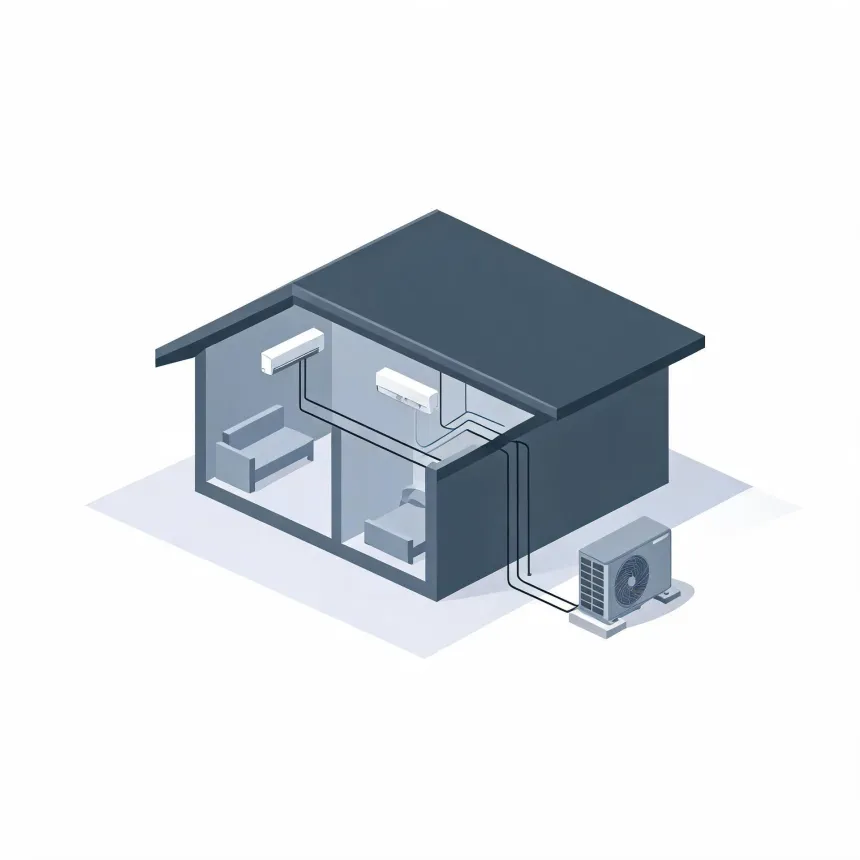
Isometric illustration of a cutaway house showing two wall-mounted mini-split indoor units connected by line sets to an outdoor condenser on a pad outside.

New York runs 24.43 cents per kilowatt-hour, among the higher electric rates in the country.

A mini split sized to the room instead of oversized is what keeps that rate from showing up on the bill.

A mini split here mostly just has to heat

Summer afternoons average 76°F
304 damaging wind events from 2015 to 2024
19 hail events from 2015 to 2024
Power here doesn't always stay onWinter storms hit Herkimer County 62 times between 2015 and 2024.

Half the homes in Herkimer County were built in 1954 or earlier. A mini split going into a house that age is going into walls, framing and window setups the manufacturer never saw. Installing one means running a line set and a wire from the outdoor unit to the indoor head, usually through an exterior wall, and an older wall can mean working around plaster, balloon framing, or wiring that's not laid out the way it would be in a newer build. None of that rules out a mini split. It just means the install has to answer to the house it's going into, not the other way around.

Any mini split going in here has to meet the same minimum as any other heat pump

Herkimer County sits in climate zone 6A, cold with winter lasting months on end. Any mini split made from 2023 on has to meet the same federal minimum efficiency as other heat pumps, since the standard doesn't treat ductless systems differently. That rules out the lowest-efficiency units from being sold here at all. A federal tax credit is available on qualifying equipment, which is worth checking against before deciding what to install.

Find a contractor
A white outdoor air conditioner condenser unit mounted on metal wall brackets against gray horizontal siding, with a blue sky and white clouds behind it.

This install has to last longer than it has to be easy

A mini split installed now should run for years, in a house built decades before it existed. If the wall it's mounted on has been reworked since 1954, that's worth telling the contractor before the walk-through, not after the line set is run. The house gets a vote in where the lines go and where the outdoor unit sits. Sizing the system right the first time matters more here, not less, because pulling an indoor head back out of an old wall to swap it is a bigger job than it would be in new construction.

Every zone needs its own head

A mini split system can cover one room or several, but each room that gets its own comfort needs its own indoor head and its own line set run from the outdoor unit. Adding zones means more line set, more wall penetrations, and an outdoor unit sized to handle all of them at once. A single-zone system is a simpler job than a multi-zone one covering the same square footage.
Where the outdoor unit can sit changes the job

The outdoor unit needs a clear, level spot with room for airflow on all sides, and it can't sit just anywhere the homeowner would prefer. The distance between the outdoor unit and each indoor head matters too, since line sets have a maximum length and running them further means more refrigerant, more mounting, and more labor. A contractor who walks the property before quoting is accounting for a path that works, not just a number on a spec sheet.

Comparing quotes on a mini split means comparing more than the price at the bottom. Ask what SEER2 and HSPF2 ratings the equipment carries, since those numbers tell you how it performs across a season, not just at full blast. Ask whether the quote is for a single-zone or multi-zone setup, and if it's multi-zone, how the outdoor unit is sized to run every head at once without falling behind. Ask what's included for the line set, the wall penetration, and the condensate drain, because those details get left out of cheaper bids and added back in later as extras. Ask about the warranty on the compressor versus the labor warranty, since they often run different lengths and only one of them costs money if something fails. A contractor who answers these without hesitation has done this job enough times to know what matters.

Installation day starts with the outdoor unit and works inward. The contractor sets the outdoor unit on its pad or bracket first, then drills the wall penetration for the line set, the wiring, and the condensate drain, usually all bundled together and run through a single hole. Inside, the indoor head gets mounted to a plate on the wall, then connected to that same line set. Once everything's run, the line set gets pulled down to a vacuum to clear out air and moisture before any refrigerant moves through it, because either one left in the lines can ruin the compressor later. Only after the vacuum holds does the system get charged and powered on. The last part of the day is checking airflow at each head and making sure the system actually satisfies the thermostat in every zone it's tied to, not just the one closest to the outdoor unit.