




A gray tabby cat sleeps curled up on a dark gray bed in a dimly lit modern bedroom with warm ceiling cove lighting and a wall-mounted air conditioning unit.

Mini Split Installation in Hudson, NY

Tell us about the job

Takes about a minute. No obligation.

New system or replacementMini-splitColumbia County, NY
Step 1 of 2

What ZIP code is the job in?

Electricity in New York ran 24.43 cents per kilowatt-hour in 2024, well above what most states pay. A mini split earns that rate back through how it's built. There's no ductwork losing cooled or heated air along the way, and the compressor adjusts its speed to the room instead of switching off and on at full power. In a place where every kilowatt-hour costs more, that difference shows up on your bill every month, not just in summer or winter but in whichever months you run it most.

8 months
October through May, your system heats
2 months
July through August, it cools
19°F
the average winter night it heats against
81°F
the average summer afternoon it cools against
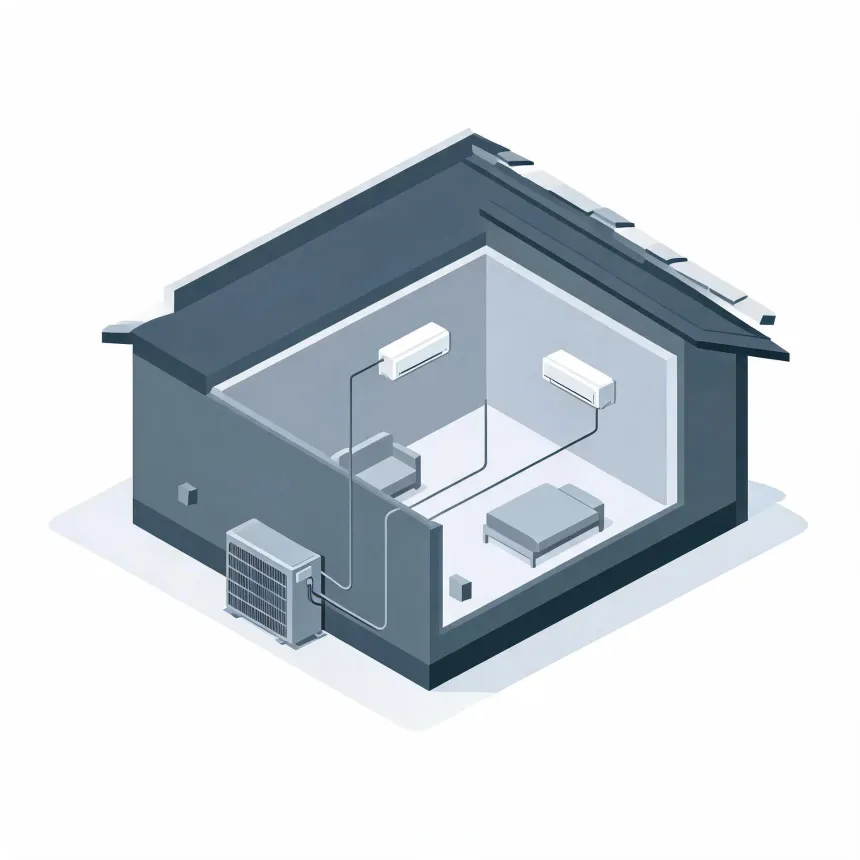
Isometric illustration of a cutaway house interior showing two wall-mounted indoor air conditioning units connected by line sets to an outdoor condenser unit beside the exterior wall.
Your system heats October through May and cools July through August.

NOAA nClimDiv, 1991–2020 normals

A quote should name the manufacturer and model of the outdoor unit and every indoor head, not just the capacity.

Systems rated the same size can still be built very differently, and the model numbers are what let you compare them.

Most of Columbia County heats with oil, and a mini split skips it

45.2% of homes heat with fuel oil
Cooling runs July through August
Summer afternoons average 81°F

Cooling only runs two months here, July and August, with afternoon highs around 81. That's a short season for a compressor to work through. Heating is the bigger job in Columbia County, and that's steady, lower-strain work too, nothing like the swings a system faces in a harsher climate. You don't need the highest-efficiency unit on the lot to handle that load. Put the money toward a mini split with a good track record for lasting, since here it's more likely to go the distance than to get worked to death.

Zone 5A sets the minimum. The federal credit helps you clear it.

Columbia County sits in climate zone 5A. Any mini split installed here has to meet the federal minimum for split-system heat pumps. That's 14.3 SEER2 for cooling and 7.5 HSPF2 for heating, for units built from 2023 on. A federal tax credit is available toward the cost of a qualifying system.

Find a contractor
A man seen from behind in a dark work shirt and tan pants carries a worn canvas tool bag up concrete steps toward a dark green paneled front door, with a potted shrub at left.
A white mini-split air conditioner outdoor condenser unit mounted on metal brackets against a beige stucco exterior wall, with a blue sky and scattered clouds in the background.

June is when this gets decided

Cooling runs two months here, July and August. June is the month to have a mini split in and running, not the month to start shopping. A compressor does not need breaking in or warming up to its job, so there is nothing lost by finishing early. Wait until a hot week in July and you are choosing from whatever is in stock and whoever has time to come out, instead of the system and the install date that actually fit your place.

What happens to what you're replacing

If oil heat is going away, the tank and the lines feeding it still need to come out or get properly closed up, and the chimney liner may no longer be needed either. If an old central system is going, the ductwork can often stay in place for a few rooms even after the mini split takes over the main load, or it can be sealed off room by room as heads go in.
Why this isn't a quick swap

A mini split isn't a one-for-one replacement the way a new furnace can be. Each indoor head needs its own line set run to the outdoor unit, and that means new holes through walls, new electrical circuits, and a place to put the outdoor unit that gives it clear airflow. Plan around that work, not around pulling one unit and setting another in its place.

Sizing a mini split isn't about matching the old system's rating. A contractor works out the heat loss and heat gain for each room separately, looking at the windows, the exterior walls, the insulation, how the room is used. Too big and the compressor short cycles, reaching the temperature and shutting off before it's pulled any moisture out of the air, so the room feels cool but clammy. Too small and it runs flat out on the coldest or hottest days and still can't keep up. Each indoor head gets sized to its room, not an even split of the total load, because a bedroom and a sunlit living room don't lose or gain heat the same way. The outdoor unit then gets matched to what all the heads need together, not rounded up for safety. A unit that's sized right runs long and steady, which is exactly how these compressors are built to work.

Installation day starts with the outdoor unit, not the indoor heads. It needs a pad or wall bracket, clear airflow, and a clean run to wherever the heads are going, so that gets set first. Each indoor head then gets mounted, and a line set runs from it through a small hole in the wall out to the compressor, carrying refrigerant lines, a drain line, and electrical wire together in one bundle. Once everything is connected, the system gets evacuated with a vacuum pump to pull out air and moisture before any refrigerant moves through the lines. Skip that step and moisture sitting in the lines can damage the compressor down the road. After that, a contractor charges the lines, powers up each head, and checks that it's calling for heat or cooling correctly before signing off.