Gas heats most homes in Ontario County
58.6% of occupied homes in Ontario County heat with utility gas. Electricity comes next at 16.5%, then propane at 13.6%.
Takes about a minute. No obligation.
58.6% of occupied homes in Ontario County heat with utility gas. Electricity comes next at 16.5%, then propane at 13.6%.
If a furnace already handles the cold months, a mini split can take over cooling and the shoulder seasons without touching the gas line. It's an addition, not a replacement for the whole system.
NOAA nClimDiv, 1991–2020 normals
A mini split's efficiency rating matters more in New York than in places with cheaper power.
At 24.43 cents per kilowatt-hour, a standard efficient unit sized right for the room is the one that keeps the bill down.



Cooling here only runs from July through August, so June is when a mini split install should happen. Get it in before July and it's ready on day one of the season instead of fighting a backlog of homeowners calling once it's already hot. There's no rush in the shoulder months either way, since the unit sits idle outside of those two months, but waiting until the first warm week means scheduling around everyone else who waited too.
Ontario County sees its share of wind and winter storms, but none of that changes what a mini split needs to do here. A standard size and a standard efficiency rating are built to handle normal weather swings, and that's what this county gets. There's no case here for oversizing or paying more for a higher-end unit than the room calls for.
Find a contractor
Two months of cooling, July and August, with afternoons averaging 79 degrees. That's a light load compared to what these units handle further south. Outside of those two months the mini split sits idle or barely runs, so most of its life is spent doing nothing at all. A unit sized right for the room doesn't need to be built for heavy, sustained heat here, and a standard efficiency tier is enough to keep up with what the county actually asks of it.
A contractor works out the right size from the room's square footage, ceiling height, window area and how many walls face outside, not by matching the number on the old unit or picking what worked next door. Too big and the unit cools the air fast then shuts off before it pulls the moisture out, leaving the room cold and clammy. Too small and it runs constantly, straining to reach a setpoint it can never quite hold.
A unit that short cycles, switching on and off instead of running a steady stretch, puts more wear on the compressor than one sized to run longer and more evenly. That wear shows up as a shorter life on a machine that otherwise has very few moving parts to begin with. Getting the size right the first time is what lets the compressor run the way it was built to.
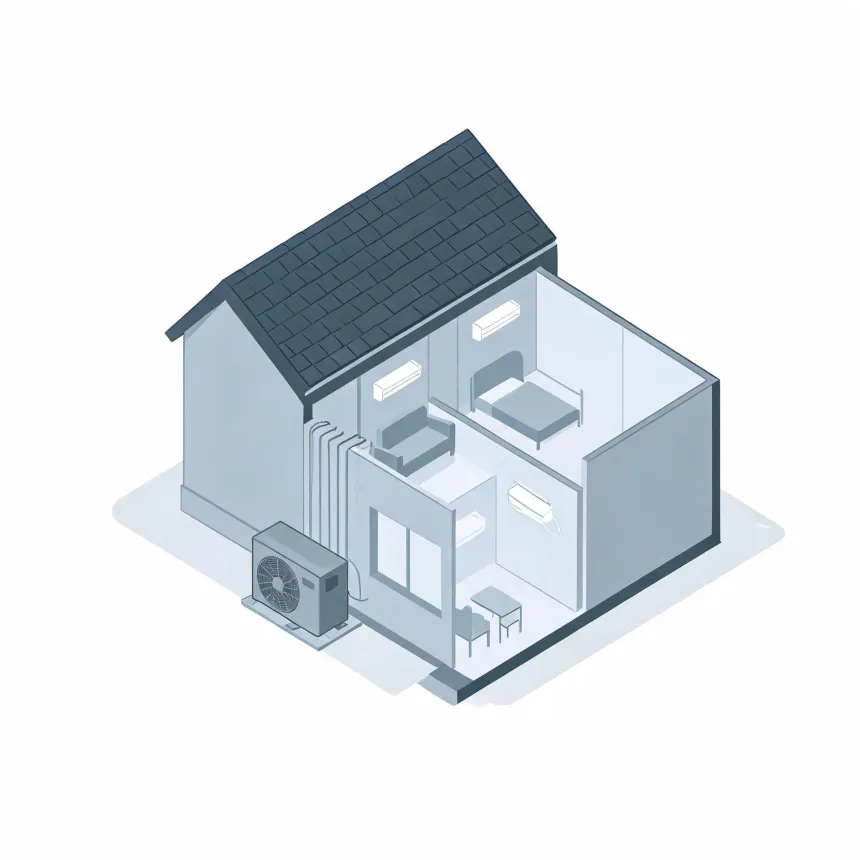
If this is replacing window units or an old through-the-wall setup, those just get hauled away, there's nothing to tie into or cap off. If it's going in alongside an existing furnace or boiler, that system stays exactly as it is. A mini split doesn't connect to ductwork or a gas line, so there's no old equipment to disconnect on that end either. The only thing that changes is a small hole through the wall for the line set and a mounting spot outside for the compressor. Whatever heated or cooled the place before keeps doing its job, or gets removed, independent of the new unit going in.
Install day starts with the spot on the wall, not the equipment. The indoor unit needs clearance above and below, and a clear shot through the wall to the outside, so that gets marked and drilled first. The line set runs through that hole, copper lines that carry refrigerant between the indoor and outdoor unit, along with a drain line for condensation and the electrical whip. Outside, the compressor sits on a pad or bracket, far enough from the wall to pull air through it properly. Once both ends are mounted and connected, the lines get pressure tested and then pulled down to a vacuum to clear out any air and moisture before refrigerant ever flows. That vacuum step is what separates a unit that lasts from one that loses its charge in a year. Only after it holds vacuum does the system get charged, powered up, and run through its paces to check the temperature split between the air going in and the air coming out.