A two-story red brick house with black shutters and a dark roof sits behind a mown lawn, large deciduous trees, and a dry-stacked stone wall in the foreground.

Mini Split Installation in Brewster, NY

Tell us about the job

Takes about a minute. No obligation.

New system or replacementMini-splitPutnam County, NY
Step 1 of 2

What ZIP code is the job in?

Bigger isn't better here

An oversized mini split cools the room fast, then shuts off before it pulls the moisture out of the air. The room ends up cold and still feels damp. A unit sized right runs longer, steadier cycles and actually controls humidity instead of just chasing the thermostat.

The load calculation drives everything else

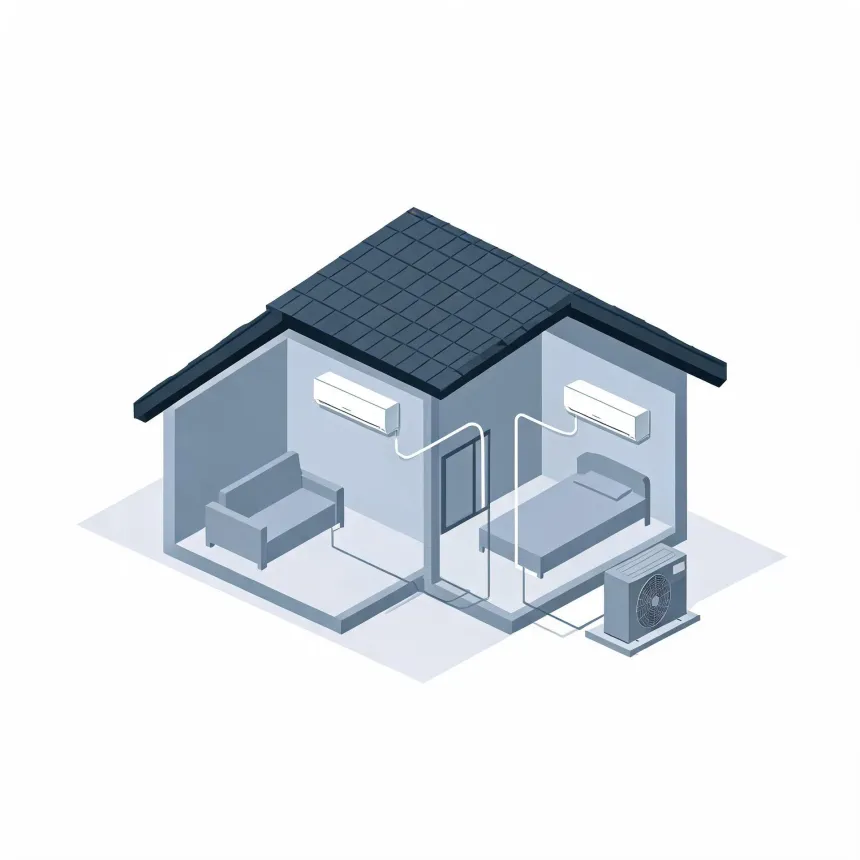
A contractor works out the heat load for each room, looking at window area, insulation, ceiling height and what's on the other side of the walls. That number decides which indoor head goes where and whether one outdoor unit can carry multiple zones or if the job needs more than one. Skip this step and every choice after it is a guess.

8 months
October through May, your system heats
3 months
June through August, it cools
21°F
the average winter night it heats against
81°F
the average summer afternoon it cools against
Isometric illustration of a cutaway house with two rooms, showing two wall-mounted indoor air conditioning units connected by lines to a single outdoor condenser unit outside the building.
Your system heats October through May and cools June through August.

NOAA nClimDiv, 1991–2020 normals

Cooling in Brewster starts in June.

Install the mini split in May and it's already running when the heat hits, not torn out mid-summer with the old system dead and a wait for the new one.

Half the homes in Putnam County were built by 1968, before mini splits existed

Half the homes here were built by 1968
Cooling runs June through August
Summer afternoons average 81°F
Electricity here runs 24.43 cents a kilowatt-hourThat's what New York homes paid in 2024, and it's why efficiency matters more on this job than most.

Most homes in Putnam County heat with fuel oil or kerosene, 57.4% of them. Another 23.3% use electricity, and smaller shares run on utility gas or bottled gas. That oil furnace or boiler still does the heavy lifting on the coldest days. A mini split fits alongside it, handling cooling all summer and taking over heating on the mild days in spring and fall when running the oil system is more than the day calls for. Nobody has to pull out a heating system that still works to add one.

Any mini split going in has to meet New York's efficiency minimums

Putnam County sits in climate zone 5A, where heating is the bigger load. A mini split installed here has to meet the federal split-system minimums, 14.3 SEER2 for cooling and 7.5 HSPF2 for heating, same as any other heat pump of its size. That rules out the lower-efficiency units still sold in warmer parts of the country. A federal tax credit is available toward the cost of a qualifying system.

Find a contractor
A white mini-split air conditioner outdoor condenser unit mounted on metal brackets against a beige stucco exterior wall, with a blue sky and scattered clouds in the background.

The house decides where the lines can run

The time-lapse shows one unit running day into night, but in a house this age the line set behind that wall has to go somewhere real. Half the homes in Putnam County were built in 1968 or earlier, and a house that old wasn't built with a spot in mind for an outdoor compressor or a path for refrigerant lines. A contractor has to find where the lines can actually run, room by room, before the install starts. Get that part right and the system runs the same way for years, day and night, without the walls fighting it.

Ask what happens at the lowest outdoor temperature

Every heat pump loses capacity as it gets colder outside, and the spec sheet shows how much is left at low temperatures. Below a certain point a unit without the right cold-climate compressor starts struggling to keep up, and the backup heat source has to carry more of the load. Ask for that number, not just the rated capacity at mild temperatures.

Ask how an outdoor unit splits capacity across rooms

An outdoor unit feeding several indoor heads has one total capacity, and that capacity gets divided among whichever heads are calling for heat or cooling at once. A system that handles one room running hard works differently once every room wants it at the same time. Ask whether the outdoor unit was matched to the full set of heads or just the biggest one.

Installation cost mostly comes down to how far the refrigerant lines have to run and how many walls or floors they have to pass through. A straight shot from outdoor unit to indoor head is quick work. A line that has to snake through an attic, drop down an exterior wall, or cross into a different part of the house takes longer and uses more material. The number of indoor heads matters too, since each one needs its own line set, its own mounting, and its own spot on the outdoor unit's capacity. Electrical work can add to it if the panel doesn't already have room for a new circuit. None of this shows up on a brochure price, because it depends on the specific walls and the specific path, not the equipment itself.

Installation starts with the outdoor unit going on a mounting bracket or pad, leveled and set far enough off the wall for air to move through the coil. Inside, the mounting plate goes up first, and the contractor drills a single hole through the wall for the line set, the condensate drain, and the power cable to pass through together. The copper lines get flared, connected to the indoor head, and then the whole system gets pulled down to a vacuum to clear out air and moisture before any refrigerant moves. That vacuum test matters more than almost anything else done that day. Air or moisture left in the lines turns to acid over time and eats away at the compressor from the inside. Once the system holds vacuum, the valves open, refrigerant reaches the indoor head, and the contractor checks line temperatures and pressures against what the manufacturer specifies for that unit. Only then does the thermostat or remote get programmed and handed over.