Most of Albany County heats with gas
Utility gas heats 64.5% of occupied homes in Albany County. Electricity is a distant second at 23.5%, with oil, kerosene and propane making up the rest.

Takes about a minute. No obligation.
Utility gas heats 64.5% of occupied homes in Albany County. Electricity is a distant second at 23.5%, with oil, kerosene and propane making up the rest.
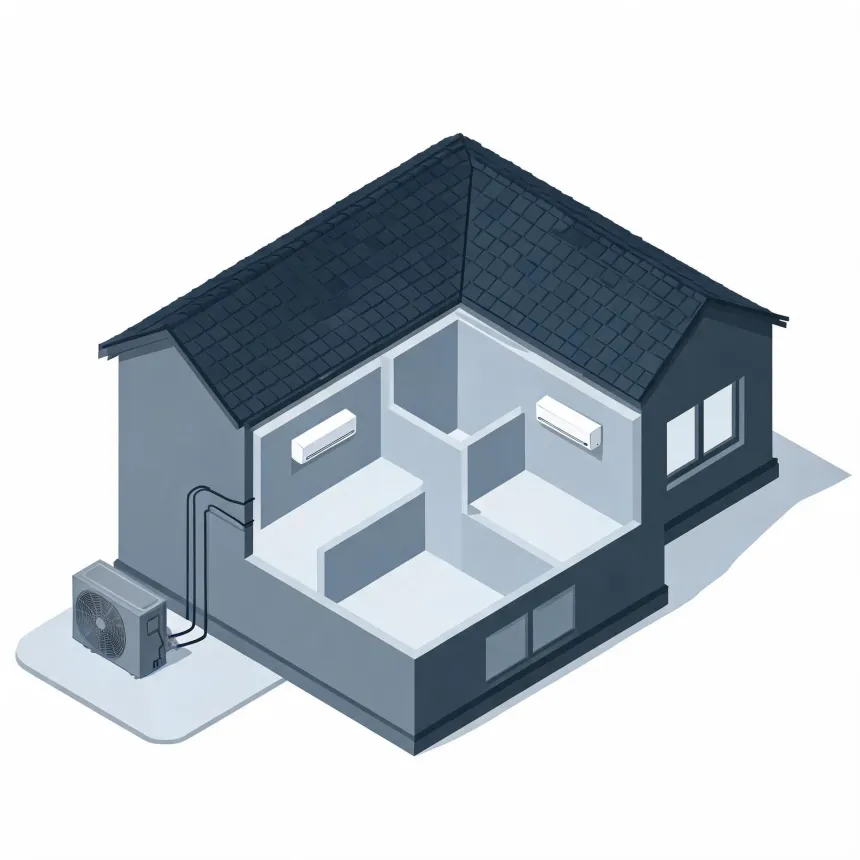
If your home has a gas furnace, a mini split adds cooling or heats specific rooms without touching the gas system. It's a separate system, not a replacement for the one you have.
NOAA nClimDiv, 1991–2020 normals
Half the homes in Albany County went up in 1964 or earlier.
A mini split going into a house that age has to work with the walls and rooms already there, not the other way around.




A standard mini split, sized to the room it's heating or cooling, is the right call here. Albany County electricity runs 24.43 cents per kilowatt-hour, which is worth knowing since that's what runs the unit. Nothing about this area pushes you toward a bigger system or a higher efficiency tier than you'd put in anywhere else. Size it to the space, pick a standard efficiency rating, and it'll do the job.
Albany County logs plenty of wind, hail and winter storm events, but none of that changes what the unit itself needs to be. A mini split still only has to heat or cool the room it's sized for. Standard size, standard efficiency rating, same as anywhere else. There's no local reason to pay for more.
Find a contractor
Two months of cooling a year means picking a standard unit, not the biggest one on the lot. Size it to the room and leave it there.
Sizing a mini split means working out how much heat the room gains in summer and loses in winter. Square footage is part of that, but so is window area, which direction they face, ceiling height, and how much insulation is behind the walls. Rooms that look the same size on paper can need different size units.
A unit too big for the room cools the air fast and shuts off before it pulls the moisture out, so the room feels cold and clammy at the same time. It also cycles on and off more, which wears the compressor harder than a unit sized to run steady. Bigger isn't a safety margin here, it's a different problem.
Installation cost mostly comes down to how many indoor heads you're running off one outdoor condenser and how far the line set has to travel between them. A single zone is the simplest case, one indoor unit, one line running to one outdoor condenser. Add zones and you add line sets, wall penetrations, and a bigger outdoor unit to drive all of them, which moves the price before anyone talks about the equipment itself. Where the condenser can sit matters too. A spot close to the indoor head with a clean wall path costs less to run line to than one that needs the line routed through framing or up multiple floors. The electrical side counts as well, since a mini split needs its own dedicated circuit, and whether the panel already has room for that or needs work changes the job. None of this is about the brand on the unit. It's about how much copper, wire, and wall the install actually touches.
Install day starts outside with the condenser going up on its mounting, either a wall bracket or a ground pad, somewhere with clear airflow on all sides. Inside, the installer mounts the indoor head on the wall, then drills a single hole through to the outside for the line set, the refrigerant lines, the drain, and the electrical wiring, all bundled together. Those lines get run between the indoor and outdoor units, connected, then the whole system gets pulled down to a vacuum to clear out any air and moisture before the refrigerant is released into the lines. That vacuum step matters more than people expect, since moisture left in the lines turns to acid over time and eats at the compressor from the inside. Once it holds vacuum, the installer charges the system, checks the electrical connections, and runs it through both heating and cooling to confirm it's pulling the temperature down and holding it. A clean install leaves one small hole in the wall and a line hidden behind a cover running down to the condenser outside.