Send the request and finding a pro stops being your problem.
A heat pump in New York usually runs 10 to 15 years. Yours might be winding down now, or something might have already quit on you, and you're trying to figure out whether it's worth fixing or whether it's done.
A lot of what shortens that life here is the work the unit does both ways. It's cooling your house through the sticky months and then, unlike a lot of the country, it may be carrying real heating load too, since not every home here runs gas. That's more hours on the compressor, more cycles on the defrost board, more chances for something to wear out early.
Power here costs more than almost anywhere else in the country, so when a heat pump starts losing efficiency, you feel it on the bill before you see it anywhere else. That's often the first sign something's off, long before the system fails outright.
If yours is getting old, or already stopped keeping up, the next step is getting a straight answer about whether it can be repaired or whether it's time to replace it. That's not something to work out by guessing. It takes someone who installs and services these systems in New York homes regularly, who's seen what tends to go wrong around year ten or twelve and what's still fine at fifteen.
Send the request and that part stops being yours to figure out. You're matched with one licensed local contractor, not a handful of companies competing for the job, someone who already knows this equipment and this climate. From there, the work of sorting out your options is off your plate.
How long do heat pumps last in New York?
Your heat pump has been running for years and you're wondering if it's near the end, or maybe it's already struggling and you want to know what to expect before you decide whether to repair it or replace it.
10 to 15 years
That range holds for most homes in New York. A heat pump here works harder than it would somewhere milder because it has to cover both your summer cooling and a real share of winter heating, even in a house that heats mostly with gas. The compressor runs more hours over a year than a straight air conditioner would, and that adds up over a decade. If yours is past 10 years, pay attention to how it's running now rather than waiting for it to fail outright. A unit near the end usually gives some warning first, longer run times, weaker output on the coldest days, a jump in your power bill before anything actually breaks.
New York summers hold a dew point around 62°F from June through August, averaged across the state by NOAA. That's the sticky range, the kind of air that feels heavy even when the temperature itself isn't that high. Your heat pump has to pull more moisture out of that air to keep the house comfortable, and the coil and compressor work harder doing it than they would in a drier climate. Over a few summers that extra load adds up, especially if the system is already past the middle of its life. If yours is struggling to keep up on a muggy afternoon, that's worth having a local contractor look at before it turns into a bigger repair. Send in the details once and a licensed contractor who works on this equipment in New York takes it from there.
One installer gets your project, so there's no bidding war over it.
Sending the form costs nothing.
A heat pump that's kept up with every winter, filters changed, coils cleaned, the outdoor unit kept clear of snow, can reach 15 years in New York, maybe longer if it was sized right for your house from the start.
One that's run through a few New York winters on a dirty filter or an iced-up coil without anyone noticing is often done by year 10. Gas backup covers for a struggling heat pump, so the trouble can go unseen until the unit quits outright.
Why it works harder in winter
Below freezing, a heat pump has to pull what little heat exists in the outside air, and it runs longer to move the same amount of heat into your house. Most homes in New York heat with gas, so a heat pump here is often doing double duty, covering the mild months and the shoulder seasons while gas takes over on the coldest nights. That split can mean less wear overall than a heat pump that carries the whole winter alone, since it isn't running flat out when it's 10 degrees outside.
What the defrost cycle costs it
When frost builds on the outdoor coil, the unit reverses itself briefly to melt it off, then switches back to heating. That cycling is normal, but it's extra starts and stops on the compressor, the part most likely to fail first. A unit that sits somewhere shaded or drifts over with snow will cycle into defrost more often. Keeping the outdoor unit clear through a New York winter cuts down on that extra strain, and it's one of the few things that affects lifespan you can actually see from your yard.
Before you get your heat pump installationAfter you get your heat pump installation
The reversing valve is what makes a heat pump different from a regular AC. It switches the direction refrigerant flows, so the same outdoor unit that cools your house in July can pull heat out of cold air in January. That part gets used every time the system switches modes, and it's working hardest right around freezing, when New York swings back and forth between heating and the occasional warm spell.
Below 30 to 35°F, frost builds on the outdoor coil, and the system has to stop and melt it off before it can keep pulling heat. You'll see the outdoor fan pause, maybe some steam rising off the unit. That's the defrost cycle doing its job, not a failure.
The compressor carries the real load all winter, running close to nonstop on the coldest days. Anything that makes it strain, a dirty coil, a low charge, a unit that's the wrong size for your house, wears it down faster than a normal winter would on its own.
What's actually happening inside the unit
The outdoor unit has a reversing valve, a small part that switches the refrigerant flow so the system can pull heat from outside air even when it's cold.
Below about 30 to 35°F, many heat pumps start a defrost cycle, briefly reversing to melt frost off the outdoor coil before switching back to heating.
During defrost, you may notice steam or the outdoor fan stopping for a few minutes, which is normal and not a sign of a breakdown.
A heat pump that short cycles, turning on and off in quick bursts, is often a sign the unit is oversized or the refrigerant charge is off.
The compressor is the part that wears hardest, since it runs almost continuously during a New York winter to keep up with heat loss.
A dirty outdoor coil makes the compressor work harder to move the same amount of heat, which shortens its life over time.
Power costs 26.39 cents per kilowatt-hour statewide
At 26.39 cents per kilowatt-hour, every degree your heat pump has to fight for costs more here than in most of the country. An older unit that's lost some efficiency, or one working through a cold snap, shows up fast on your bill.
EIA-861 2025 statewide residential average
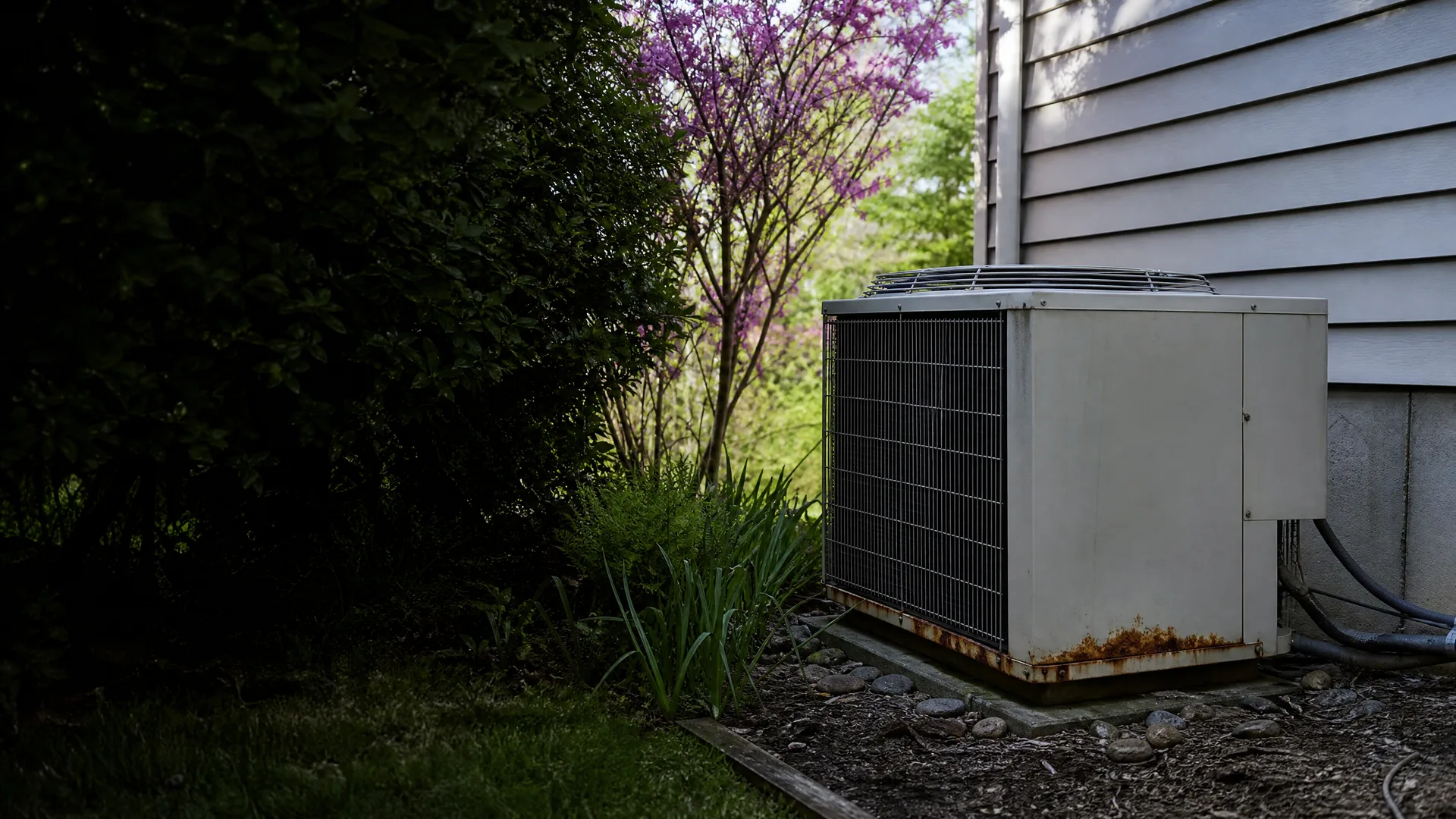
You go out to clip the forsythia back and you see it, off to the side of the yard where the snow finally cleared. Rust along the base of the unit, a reddish ring where the metal meets the pad. It's been there through a couple of winters, you think, you just hadn't looked close. The fan spins fine when it kicks on. But you crouch down and run a finger along the seam and some of it flakes off onto the grass. You think about the bill that comes every month at 26.39 cents a kilowatt-hour, and whether this is the year it finally costs you more than it's worth.
A heat pump in New York runs 10 to 15 years, less if the winters here have been hard on it, more if it's been kept up. That range is the honest answer, and where your unit falls in it depends on what's inside the cabinet and what it's been through. If you're deciding between another repair and a new install, a licensed contractor near you who works on heat pumps all year, through the humid summers and the cold snaps both, can tell you which side of that line yours is on. You'd be working with one contractor, local to you, not a handful of companies competing for the job. Someone who sees these units fail and keep running in New York winters season after season knows what a reversing valve going bad looks like versus a coil that's just dirty, and what's worth fixing at ten years versus what isn't. That's the read you need before you spend money either way.