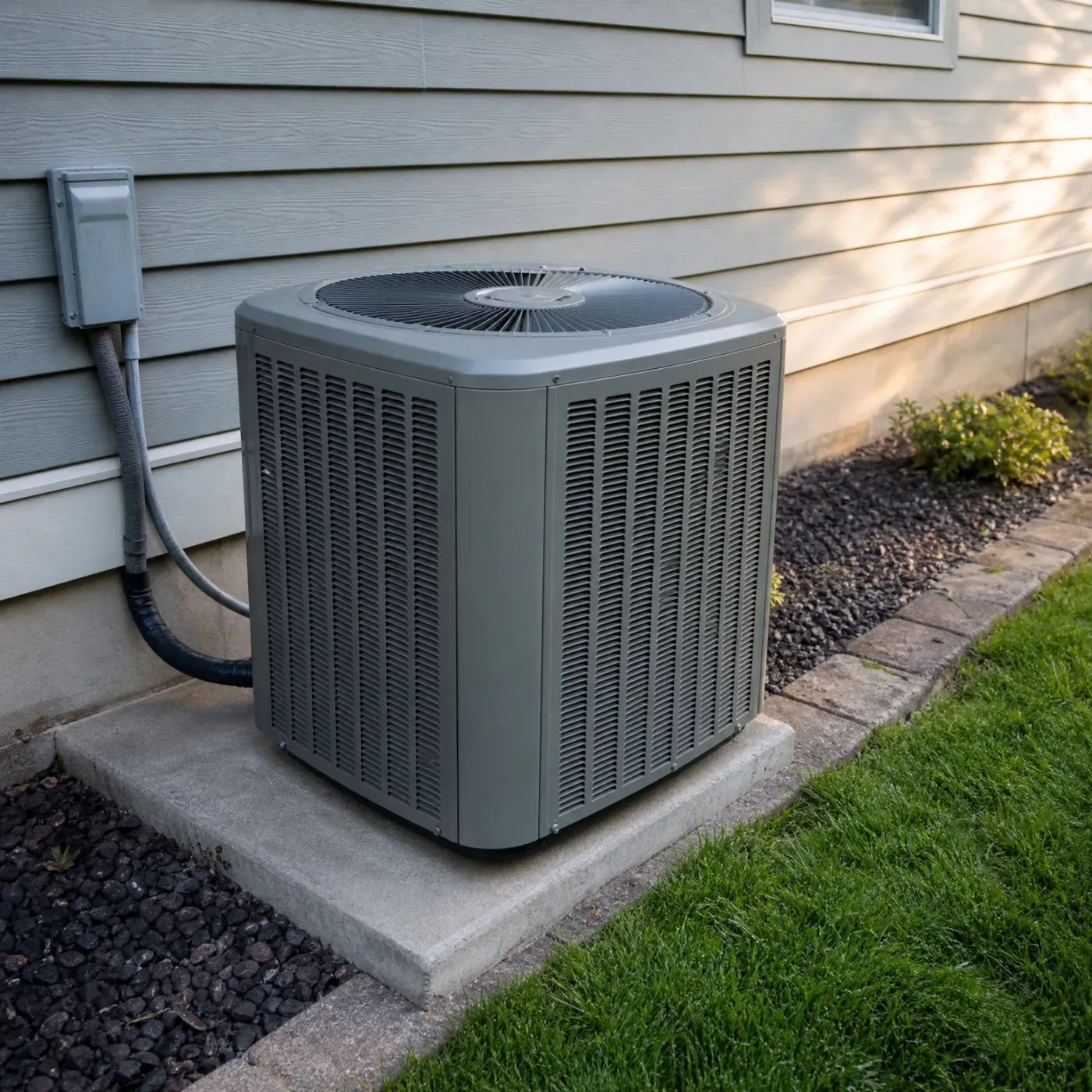
Running the way it should
The coil is clean, the pad is level, and the unit cycles on and off without straining. Clear airflow around it like this is part of what gets a system to the far end of that 15 to 20 year range.

A central air conditioner in New York lasts about 15 to 20 years. The unit sits outside through winter and only runs hard for a few months, April through October, so it doesn't wear the way it would in a place that runs cooling year round. What shortens that life is sticky, humid summers that keep the compressor working long hours to pull moisture out of the air along with the heat. A system that's short on refrigerant or undersized for the house works even harder on those humid days, and that strain adds up faster than the calendar suggests. If your air conditioner came with the house, check its age against that range. One running past 20 years, or one that's needed repeat repairs the last couple of summers, is closer to the end than the start. That matters most going into a New York summer, when a failure means waiting on relief rather than planning for it.


Most of what goes wrong traces back to a handful of parts. The compressor sits in the outdoor unit and does the most work, so it's also what costs the most to replace when it goes. Keeping the coil around it clear of leaves and grass clippings matters more than people think, because a dirty coil forces the compressor to work harder than it should. Refrigerant isn't something a system uses up. It's sealed in for the life of the unit, so if the charge is low, there's a leak somewhere in the lines, not normal wear. Inside, near the furnace, the other coil can freeze over, and that's almost always airflow, usually a dirty filter, not a refrigerant issue. A unit that hums without the fan kicking on often points to a capacitor failing, which tends to happen well before the compressor does. And the compressor itself runs one way: full on or full off, with nothing in between, so there's no low setting easing the strain.





The coil is clean, the pad is level, and the unit cycles on and off without straining. Clear airflow around it like this is part of what gets a system to the far end of that 15 to 20 year range.

Grime like this across the louvers and fan grille blocks airflow, so the compressor runs longer to cool the same house. A unit that looks like this is closer to the end than the beginning, and a August breakdown is the kind that can't wait.
At 26.39 cents per kilowatt-hour, every year your compressor runs with a dirty coil or low refrigerant shows up fast on your bill. An air conditioner that's losing efficiency doesn't just wear out sooner, it costs more to run while it does.
EIA-861 2025 statewide residential average

This is what a unit on track for the full 15 to 20 years looks like. The pad is level, the fins are clean, and the conduit to the disconnect is intact. Nothing is blocking airflow around the cabinet, so the compressor isn't working harder than it has to.

Grime like this across the fins chokes airflow into the coil, so the compressor runs longer and hotter to do the same job. Left this way through a few New York summers, it's the kind of unit that gives out well short of 15 years instead of reaching 20.


If your air conditioner is past 15 years and you've seen what strain looks like up close, a failing compressor isn't a repair most homeowners want to gamble on. Replacing one alone can run close to what a new system costs, and the rest of the unit is already worn to match it. A new install also means dealing with a system sized and charged right for a New York summer, not whatever was standard when the old one went in. Finding a contractor who knows which units hold up here and which parts fail first takes time most people don't have when the house is already warm. Send the request and that search becomes someone else's job, handled by a licensed, local contractor who works on this equipment every season, not a handful of companies competing for your callback.
Fifteen to twenty years is the range for a central air conditioner in New York, and where your unit falls in it depends on the coil, the charge, and how much strain the compressor has carried along the way. Two systems installed the same year can be in very different shape by year 15. One has been running clean, cycling the way it should. The other has been struggling for a while, and the compressor is usually what gives out first when that happens, which is also the most expensive part to replace on its own.
That's why it helps to have someone local looking at it, not a general answer. A contractor who services this equipment every summer in your area has seen what units your system's age tend to run into, and can tell you honestly whether what you're looking at is a repair or the start of the end. Sending one request connects you with one licensed, local contractor, not a handful of companies competing for the job and calling you separately. That's one call to manage, from someone who already knows the equipment common to homes around you.
You don't need to guess at where your system stands. Once someone's looked at the coil, the refrigerant charge, and how the compressor is running, you'll know whether you're looking at more good years or a system on its way out, and what to do about it either way.
Only one pro gets your request, so you hear from one company.
You're not committing to anything by asking.