
Explain it one time
Repair or replace a heat pump in New York
A heat pump that's struggling with a sticky New York summer or falling behind in January might need a repair, or it might be at the point where replacing it makes more sense. That depends on its age, what's failing, and what it would cost to keep patching it versus putting in a new one. Below is how to tell which side you're on, so you can skip calling around to different companies and explaining the same problem more than once.
Start one formA heat pump worth repairing is one that's still doing its job most of the year and ran into a single failure: a bad capacitor, a stuck reversing valve, a refrigerant leak. A contractor can usually fix that and send you on your way. Replacement starts making more sense once the unit is old enough that parts are getting harder to find, or once it's lost the ability to keep up on the coldest days and you're leaning on backup heat more than you should. New York winters push a heat pump hard, and one that was already borderline before this season tends to show it in January, not July. If you're fixing the same system every year, or a technician tells you the compressor itself is failing, that's usually the point where paying for another repair stops making sense compared to a new unit that can actually hold the house at temperature through the cold months.




A heat pump has a few more ways to fail than a straight air conditioner, because it does more jobs. It has to switch directions between heating and cooling, which means a reversing valve that can stick. It has to defrost itself in winter, which means a control board that can quit and let ice take over the outdoor coil. It leans on refrigerant to move heat both ways, so a slow leak costs you more here than it would on a cooling-only system. When the outside air gets too cold for the heat pump alone, backup heat strips take over, and a contractor checks how often those are kicking in, since that tells them whether the heat pump is actually keeping up or just coasting on the backup. The compressor sits behind most of this. It's the part that costs the most to replace, and depending on what a contractor finds, it can be the thing that settles whether this is a repair or a new system.
How a heat pump fails
- A heat pump's reversing valve is what lets it switch between heating your house and cooling it, and when it sticks, the system can get stuck in one mode.
- The outdoor unit runs a defrost cycle in winter, melting frost off the coil, and a bad defrost control board can leave ice building up until airflow stops.
- A heat pump moves heat instead of burning gas to make it, so a refrigerant leak hits efficiency harder than it would in a central air conditioner alone.
- The compressor is the one part that's expensive enough to decide the repair-or-replace question on its own, since replacing it can cost close to half a new system.
- Auxiliary heat strips kick in when the outdoor temperature drops too low for the heat pump to keep up, and a contractor checks whether those are cycling on more than they should.
- A unit low on refrigerant will often keep running without ever reaching the temperature you set it to, which shows up as a rising power bill before it shows up as a breakdown.


A heat pump that short cycles, runs constantly, or can't keep the house at setpoint when it's 10 degrees outside is already costing you more in electricity than a working one would.
Power in New York runs among the highest rates in the country, so a system working harder than it should shows up fast on the bill, not just on the coldest night.


What a failing heat pump does to your house
- A heat pump that won't hold 68 in January is drawing on backup electric heat strip, and that runs up your bill fast.
- If the outdoor unit ices over and doesn't clear itself, the defrost control is likely bad, and the coil stays blocked.
- A system stuck in one mode, heat or cool, usually means the reversing valve, and that's a repair most contractors can make.
- Once a heat pump is 10 to 15 years old, a major failure like a compressor or coil leak often costs more to fix than to replace.
- An oversized or undersized replacement will short cycle or run constantly, so sizing it to your house matters more than the brand.
- A refrigerant leak that keeps coming back means the line set or coil has a real problem, not a top-off fix.
When a heat pump can't keep up, the first sign is usually the electric strip kicking in to cover the gap, and that's the most expensive heat in the house. You'll see it on the bill before you see it anywhere else, especially with New York power rates. Outside, the unit should run a defrost cycle and come back clean. If it ices up and stays iced, the coil can't pull heat from the air at all, and the system is working against itself. A heat pump that only blows warm or only blows cool, no matter what the thermostat is set to, has a reversing valve that's stuck, and that's a part a contractor can usually replace without touching the rest of the system. Refrigerant is different. A system low on charge once can be topped off. A system low on charge every season has a leak somewhere in the line set or the coil, and topping it off again just delays the same call. Age changes the math on all of this. A heat pump in its first decade is usually worth fixing. One past 10 to 15 years that needs a compressor or has a coil leak is often a case where the repair bill gets close to a new system, especially a correctly sized one. Sizing matters as much as the equipment itself. A unit too big for the house will short cycle, and one too small will run nonstop trying to catch up, and either way you'll feel it in comfort and in cost.


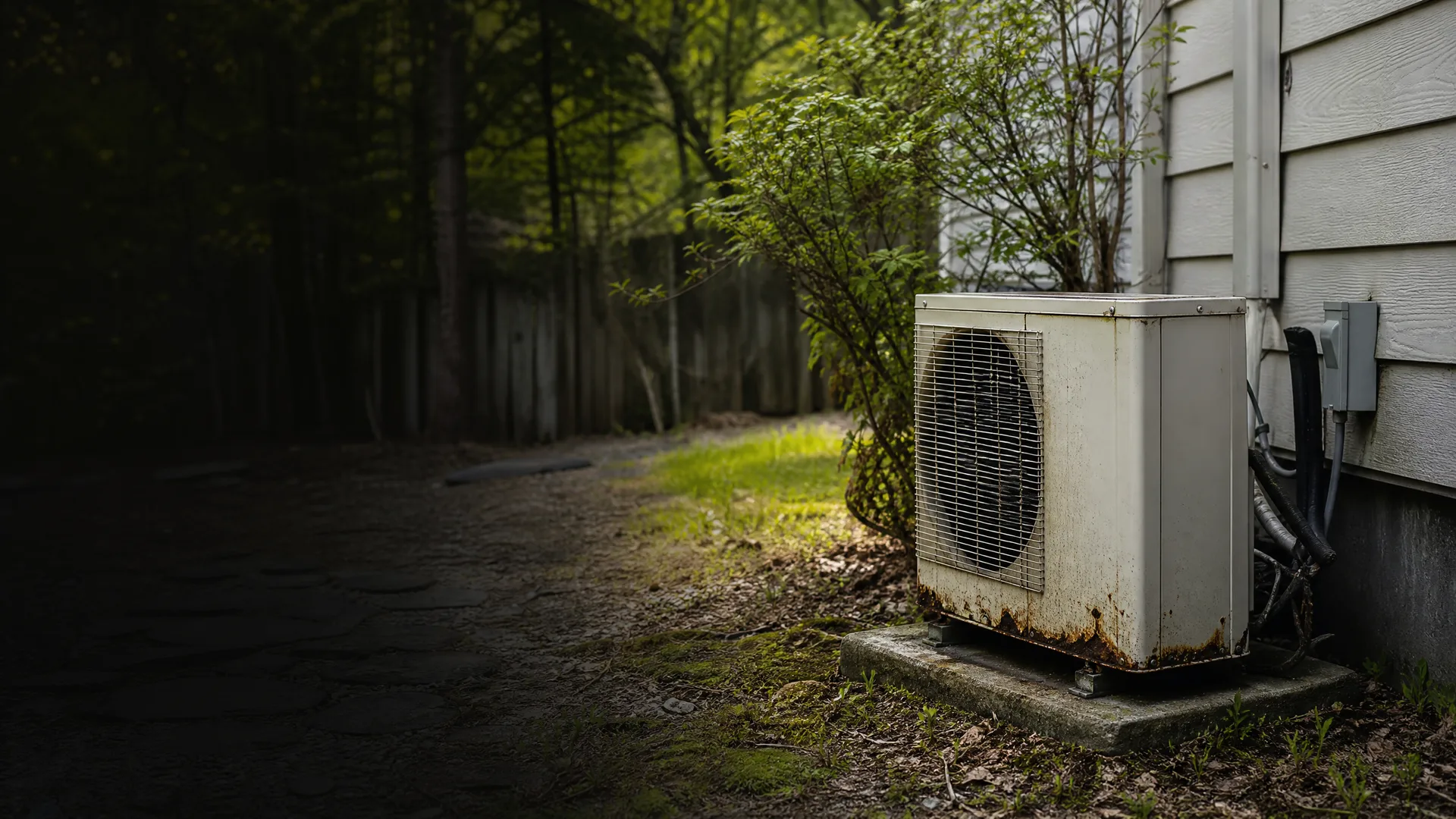
You're out checking the yard in March, before the beds need any real work yet, and you catch sight of the outdoor unit against the fence. Rust has crept along the base, a thin orange line where metal has been sitting wet all winter. It still runs. You can hear it. But you crouch down and touch the seam near the bottom and the metal gives slightly, soft in a way it shouldn't be. You think about the contractor who serviced it two summers back, someone who works on these units all over this part of New York and would know from that rust line alone whether it's surface or something eating into the cabinet. You straighten up, make a note to call before it warms up and you need it every day.
No quotes to chase
Once you've worked out whether repair or replacement makes sense, there's still the part of finding someone to do it. That usually means searching for contractors, calling a few, explaining the same thing about your heat pump each time, then waiting on quotes to compare. Submit the request here and it goes to one licensed New York contractor, not five companies competing for your callback. Someone who works on heat pumps all year in this climate, through the humid stretch of summer and the cold snaps in January, has seen what usually goes wrong and what it takes to put right. That matters more here than in most places, since power costs enough that a system limping along on backup heat strip or a clogged coil shows up fast on your bill. Whether it ends up being a repair or a full replacement, getting the right person looking at it is what moves things forward.

A summer dew point averaging 62°F across June, July and August, per NOAA climate normals, means the air here holds a lot of moisture most days. Your heat pump has to pull that moisture out before it can get the house to feel cool, so it runs longer cycles even when the thermostat shows you're close to setpoint. A system that's lost capacity, from a low charge or a coil that's not moving heat like it used to, falls behind on sticky days first. You'll notice it as a house that feels cool enough by the number but still damp.
NASA POWER T2MDEW county cells weighted by homes
Why does my heat pump blow cold air before it warms up?
You turn the heat up on a cold January morning and the air coming out of the vents feels cool, not warm, at least for the first minute or two. It feels like something's wrong, especially with power costs what they are here, but it can be normal depending on what mode the system is running in to catch up.
It's pulling air through before the coil's up to temperature, or running on backup heat strips
A heat pump moves heat rather than burning fuel for it, so the air coming out of the vents is never as hot as a gas furnace's. Right after the system kicks on, the blower can start moving air a few seconds before the outdoor coil has absorbed enough heat to warm it, and that short lag feels cold at the register. If the air stays cool for more than a few minutes, or if it's a single-digit morning, the system has likely switched to backup electric heat strips to keep up, and those take a bit to bring the air temperature up too. Either way, warm air should follow within a few minutes. If it doesn't, something's keeping the system from reaching full output.

A contractor sizes the new heat pump to your house's heating and cooling load.
The old outdoor and indoor units get disconnected and removed.
New line sets get run if the old ones don't match the equipment.
The outdoor unit goes in on a new pad or mounting bracket.
Power costs 26.39 cents per kilowatt-hour statewide
At 26.39 cents a kilowatt-hour, every backup strip cycle or extra hour your heat pump runs to catch up costs more here than almost anywhere else. A unit that's losing efficiency won't just run longer, it'll show up clearly on your bill.
EIA-861 2025 statewide residential average

Repair it if it's one problem. Replace it if it's the system.
A single bad part on a heat pump that otherwise keeps up with a New York summer and a New York winter is worth fixing. A coil caked with years of wear, a defrost control that keeps letting the outdoor unit ice over, or a system leaning on backup strip heat every cold morning is telling you something bigger is wrong. At 26.39 cents a kilowatt-hour, that difference shows up on your bill either way.
Once you know which one you're dealing with, the next question is who fixes it. That means finding a contractor who works on heat pumps in this climate, not just central air, and who won't need the whole story repeated twice. A local contractor who sees these units every season, through the humidity and the defrost cycles both, already knows what tends to fail first in a system like yours. You get matched with one, not a list of five companies calling you back at once.


Heat Pump Installation
Skip the calls to every shop

- A local installer who puts in heat pumps gets your project.
- Get in touch with a local installer about a new heat pump.

- Send the form and stop researching installers for the new heat pump.
- One request ends the search for a heat pump installer.

- Describe the project once instead of to every installer.
- Answer a few questions instead of calling shop after shop.

- Only one pro gets your request, so you hear from one company.
- Your request stays with one local pro.