A white wooden picket fence curves along a mown lawn in front of a row of similar gray clapboard houses with gabled roofs, backed by large leafy trees.

Heat Pump Repair in Yonkers, NY

Tell us about the job

Takes about a minute. No obligation.

RepairHeat PumpWestchester County, NY
Step 1 of 2

What ZIP code is the job in?

October is when weak units show up

Heat pumps in Yonkers switch over to heating in October, and that first stretch of real cold is when a part that was already struggling finally gives out. If yours is short cycling or blowing cool air once the weather turns, September was the warning, not the cause.

The same goes in reverse come June

Switching over to cooling in June puts a different kind of load on the system. A heat pump that ran fine all winter can still have a weak capacitor or low charge that only shows itself once it has to cool the house instead of heat it.

8 months
October through May, your system heats
3 months
June through August, it cools
24°F
the average winter night it heats against
82°F
the average summer afternoon it cools against
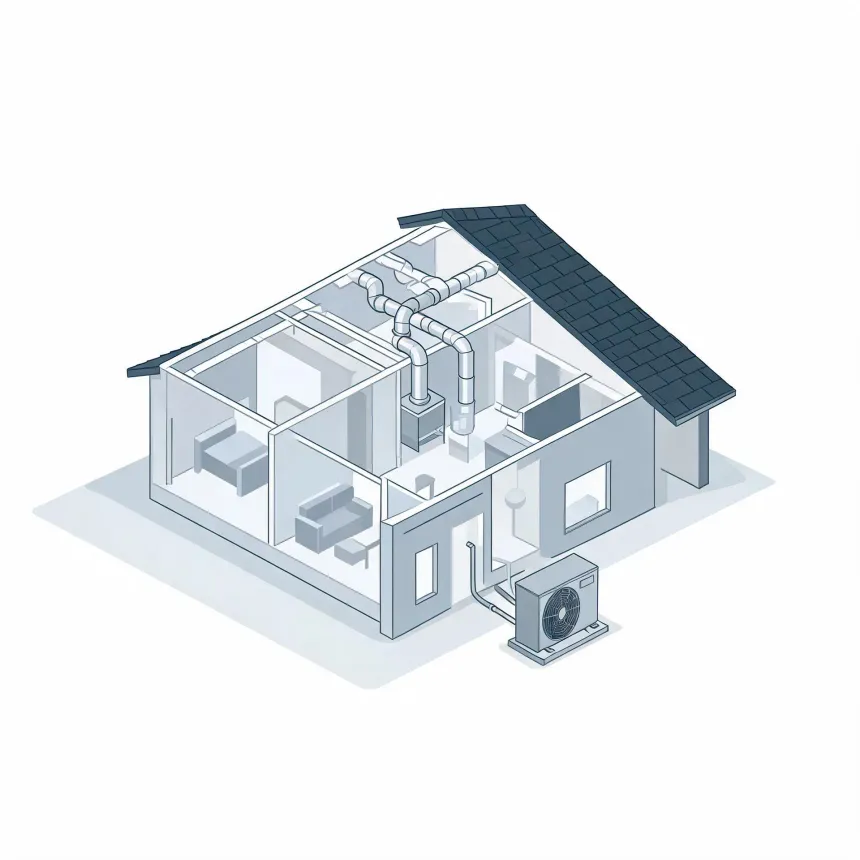
Isometric line illustration of a cutaway house showing interior rooms with furniture, ceiling ductwork connected to an indoor air handler, and an outdoor condenser unit linked by refrigerant lines.
Your system heats October through May and cools June through August.

NOAA nClimDiv, 1991–2020 normals

Winter storms have hit Westchester County 42 times between 2015 and 2024.

A heat pump that quits during a cold snap needs a repair call that week, not a wait and see.

A heat pump that's running badly costs more here than almost anywhere else

Power costs 24.43 cents a kWh statewide
167 damaging wind events from 2015 to 2024
16 hail events from 2015 to 2024

Half the houses in Westchester County were built in 1959 or earlier. If your heat pump came with a house that old, it may not be the original system, but it's worth finding out one way or the other. A heat pump has a harder job than most of what it's replacing was built for, and a unit nearing the end of its life tends to show it in exactly the way yours might be acting now, struggling to switch over, running longer than it should, or giving out partway through the job. Before you pay for a major repair, ask whoever comes out how many years the system has left in it. Sometimes the honest answer changes what's worth fixing.

The weather here isn't the problem. Find out what is.

Westchester has had its share of wind and winter storms, same as a lot of places. That's not why your heat pump is acting up. Most heat pump trouble comes down to a part wearing out or a charge that's run low, and that holds true whether the system sees rough weather or not. Worth getting someone out to look at what's actually going on before guessing further.

Find a contractor
A gray heat pump condenser unit mounted on a concrete pad against the gray lap-siding exterior wall of a house.

Find out what you're actually repairing

Ask about the age of the system before you approve a repair. A tech can check the nameplate date against when your house was built and tell you whether what you have is original equipment or a replacement. That one number changes the math on whatever they quote you.

What you'll actually notice first

A heat pump in trouble rarely just quits outright. It runs longer than it used to, blows air that's lukewarm instead of warm or cool, or cycles on and off in short bursts instead of settling into a steady run. The outdoor unit might ice over and stay that way instead of defrosting on its own. Any of these is worth a call, not something to watch for another month.

What the sound and smell tell you

A clicking or buzzing at startup can mean a failing relay or a capacitor that's about to go. A grinding or screeching points to a motor bearing wearing out. A burning smell means stop running it and get someone out, since that can mean a wiring or motor problem that gets worse the longer it runs. None of these fix themselves.

A heat pump that's struggling doesn't fail on its own schedule, the compressor does. Let it keep running low on charge or on a failing capacitor and the compressor is the part absorbing that strain every time it cycles. That's the one part in the system a tech will tell you not to push past its limit. Ice on the outdoor unit works the same way. A little frost clears on its own during a normal defrost cycle, but a coil that stays iced over is losing airflow, and the system keeps trying to push through it instead of shutting down. A capacitor or a sensor is a straightforward swap. A seized compressor is a different conversation entirely.

A diagnostic visit starts outside, not inside. A tech will check the outdoor unit first, looking at the coil, the fan, and whether refrigerant pressure is where it should be. Low charge shows up as a gauge reading that's off, and that alone can point to a leak before anything else is touched. Inside, they'll pull the cover off the air handler and look at the capacitor and contactor, since those are the parts that fail quietest and cause the most confusing symptoms. A multimeter tells them whether the capacitor is holding its charge or whether it's weak, which a visual check alone can't show. If the system has been short cycling, they'll also check the thermostat wiring and the control board before assuming the problem is mechanical at all. None of this takes guessing. It takes opening the unit up and testing the parts that fail most often first.