







A row of illuminated white colonial houses with black shutters and a stone wall along a road at dusk.

Heat Pump Repair in Watertown, NY

Tell us about the job

Takes about a minute. No obligation.

RepairHeat PumpJefferson County, NY
Step 1 of 2

What ZIP code is the job in?

A heat pump in Jefferson County works for nine months, September through May, with only July and August off. That short break is why August matters. Any weak part, a struggling capacitor or a contactor on its way out, tends to fail once the system has to switch over and start pulling heat again. If yours is acting up now, in the first weeks of the season, that timing is not a coincidence. It is usually the moment a problem that was building all along finally shows itself.

9 months
September through May, your system heats
2 months
July through August, it cools
13°F
the average winter night it heats against
78°F
the average summer afternoon it cools against
Isometric cutaway illustration of a house showing interior ductwork, an indoor air handler unit, and an outdoor condenser unit beside the building.
Your system heats September through May and cools July through August.

NOAA nClimDiv, 1991–2020 normals

Watertown winters average 13°F overnight, and a heat pump is built to run in cold like that.

If yours isn't keeping up, the cold outside isn't the reason. Something in the system needs attention.

At 24.43 cents a kilowatt-hour, a heat pump that's struggling costs you every month it runs

Power costs 24.43 cents a kWh statewide
Climate zone 6A
Cooling runs July through August
Half the homes here were built in 1972 or earlierA heat pump that old is likely near the end of its life

A heat pump that's short cycling, or running nonstop and still not reaching the thermostat setting, is pulling power the whole time it does that. That cost shows up on the bill before it shows up as a breakdown. Waiting to see if it gets better just means paying more each month for a system that isn't fixing itself. Get it looked at while it's a repair, not a replacement.

Know what you're repairing before you pay for it

If your heat pump came with the house, it may already be past the point where another repair makes sense. Before paying for the fix, ask the contractor how much life the system has left.

Find a contractor
A man in a dark long-sleeve shirt, tan pants, cap and work boots carries a canvas tool bag up gray porch steps toward a dark green front door, with a potted shrub beside the entry.
A gray outdoor HVAC unit mounted on a concrete pad beside a house with gray lap siding and a stone foundation.

Why running it longer doesn't buy you time

A heat pump low on refrigerant doesn't just run weaker. It runs harder, and the compressor is what pays for that. A clogged filter or a dirty coil does the same thing. Airflow drops, the cycle stretches out, and the compressor sits under load longer than it was built for. A failing capacitor behaves the same way. It lets the compressor start hard and run rough instead of failing clean. None of this fixes itself by running more. Keep it going and you're not preserving the system. You're wearing out the one part that's hardest to replace, and turning a reset or a swapped part into a problem that takes the whole unit down with it.

What the technician checks first

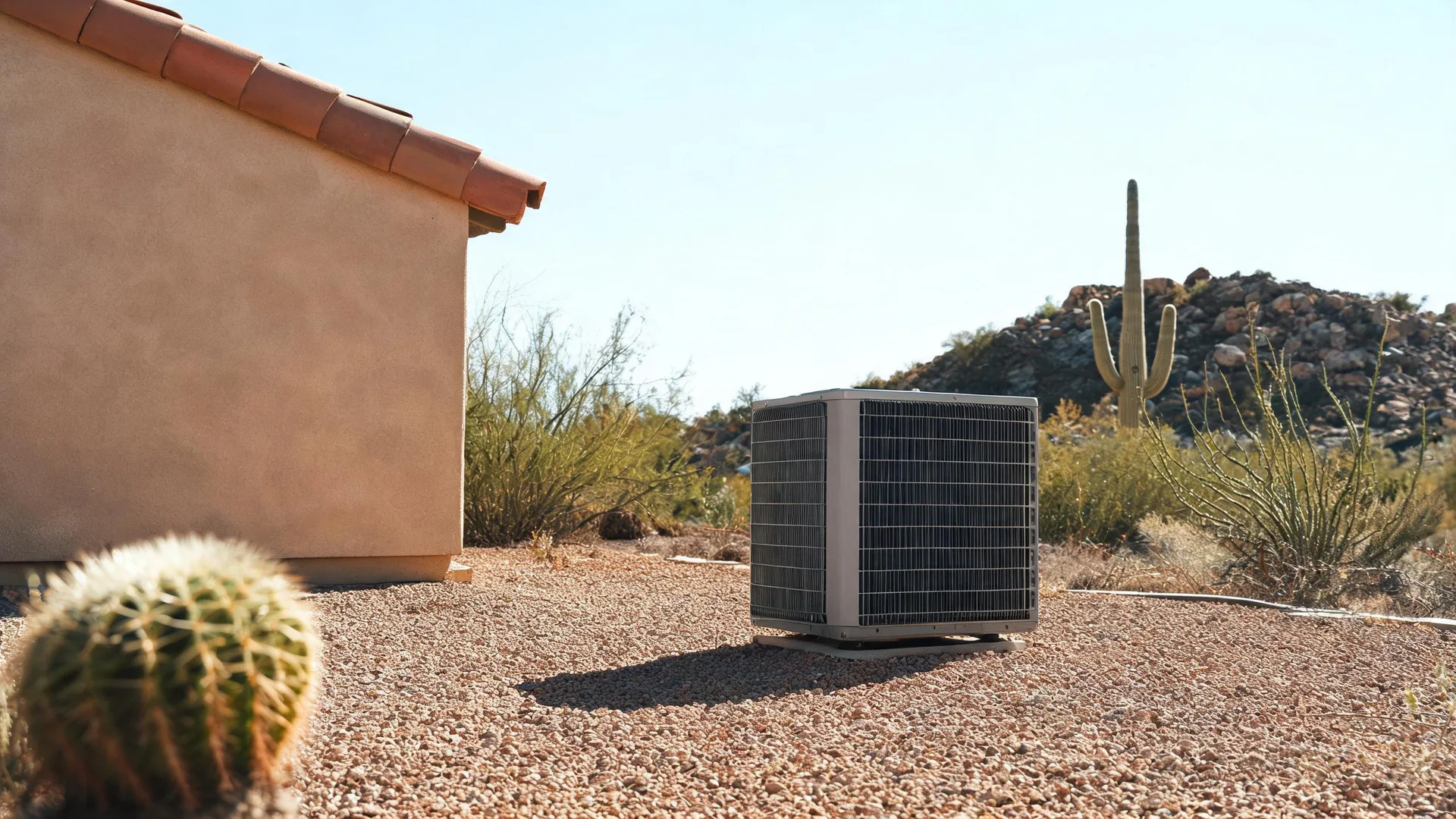
A diagnostic starts outside at the outdoor unit. The technician reads the refrigerant pressures, checks the temperature split across the coil, and looks at the amp draw on the compressor. Those readings usually point straight at what's wrong before any panel comes off indoors.
Why the visit comes before the quote

A contractor won't know whether you need a part or a system until the diagnostic is done. A bad reversing valve and a low charge can feel the same on the thermostat, weak heat, long run times, but they're fixed in completely different ways. The visit is what tells you which one you're actually dealing with.

Before anyone comes out, there are a few things worth checking yourself. Look at the outdoor unit. If it's packed with leaves, caked in ice, or boxed in by snow, air can't move through it and the system will struggle no matter what else is right. Check the thermostat is set to heat and the setpoint is actually above room temperature, since a setting bumped by accident looks exactly like a failing system. Go to the indoor filter and hold it up to the light. If you can't see through it, swap it, because restricted airflow alone can cause weak heat and long run times. Check the breaker for the outdoor unit hasn't tripped. None of this fixes a bad capacitor or a low charge, but it rules out the easy explanations before you pay for a diagnostic.

Some repairs are worth it no matter the age of the system. A capacitor, a contactor, a blower motor, these are parts a tech swaps in one visit, and once it's done the system runs like it did before. What changes the math is the compressor. It's the part that costs the most to replace, and when it's the one failing, you're not paying to fix the heat pump so much as deciding whether to rebuild it around one part. A refrigerant leak sits in between. The fix is straightforward if the leak is found and sealed, but a system that's been low for a long time can mean a compressor that's already been running stressed. Ask what's actually failing before you decide it's worth fixing.