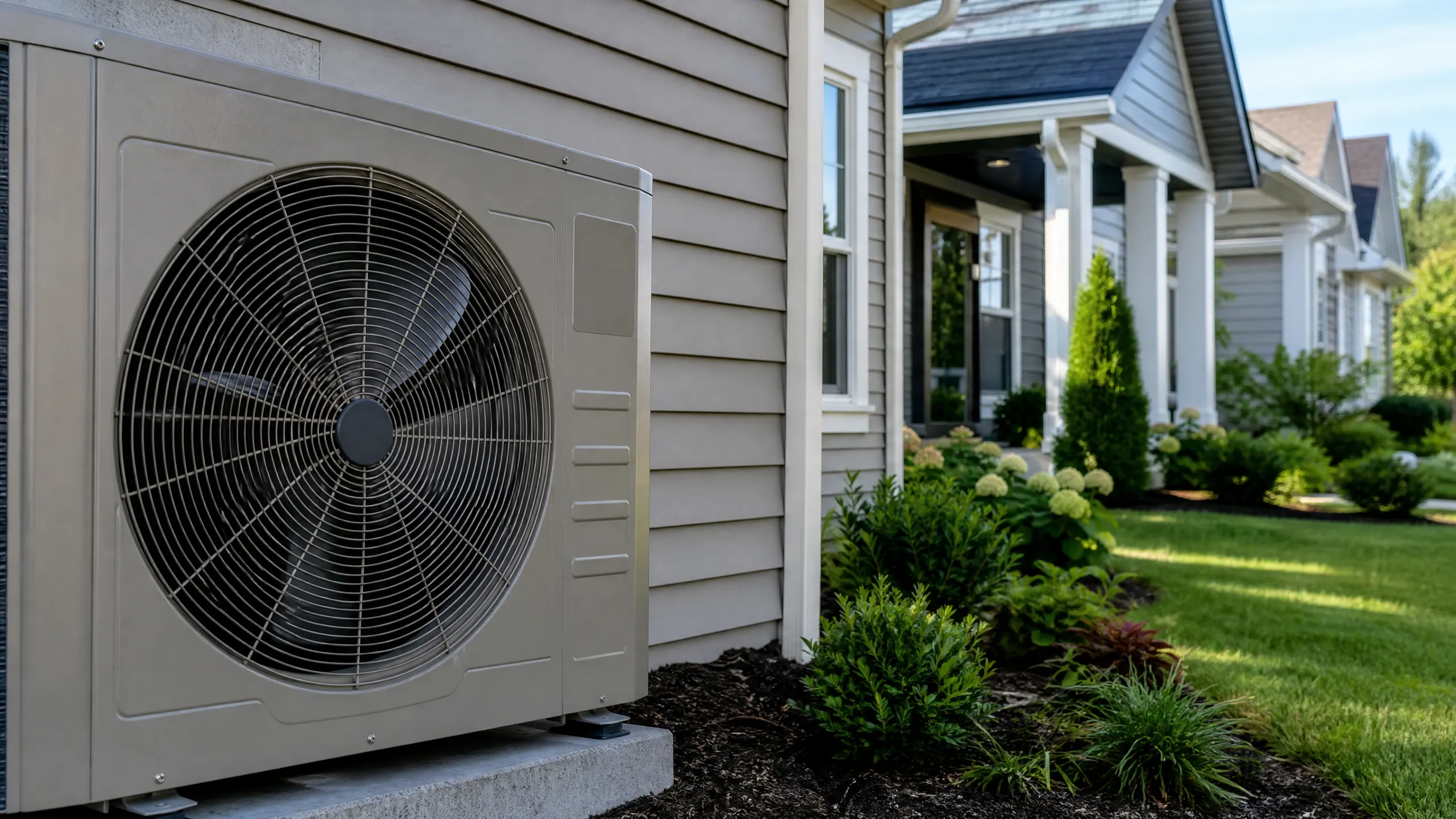





A large outdoor air-conditioning unit mounted beside a vinyl-sided house, surrounded by mulched garden beds and green shrubs.

Heat Pump Repair in Staten Island, NY

Tell us about the job

Takes about a minute. No obligation.

RepairHeat PumpRichmond County, NY
Step 1 of 2

What ZIP code is the job in?

A heat pump here works hardest right at the turn of the season, in October and in June. That first real cold snap or the first stretch of heat is when a weak part finally gives out. A capacitor or a contactor that was already marginal often holds on fine during the mild weeks and fails the first time the system has to run long and hard. If your heat pump is struggling now, this is likely why. It was due.

7 months
October through April, your system heats
4 months
June through September, it cools
28°F
the average winter night it heats against
84°F
the average summer afternoon it cools against
Isometric cutaway illustration of a single-story house showing interior rooms, ceiling ductwork connected to an air handler, and an outdoor condenser unit linked by a line set.
Your system heats October through April and cools June through September.

NOAA nClimDiv, 1991–2020 normals

A heat pump in Staten Island isn't fighting extreme heat or deep cold most of the year.

A unit that's been reasonably maintained is usually worth repairing rather than replacing.

Electricity here runs 24.43 cents a kWh, so a heat pump that's struggling is costing you more every day it's not fixed

Power costs 24.43 cents a kWh statewide
36 damaging wind events from 2015 to 2024
13 winter storms from 2015 to 2024

Every day it runs wrong, it costs you more

At 24.43 cents a kWh, a heat pump working harder than it should shows up fast on your bill. Get it looked at before another month passes on a system that isn't running right.

Find a contractor
A gray heat pump condenser unit mounted on a concrete pad against the gray lap-siding exterior wall of a house.

What a heat pump sounds and looks like when something's wrong

Watch the outdoor unit. A little frost in winter is normal. A solid sheet of ice that never melts off means the defrost cycle isn't working. Inside, listen for short cycling. The system kicks on, runs a few minutes, shuts off, then starts again before the room ever warms up. That usually means a refrigerant problem or a failing sensor, not something that works itself out. Air blowing lukewarm instead of warm is another sign, especially if the outdoor fan is spinning fine and the unit still can't keep up. If the system drops into emergency heat on its own, or you have to switch it there yourself just to get warmth, the heat pump has stopped carrying the load. None of this means the whole system needs to go. Most of the time it's one part, a reversing valve, a sensor, a failed capacitor, and a tech can test it and swap it without touching anything else.

The reversing valve takes the most abuse

The reversing valve is what lets a heat pump switch between heating and cooling, and it shifts position every time the system changes modes. A valve that sticks can leave the system stuck in one mode, or leave it running without actually changing the air temperature. It doesn't fail as often as smaller parts, but when it does, it's rarely a quick swap.
Most failures are smaller than that

A run capacitor weakens after years of starting the compressor and fan, then one day it can't push them into motion. A contactor pits from arcing every time it closes and eventually stops making contact. A sensor drifts out of calibration and feeds the control board bad readings. These parts fail far more often than the reversing valve, and they're also the faster ones to replace.

Before anyone comes out, check the thermostat batteries and the setting itself. It sounds obvious, but a thermostat stuck in the wrong mode or with a dead backlight gets mistaken for a dead system all the time. Next, go look at the outdoor unit. Clear away leaves, mulch or anything stacked against it, since a blocked unit can't move air and will struggle no matter what's wrong inside. Check the air filter. A filter clogged with dust chokes the airflow and can make a perfectly good heat pump act like it's failing. Then check your breaker panel. A tripped breaker will shut the whole system down and reset is often all that's needed. None of this fixes a bad capacitor or a stuck reversing valve, but it rules out the simple stuff first, and it gives a tech a clearer picture of what's actually wrong when they do show up.

A heat pump has fewer moving parts than a furnace, so when one part fails, it's usually just that part, not a sign the whole system is breaking down. Age matters more than any single symptom, and a tech can tell you how a unit's age stacks up against its expected life. A system still well within its working life is usually worth repairing almost regardless of what's wrong, since the compressor and coils, the expensive parts to replace, are probably still sound. Closer to the end of that life, the question changes. If the compressor itself is failing, that's a different conversation than a bad capacitor, since the compressor is most of the cost of the whole system. If a system has needed a repair every season for the last few years, that pattern is worth more than any single breakdown, since it usually means something is wearing out faster than it should.