






A long white picket fence runs beside a mown grass strip in front of a row of gray gabled houses, with large leafy tree branches overhead.

Heat Pump Repair in Queens, NY

Tell us about the job

Takes about a minute. No obligation.

RepairHeat PumpQueens County, NY
Step 1 of 2

What ZIP code is the job in?

October is when most heat pumps here get asked to switch over and work hard for the first time since spring. If a capacitor or a reversing valve was already marginal, this is when it gives out. The same thing happens in reverse come June, when cooling starts after four months of the system sitting idle. A unit that struggled last season and got nursed through often fails right at the point it has to carry real load again. If yours is acting up now, that timing is probably not a coincidence.

7 months
October through April, your system heats
4 months
June through September, it cools
28°F
the average winter night it heats against
83°F
the average summer afternoon it cools against
Isometric cutaway illustration of a small house showing interior rooms with furniture, an indoor air handler with flexible ducting, and refrigerant lines running to an outdoor condenser unit beside the building.
Your system heats October through April and cools June through September.

NOAA nClimDiv, 1991–2020 normals

Queens winters average 28°F at night across December, January and February, well within what a heat pump is built to handle.

A heat pump that's struggling this winter has a broken part, not a climate problem too big for it.

Half the homes in Queens County date to 1953 or earlier, so a heat pump that's failing now may simply be old

Half the homes here were built by 1953
116 damaging wind events from 2015 to 2024
33 winter storms from 2015 to 2024
Power here is not cheapNew York electricity ran 24.43 cents per kilowatthour in 2024.

A heat pump that won't hold its setting is usually a problem with one part, not the whole system. A failed contactor or a weak run capacitor gets replaced on its own, and the rest of the unit keeps running. A reversing valve stuck in one position is the same kind of fix. What changes the math is the compressor. That's the part that actually moves refrigerant and does the work of heating or cooling, and a tech can't swap it out the way they would a capacitor. If the compressor has failed, you're usually looking at replacing the outdoor unit rather than repairing it. Age matters, but not on its own. A unit that's only a few years old and hasn't been maintained can fail the same way an old one does, and an older unit that's been serviced every year can still have a long run left in it. Ask what actually failed before you ask how old it is.

A struggling heat pump costs more here than most places

At 24.43 cents per kilowatthour, a heat pump that's cycling wrong or running longer than it should is adding to the bill every day it goes unfixed. Get the part that's actually failing diagnosed and replaced.

Find a contractor
A man in a cap, dark jacket and tan work pants, seen from behind, carries a canvas tool bag up concrete steps toward a dark green front door of a gray clapboard house with a potted shrub beside it.
A gray air-source heat pump mounted on a concrete pad next to a house with gray vinyl siding, surrounded by gravel and flanked by green shrubs and white hydrangea flowers.

What actually wears out on a system that never gets a season off

A heat pump runs every day of the year, not just a few months like a furnace or an AC unit alone. That nonstop duty cycle is why certain parts wear out in a fairly predictable order. The outdoor fan motor and its bearings take the most hours of anyone on the system. They start making noise before they quit outright. The reversing valve only shifts position when the system switches between heating and cooling. It takes a hit every single changeover rather than running continuously, and that is usually where a stuck valve comes from. Refrigerant does not get used up over time. A system that is low almost always has a leak in the lines or the coil, not a part that just needs topping off. A defrost control board can fail quietly. The unit keeps icing over in cold weather and never clears it. That looks like the system cannot keep up, but it is usually a bad sensor or board telling the system the wrong thing. None of this means the whole machine is going. It is one part wearing out from the job it was built to do.

What you can check safely

Look at the outdoor unit and clear away leaves, mulch or anything blocking the sides and top. Check the air filter and swap it if it is gray with dust. Check the thermostat is set to the right mode and the batteries are not dead. Look at the outdoor unit's fan through the grille and see if it is spinning when the system calls for heat. None of this takes the cover off anything or touches wiring.
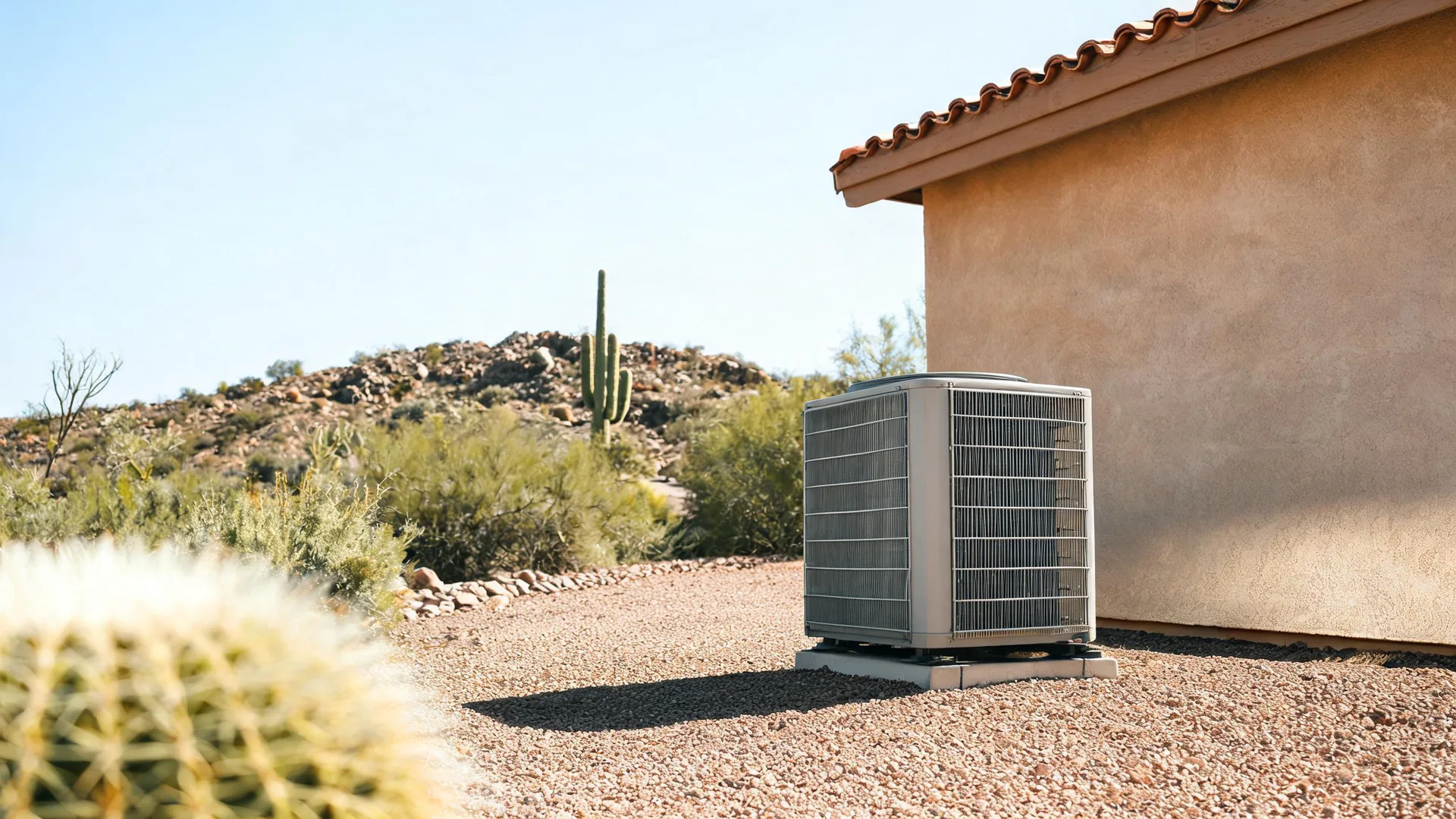
What that tells a tech before they arrive

If the fan is not spinning and the unit is silent, that points toward power or a capacitor rather than refrigerant. If the fan runs but the air at the vents is cold when it should be warm, that points toward the reversing valve or the compressor instead. Telling the tech what you saw before they get there often narrows down the visit before they open the panel.

A heat pump that's icing up or short cycling will keep running if you let it, and that's the problem. Ice on the outdoor coil blocks airflow, so the system pulls harder to move the same amount of heat, and that strain lands on the compressor. A reversing valve that's partly stuck still shifts back and forth, grinding against a position it can't fully reach, until it jams for good. Low refrigerant from a small leak makes the compressor run hotter than it's built for, and that heat is what eventually kills it outright. The compressor is the one part on the whole system that can't be swapped out on its own, so the parts that fail first are worth catching before the strain reaches that far. A system acting up today and a system not turning on at all later are often the same fault, just further along.

A diagnostic visit starts outside, at the unit itself. A tech checks the readings with gauges hooked to the lines, because that tells them what the refrigerant is actually doing, not just what the thermostat says it's doing. They'll check the amp draw on the compressor and the fan motor too, since a motor pulling more current than it should is a motor on its way out even if it still runs today. Inside, they'll look at the air handler, check the coil for ice or buildup, and test the reversing valve by forcing it to switch while the system runs. A lot of this comes down to comparing what the system is doing against what it should be doing for the mode it's in and the temperature outside. Once that points to a part, the tech can tell you whether it's a straightforward swap or something that changes the conversation entirely.