






A row of similar gray and white wood-sided houses with gabled roofs behind a white picket fence, with a mowed lawn in the foreground and dense green trees behind.

Heat Pump Repair in Plattsburgh, NY

Tell us about the job

Takes about a minute. No obligation.

RepairHeat PumpClinton County, NY
Step 1 of 2

What ZIP code is the job in?

Plattsburgh winters are long and cold, overnight lows averaging 11°F across December, January and February. That's a lot of hours for a heat pump to run. But it's normal wear for this climate, not a sign something unusual is happening to your unit. Most heat pump trouble after a stretch like this comes down to the same few things. A failing defrost board, a low refrigerant charge, a reversing valve stuck in one position. None of that is specific to this county. It's the usual list, and a tech working through it in order will find the one that's actually wrong.

9 months
September through May, your system heats
1 months
July through July, it cools
11°F
the average winter night it heats against
76°F
the average summer afternoon it cools against
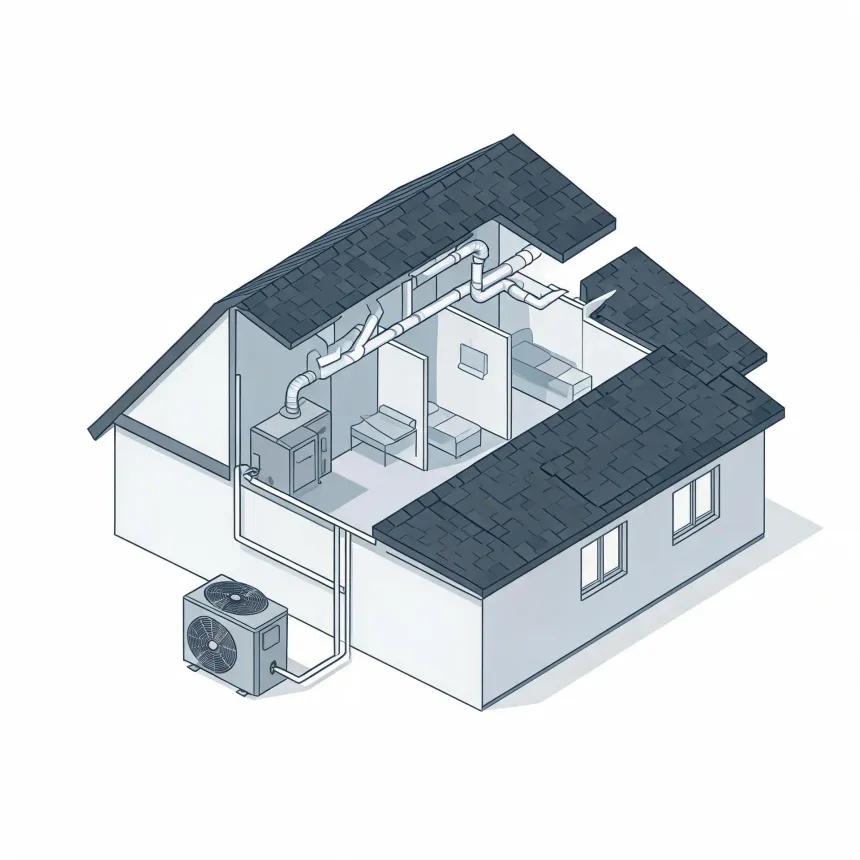
Isometric line illustration of a cutaway single-story house showing interior ductwork, an indoor air handler unit, and an outdoor condenser connected by refrigerant lines, with a dark shingled roof.
Your system heats September through May and cools July through July.

NOAA nClimDiv, 1991–2020 normals

Heat here starts up in September, after August sits idle.

A heat pump that's been quiet for months will show its weak part in the first cold snap, not before.

A heat pump that's struggling to keep up still pulls full power at 24.43 cents a kWh

Power costs 24.43 cents a kWh statewide
Climate zone 6A
Cooling runs July through July
The house's age isn't the clue hereHalf the homes in Clinton County were built in 1974 or earlier, half in 1974 or later. The age of the house doesn't tell you the age of the heat pump.

A heat pump that's short cycling or blowing lukewarm air isn't using less power to do it. The compressor still draws full current whether the output is warm or barely room temperature. So a unit that's struggling along for a few weeks adds real cost at 24.43 cents a kWh before anyone looks at it. Waiting doesn't save you anything, since the broken unit keeps running the whole time. Get the cause found and fixed instead of letting it limp through the cold.

Get the usual fix

Nothing about this area is especially hard on it. It's most likely the usual problem with the usual fix.

Find a contractor
A man in a cap, dark long-sleeve shirt and tan pants walks up concrete steps toward a green front door, carrying a canvas tool tote, with a potted shrub beside the entry.
A gray air-source heat pump mounted on a concrete pad next to a house with gray vinyl siding, surrounded by gravel and flanked by green shrubs and white hydrangea flowers.

What to check before the tech shows up

Before anyone comes out, look at the outdoor unit first. Snow or ice piled against it blocks airflow, and so does a cover left on from last season. Check the air filter inside. A clogged filter starves the system and can make it ice up outside even when nothing else is wrong. Look at the thermostat setting versus what the house is actually at, and check that it's set to heat and not fan only. If the outdoor unit is caked in ice beyond what you'd clear by hand, don't chip at the coil. Leave that for the tech, since the fins bend easily and a bent coil is its own repair. If you flip the breaker and the unit still won't start, that's worth telling the tech before they arrive. It narrows down what they test first.

The reversing valve is often the one that sticks

The reversing valve switches the system between heating and cooling, and it has to move every time the cycle changes. Over years of switching back and forth, the valve can stick partway, so the unit runs but blows the wrong temperature air or gets stuck defrosting. It's a common failure point because it's one of the few parts doing mechanical work on every cycle.
A low charge rarely comes from one big leak

Refrigerant doesn't get used up the way fuel does. If the level is low, it's leaking out somewhere, usually a slow seep at a fitting or a worn spot in the coil. Topping off the charge without finding the leak just means doing it again later. A tech checking the charge will also check for where it's getting out.

A heat pump that's icing up or short cycling will keep running that way until something forces it to stop, and that's the problem. Ice on the outdoor coil blocks airflow, so the system pulls in less heat each cycle and runs longer to make up for it. Running longer in that state builds more ice, not less. A reversing valve stuck partway makes the compressor work against itself, and it can overheat or trip on its own protection if it's left to do that for days. A slow refrigerant leak behaves the same way. The charge keeps dropping, the compressor keeps working harder to move less heat, and a part sized for a full charge wears out faster running under a load it wasn't built for. None of these start out as compressor problems. Left alone, that's usually where they end up.

Most heat pump failures are worth fixing. A bad defrost board, a stuck reversing valve, a low charge from a small leak. Those are parts, and a tech replaces them without touching the compressor or anything else in the system. The compressor is a different story. It's the most expensive part in the unit, and if that's what's failing, putting money into it often doesn't make sense next to a new system. An aging unit isn't doomed just for being old, but a worn compressor failing alongside a worn reversing valve is a different conversation than one part failing on an otherwise sound unit. Ask what's actually failing before deciding anything. That answer tells you more than how old the unit is.