A white picket fence runs along a grass lawn in front of a row of similar gabled houses with siding, beneath overhanging leafy tree branches.

Heat Pump Repair in Newark, NY

Tell us about the job

Takes about a minute. No obligation.

RepairHeat PumpWayne County, NY
Step 1 of 2

What ZIP code is the job in?

Winter is the real work here

Newark sits in a cool climate zone where heating carries the bigger load, and the average overnight low runs 20°F through December, January and February. A heat pump here spends most of its effort keeping up on cold nights, not fighting summer heat.

That makes repair worth a closer look

A heat pump that's struggled with heavy loads for years wears differently than one that's just getting older. If yours is acting up, age or a specific part failing is more likely the cause than the system being worn out from overwork.

8 months
October through May, your system heats
2 months
July through August, it cools
20°F
the average winter night it heats against
79°F
the average summer afternoon it cools against
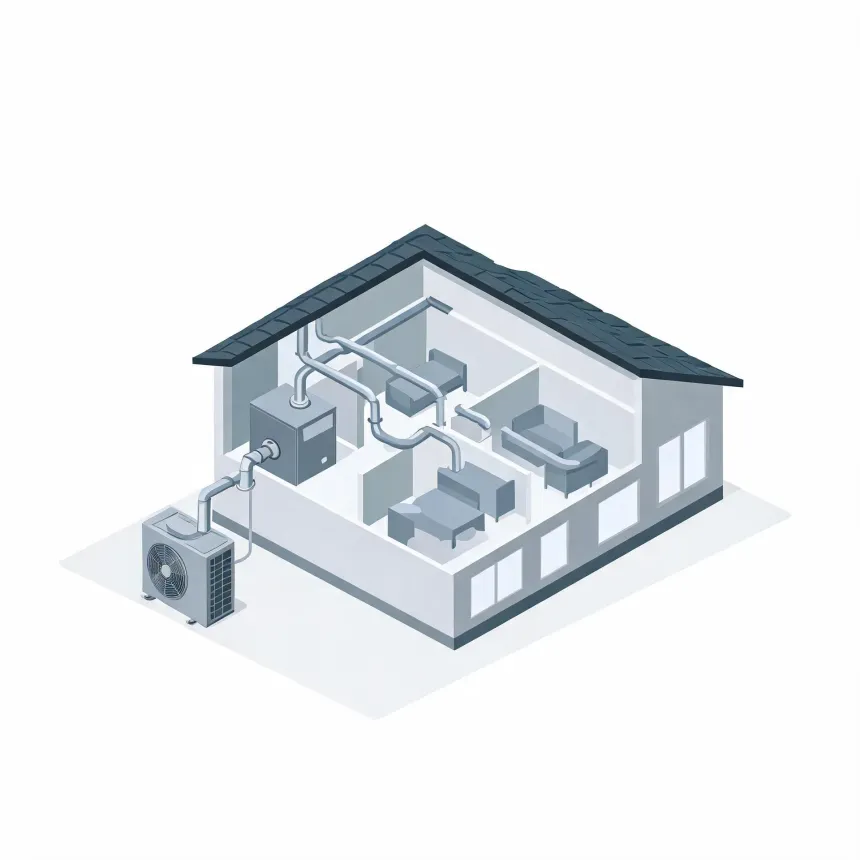
Isometric cutaway illustration of a single-story house showing an indoor air handler, branching ductwork through rooms with furniture, and an outdoor condenser unit connected by a line outside the wall.
Your system heats October through May and cools July through August.

NOAA nClimDiv, 1991–2020 normals

Heat in Newark starts up in October, after sitting idle since May.

A heat pump that's been off for months often shows its weak part in that first cold snap.

At 24.43 cents a kilowatt-hour, a struggling heat pump runs up your bill fast

Power costs 24.43 cents a kWh statewide
Climate zone 5A
Cooling runs July through August
Newark homes run older than mostHalf the homes in Wayne County were built in 1968 or earlier.

So don't wait on this. A heat pump that's short cycling, running constantly, or blowing air that's not quite warm enough is pulling power the whole time it's doing it, and at 24.43 cents a kilowatt-hour that shows up on the bill fast. A system working harder to make up for a bad part doesn't use a little more power, it uses a lot more. Get a contractor out to find the actual cause, whether that's a sensor, a valve, or something in the outdoor unit, rather than letting it run rough through the winter.

Ask how much life is left before you repair it

If your heat pump came with the house, ask the contractor how much life it has left. Half the homes around Newark were built in 1968 or earlier, and a system that old has likely already outlived what you'd expect from a heat pump. Find out before paying for a big repair whether that money is better spent on a new system.

Find a contractor
A man in a dark long-sleeve shirt and tan work pants, seen from behind, steps onto a porch toward a dark green paneled door while carrying a canvas tool bag with tools in its outer pockets, with a potted shrub to the right.
A white mini-split heat pump outdoor unit mounted on a concrete pad beside a gray-sided house, surrounded by gravel and green shrubs.

What to check before you call anyone

Before anyone comes out, a few things are worth checking yourself. Look at the outdoor unit first. If it's caked in ice or buried in leaves and debris, airflow is blocked and that alone can cause weak heat or short cycling. Check your thermostat is set to heat and the temperature is actually set above room temperature, it sounds obvious but it gets missed. Go to your breaker panel and make sure nothing's tripped, a heat pump has breakers for both the indoor and outdoor unit. Change the air filter if you haven't in a while, a clogged filter starves the system of airflow and can make it run constantly without catching up. Walk through the house and feel the vents. Air that's moving but not very warm can be normal for a heat pump on a cold day, that's just how the equipment works, but air that's barely moving at all points to a blower or duct problem rather than the heat pump itself. None of this tells you what's actually broken. But it rules out the easy stuff before you pay someone to find out the real cause.

The reversing valve takes the most wear

The reversing valve switches the system between heat and cooling, and it cycles more than almost any other part in a heat pump. When it sticks, the system can blow cold air when it should be heating, or get stuck in one mode entirely. A furnace never has a part like this, which is part of why heat pumps fail differently.

The outdoor unit wears on its own schedule

The defrost board and sensors sit outside through every freeze and thaw, and that takes a toll indoor parts never face. A failed defrost sensor can let ice build up on the coil until the unit can't pull in enough air to heat the house. The compressor usually holds up the longest, but once it starts failing, it's rarely worth repairing by itself.

A small problem rarely stays small on a heat pump that keeps running. A reversing valve stuck halfway makes the compressor push against itself, and that strain shortens its life fast. Ice on the outdoor coil from a bad defrost sensor blocks airflow, so the system runs longer to compensate, which only piles more frost onto the coil. A blower pulling air through a clogged filter works the same way, straining harder to move the same amount of air through a smaller opening. None of these start as big repairs. Left running instead of fixed, they get there.

The question is whether the broken part is isolated or whether it's already dragged others down with it. A failed capacitor or a bad sensor is a clean fix, swap the part and the system runs like it did before. A compressor that's been struggling for a while is a different story, because other parts have usually been compensating for it and wearing faster as a result. Age matters more than the symptom does. A system that's still within its expected life with one bad part is usually worth fixing. A system already near the end of what it can give, with a major component failing, often isn't worth sinking money into, since the next failure may not be far behind. A contractor can tell you which situation you're in before any repair starts, not after.