White colonial houses with lit windows photographed at dusk along a tree-lined residential street.

Heat Pump Repair in Auburn, NY

Tell us about the job

Takes about a minute. No obligation.

RepairHeat PumpCayuga County, NY
Step 1 of 2

What ZIP code is the job in?

The tech checks the system before touching anything

A diagnostic visit starts with questions and gauges, not a wrench. The tech wants to know what the heat pump is doing, when it started, and whether it's blowing warm, blowing cold, or not blowing at all. Then they check refrigerant pressures, electrical readings at the compressor and the air handler, and the condition of the coils before deciding what's actually wrong.

Finding the cause decides the rest of the visit

A heat pump that runs but won't heat points somewhere different than one that short cycles or won't start. Low charge, a failing reversing valve, a bad capacitor, and a frozen coil all show different symptoms and get found in different ways. Once the tech knows which one it is, they can tell you what the repair involves and whether it makes sense to fix this unit or think about replacing it.

8 months
October through May, your system heats
2 months
July through August, it cools
19°F
the average winter night it heats against
78°F
the average summer afternoon it cools against
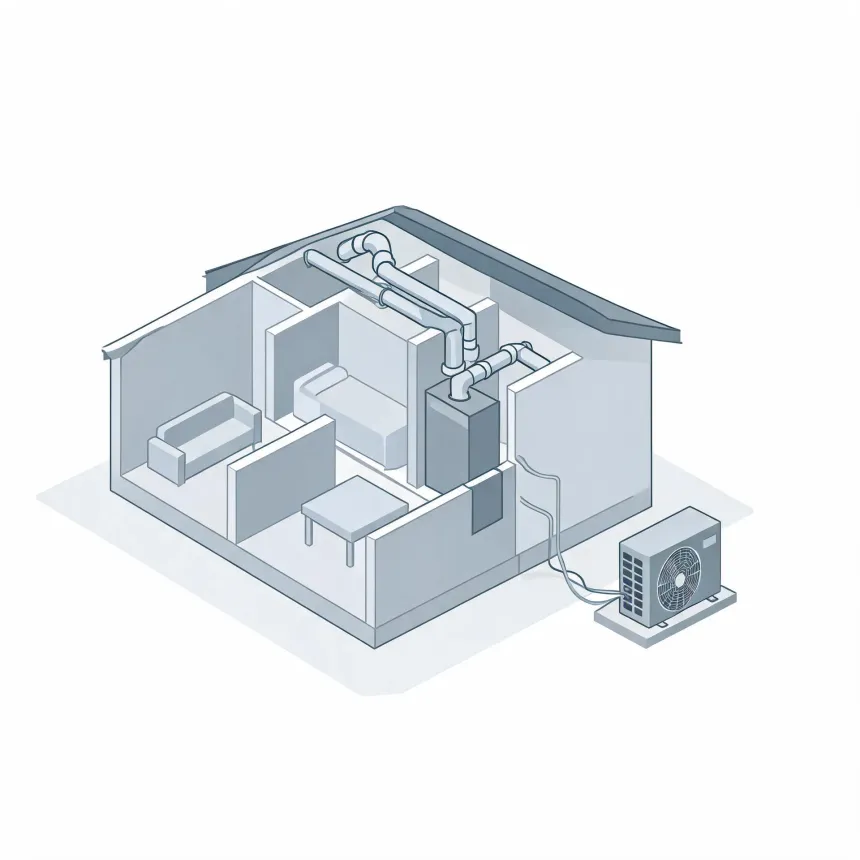
Isometric line illustration of a cutaway house showing interior rooms with furniture, ceiling ductwork connected to an indoor air handler, and a line running outside to an outdoor condenser unit.
Your system heats October through May and cools July through August.

NOAA nClimDiv, 1991–2020 normals

Check the outdoor unit before anything else

If ice is covering the coil or leaves are packed against it, that alone can stop a heat pump from heating right, and it's something you can see without opening a panel.

A heat pump running bad costs more here than most places

Power costs 24.43 cents a kWh statewide
160 damaging wind events from 2015 to 2024
13 hail events from 2015 to 2024

Cayuga County sees its share of wind, hail and winter storms, but none of that singles out your heat pump. Weather here runs about like weather anywhere else in the Northeast, and a heat pump that's struggling is almost always dealing with something ordinary. A low charge, a dirty coil, a failing capacitor, a reversing valve stuck in one position. Those are the same problems a tech finds in heat pumps everywhere, and they get fixed the same way here as anywhere else. The county's weather history doesn't change the diagnosis. It just means the usual causes are still the ones to check first.

Get the usual fix

Nothing about this area is especially hard on it. It's most likely the usual problem with the usual fix.

Find a contractor
A gray heat pump condenser unit mounted on a concrete pad against the gray lap-siding exterior wall of a house.

A heat pump that runs constantly wears constantly

A heat pump works year round, not just in the cold months, so there's no off season where the parts get a break. Every time it switches between heating and cooling, the reversing valve shifts position, and that valve wears from the switching itself, not just from age sitting still. Capacitors weaken gradually from the constant start cycles, long before they fail outright. Outdoor coils collect dirt and debris with every hour the fan runs, and a coil that's been gathering grime for a long stretch loses its ability to transfer heat efficiently. None of this happens because of one bad day of weather. It happens because the unit has been cycling on and off for years, and each cycle asks a little more of parts that were never going to last forever.

A frozen coil gets worse by the hour

A heat pump low on charge or stuck in defrost starts with a thin layer of frost on the outdoor coil. Left running, that frost turns into a solid block of ice that blocks airflow completely. The compressor keeps trying to do its job against that restriction, which is harder on it than the original problem ever was.

A struggling compressor doesn't fail quietly

A compressor low on refrigerant or running on a weak capacitor draws more current than it should every time it starts. Each cycle like that adds wear to the windings. What starts as a repair to a capacitor or a refrigerant leak can end as a compressor replacement if the unit keeps running in that condition.

A heat pump in trouble usually tells you in how it runs, not just whether it runs. It might turn on and off every few minutes instead of settling into a cycle. It might blow air that's cool when it should be warm, or warm when it should be cool. You may hear it humming without starting, or notice the outdoor fan isn't turning while the indoor blower is. Ice on the outdoor coil outside of a normal defrost cycle is worth paying attention to, as is a hissing or bubbling sound near the lines, which can point to a refrigerant leak. A unit that runs constantly without ever satisfying the thermostat is telling you the same thing as one that won't start at all. Something in the cycle isn't finishing the way it should.

The honest answer depends on what broke and what else is close behind it. A capacitor or a run of low refrigerant is a straightforward fix on its own, and age aside, that kind of repair is usually worth doing. A failed compressor or a reversing valve that's stuck is a different conversation, because those repairs cost more and sit on a unit that's already partway through its life either way. The thing to ask isn't just what this repair costs, it's whether the unit has had other problems before this one. A heat pump that's needed a few service calls in the last couple years is telling you something that a first-time repair isn't. One failure is a repair. A pattern of them is a unit deciding for you.