





Why your mini split isn't heating in a New York winter

RepairMini-splitNew York
Step 1 of 2

What ZIP code is the job in?

Why isn't my mini split heating when it's cold outside?

Cold snaps in New York are when a mini split's heating problems show up most, and that's exactly when you need it working. If you keep an eye on your system and caught this early, you're already ahead of a bigger repair. The question is whether the unit is struggling because of the weather itself or because something inside it is failing, and those two causes call for different fixes.

Below a certain temperature, a mini split loses heating capacity, and a failing part can stop it completely

Most mini splits lose heating capacity as the outdoor temperature drops, and some models aren't rated to heat at all once it gets cold enough. If your unit is a standard model rather than one built for cold climates, a night in the teens or single digits can leave it blowing air that never feels warm. That's expected behavior, not a fault. What isn't expected is a unit that stops heating well before it should, or one that used to handle New York winters fine and suddenly can't. That points to something failing inside it, often the defrost cycle getting stuck, a refrigerant leak, or a compressor losing strength. A contractor who services mini splits can tell you which one you're dealing with.

A woman in a cream turtleneck sweater stands beside a multi-pane window looking out at falling snow, with a dimly lit living room containing a lamp, sofa and shelves behind her.
A woman in a beige turtleneck sweater stands by a large window with snow-covered trees outside, in a living room with a lit lamp, sofa with cushions, and a wood stove with visible flames.
A woman with long dark hair in a beige knit turtleneck sweater stands beside a window with snow outside, looking off to the side, with a warmly lit living room containing a sofa, lamps and a coffee table behind her.
A woman with shoulder-length brown hair in a beige knit sweater stands near a window looking outside at falling snow and snow-covered evergreens, with a dimly lit living room, sofa, lamp, bookshelf and framed landscape painting behind her.

Still Running or Dead Stop

Keeps working, needs a fix

  • The outdoor unit still runs and the fan spins, but the air coming out of the indoor head is cool instead of warm.
  • A frozen coil or iced-over outdoor unit after a cold snap points to a defrost cycle that isn't completing.
  • If the system worked fine last winter and the only change is this stretch of cold, a refrigerant leak or failing sensor is more likely than normal wear.
  • Error codes on the indoor head's display or blinking lights are the unit telling you something specific, not a reason to wait it out.
  • Short cycling, where it heats for a few minutes and shuts off, usually means a part is tripping a safety switch rather than the whole system failing.

Won't run at all

  • No fan noise, no air movement, and no response from the remote or thermostat points to a power or control board problem, not a heating issue.
  • If the outdoor unit is buried in snow or ice and can't pull air through it, nothing inside will run right until that's cleared.
  • A breaker that's tripped or a disconnect switch that's off will leave the whole system dead with no error codes to go on.
  • When the indoor head powers on but the outdoor unit never kicks in, the compressor or the wiring between the two units is the likely place to look.
  • A system that ran fine in summer but won't start now that temperatures dropped often points to a part made specifically for heating mode, like a reversing valve.
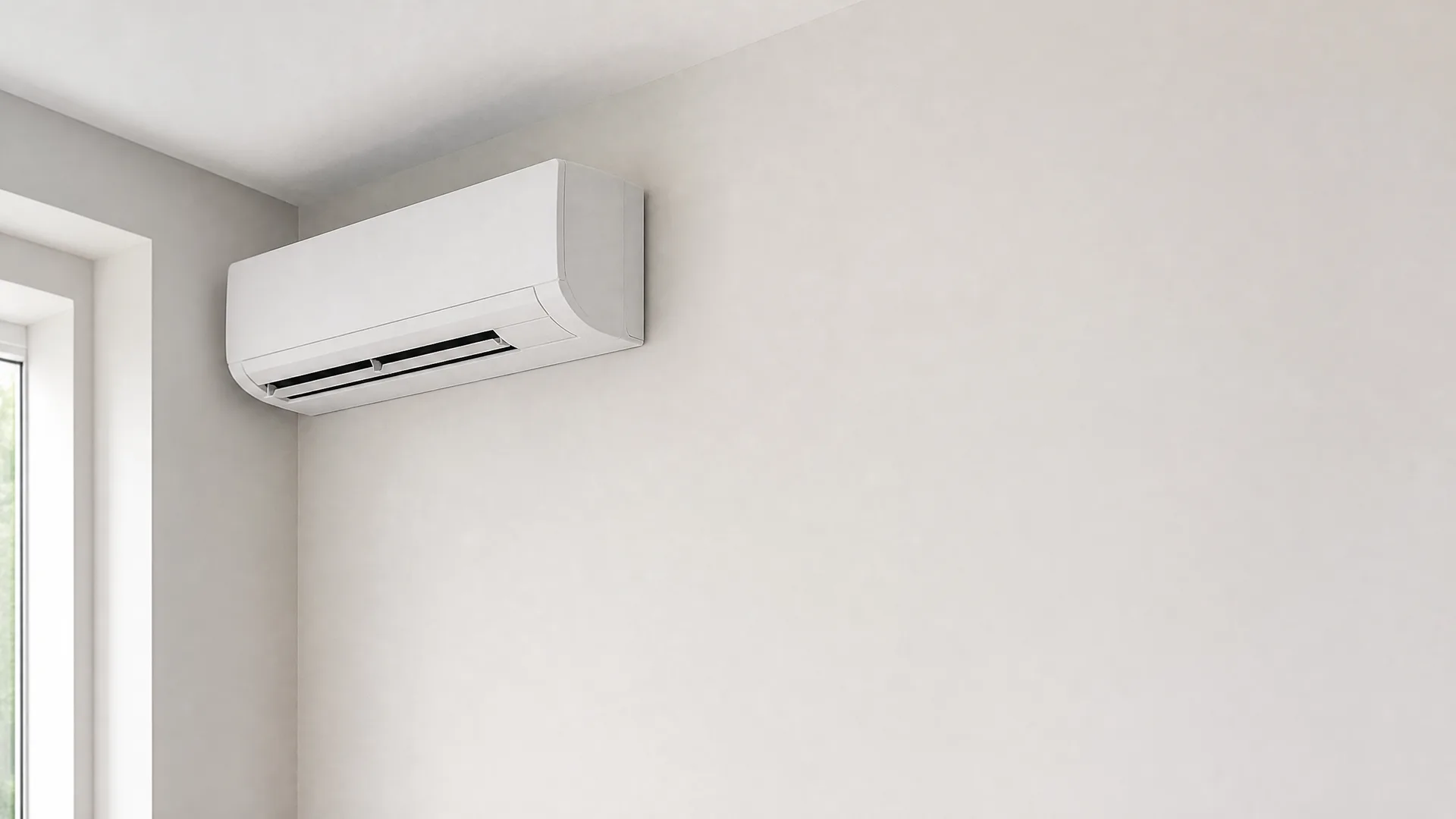
A white wall-mounted mini-split air conditioner installed high on a plain light-colored interior wall near a corner, with a window frame at the left edge.

How a mini split makes heat

A mini split doesn't burn anything to heat your home. The outdoor unit pulls heat out of the cold air outside and moves it in through the refrigerant line to the indoor head. Below freezing there's less heat in the air to grab, so the system has to work harder and run longer to hold the same temperature. That's normal. What's not normal is warm air stopping altogether or the outdoor unit icing over and staying that way.

A white wall-mounted mini-split air conditioner installed near the top of an interior corner wall, with large blank light-colored wall space to the left.

Why defrost cycles matter here

New York winters put a mini split through repeated freeze and thaw as temperatures swing through the day. Every so often the outdoor unit has to pause and run its defrost cycle, melting off the frost so the coil can keep pulling heat from the air. If a sensor or a reversing valve isn't doing its job, that cycle doesn't complete and ice builds up faster than it clears. That's often the difference between a system that struggles and one that quits.

Is your mini split running but your house still feels cold?

You check the indoor head and the fan is on, but the air coming out is room temperature or cooler. The living room never quite gets warm no matter where you set the thermostat. The outdoor unit might be caked in ice, or you hear it cycling on and off more than usual. Some rooms stay colder than others if you're running more than one head. With gas heat backing up most homes here, a mini split that stops pulling its weight usually just means your gas furnace or boiler picks up the load and your bill climbs. If the mini split is your only heat in that room, a prolonged cold snap with no output is worth acting on before pipes in that space get exposed to real cold.

A white wall-mounted mini-split air conditioner unit installed high on a beige interior wall below white crown molding, with a window and woven shade at the left edge showing green foliage outside.

Running clean

The indoor head sits near the ceiling, cover clear, air moving warm across the room. Nothing iced up outside, no odd smell, no noise beyond the usual hum. This is what your mini split looks like when the defrost cycle is doing its job and the filter isn't fighting it.


A dusty, stained white wall-mounted mini-split air conditioner indoor unit installed high on a plain off-white interior wall near the ceiling.

Dust built up

That gray film across the indoor unit is more than looks. Dust packed into the coil and filter blocks airflow, so the head can't move heat into the room even when the outdoor unit is running fine. A unit that looks like this is usually working harder for less heat.

A white wall-mounted mini-split air conditioner indoor unit with dark louvered vents, installed near the ceiling on a beige wall below white crown molding.
Before you get your mini split repair
A white wall-mounted mini-split air conditioner on a beige interior wall, with a window at left showing trees and a wooden fence, and dark wood flooring below.
After you get your mini split repair

Call a repair tech

A local tech who works on mini splits all winter knows which part usually fails in weather like this. One company gets your call, not five, and you get one tech out to look at it.

Find a licensed pro

Wait it out

If it's just a defrost cycle struggling through one cold night, it might catch up on its own. If the coil stays frozen, you're heating with a unit that can't keep up until someone opens it up.

Find a licensed pro
A bearded man in a plaid flannel shirt looks out a window at snow-covered conifer trees, with a steaming ceramic mug on the sill and wooden shelves holding dishes and a plant behind him.
A smiling bearded man in a green t-shirt sits on a gray sofa, looking down toward a device at the bottom of the frame, with a bookshelf and a green plant blurred behind him.
A white wall-mounted mini-split air conditioner on a light gray wall above a gray sofa with cushions, with a framed abstract artwork at right, a wooden door and potted plant at left.

Get the right pro for your mini split

Only one pro gets your request, so you hear from one company.

Describe your mini split job, and a local pro who handles it gets in touch.

Find a local pro

No fee to send it, and nothing to sign.

Power costs 26.39 cents per kilowatt-hour statewide

At that rate, a mini split struggling to heat and running longer to catch up shows up fast on your bill. A tech who can get it back to heating normally, instead of straining through another cold snap, is worth having out sooner rather than later.

EIA-861 2025 statewide residential average

A dim room with a wall-mounted mini-split air conditioner above a faint vertical stain running down the wall, a folded grey towel on the wood floor at the baseboard, and a desk with monitor, lamp, small plant and office chair by a window.

It's late August, and you're at the desk in your home office trying to get through the afternoon. The AC's been on since noon. You notice the carpet under the mini split feels damp before you see why. A streak runs down the wall below the indoor unit, dark against the paint, and water has pooled enough that you've laid a towel under it. The unit is still blowing cold air, steady as ever. You stand there a second, towel in hand, looking up at the case like it'll tell you what's dripping and from where.

A woman in a cream sweater and jeans stands in an open black front door of a white stucco house, viewed over the shoulder of a man in a navy jacket in the foreground.

What's happening inside during the defrost cycle

When the outdoor unit gets coated in frost, it has to stop and melt it off before it can keep pulling heat from the air. To do that, it reverses itself for a few minutes, running like an air conditioner in reverse to send heat out to the coil instead of into your house. That's why the indoor head can blow cool air for a bit even though nothing's broken, it's partway through clearing the coil. The reversing valve, the defrost sensor, and a small board that times the whole thing all have to work together for this to go smoothly and switch back to heating when it's done.

If any one of those sticks, the cycle doesn't end on its own. The valve stays in cooling mode, the sensor misreads the coil temperature, or the board never gets the signal to switch back. A local tech who works on these systems through the winter has usually already seen which part lets go first in weather like this, and once you're matched with one, that's the question they're there to answer for your unit, not every make they've ever touched.

Interior corner of a living room with a sheer-curtained window, a light wood console table holding a vase of greenery and a shallow bowl, a woven basket on the lower shelf, and a blurred upholstered sofa and dark wood table in the foreground.
A two-story house with beige siding, white-trimmed windows with shutters, and a small covered porch, fronted by a mowed lawn and a wet concrete walkway leading to the sidewalk, with leafy trees and hedges on both sides in low golden sunlight.

Summer humidity here runs high enough that the average dew point sits at 62°F across June, July and August, according to NOAA climate data. That's the kind of air that feels heavy even when the temperature itself isn't that bad. Your mini split spends those months pulling moisture out of the air as much as it cools it, and the indoor coil stays wet for hours at a stretch. That's unrelated to winter heating trouble, but it means the same system doing double duty each summer is the one you're asking to switch over and run a defrost cycle correctly every time a cold snap hits.

NASA POWER T2MDEW county cells weighted by homes

A white wall-mounted mini-split indoor unit installed high on a gray interior wall, with a window at left and part of a light gray sofa with a dark cushion at lower right.
Warm air moving steadily from a clean indoor head, with nothing iced up on the unit outside.
A white wall-mounted mini-split air conditioner indoor unit with visible dust and staining along its lower vent, installed on a plain pale wall.
Dirt and mold built up along the vents mean the unit is working harder and moving less heat into the room.

A mini split that won't heat in the cold usually comes down to a defrost cycle that isn't finishing, a low refrigerant charge, or a sensor telling the system something that isn't true. None of those fix themselves by waiting through another cold snap. A local tech who services mini splits all winter has seen these same symptoms on other units in your area and knows which of the three to check first, instead of working through a list from scratch. You'll be matched with one licensed contractor near you, not a handful of companies competing for the callback, so the person who shows up is the one who takes the job. Get the heat pump checked, get the part that's failing replaced, and the indoor head goes back to doing what it's built to do: pull warmth out of cold air and move it into your living room, even when it's well below freezing outside.

Sunlight falls across a cream-colored interior wall corner with white baseboard molding, a wood floor, a woven rug edge, a wooden furniture leg at left, and a window showing green foliage outside.
Empty room corner with beige walls, white baseboards, a white-framed window at upper left showing green foliage, and sunlight falling on a wood plank floor.
A corner of a room with beige walls, a window at left, a wooden two-door cabinet holding a pale ceramic vase with leafy branches, and a woven jute rug on a wood floor.
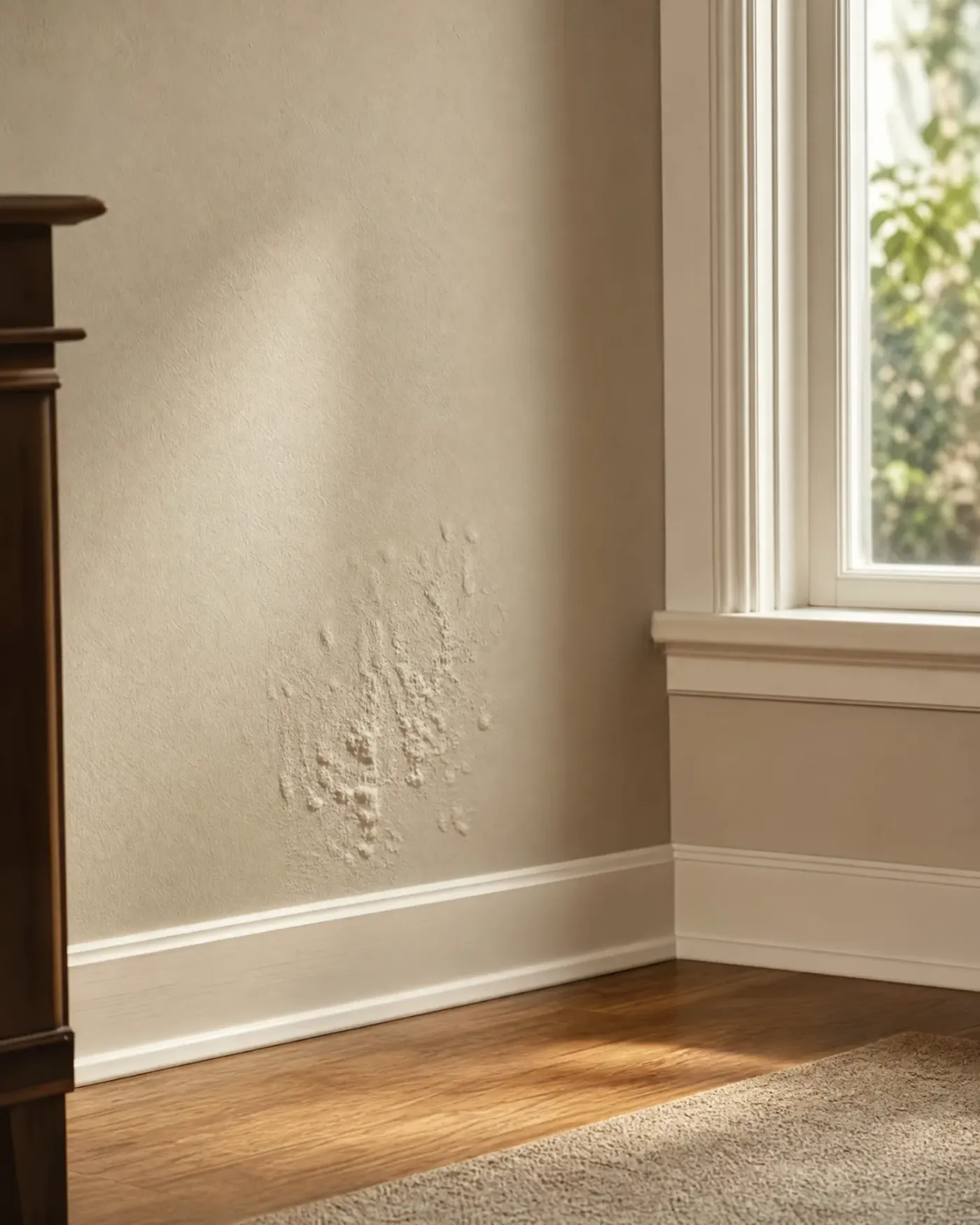
Interior room corner with a beige textured wall showing a patch of blistered, bubbled paint above white baseboard, next to a white-framed window with greenery outside, wood flooring and carpet edge below.
Empty room corner with beige walls, white baseboards, two windows with sills showing green foliage outside, and sunlight patterns on a wood plank floor.

A pro who works on mini splits

Your request stays with one local pro.

Get a licensed local pro

Sending the form costs nothing.