
No phone calls to make
Why your mini split isn't cooling in New York
A mini split that won't keep up when it's humid out usually comes down to one of a few things: low refrigerant, a dirty coil, a clogged filter, or an outdoor unit that's struggling. This page gets into what's behind each one. Skip the search for a contractor, the back and forth calls, and retelling the problem from scratch. One licensed New York tech who knows this equipment takes it from here.
Start one formA mini split that runs but doesn't cool usually isn't making enough cold air, or it's making cold air that never reaches the room. Low refrigerant is a common cause. A mini split doesn't use up refrigerant the way a car uses gas; if the level is low, it's because the system is leaking, and a unit low on refrigerant will run constantly without bringing the room down to temperature. A dirty outdoor coil does something similar, it can't shed heat fast enough, so the unit works harder and still falls behind. A clogged filter cuts off airflow at the indoor head, so even a healthy system blows weak, lukewarm air. In New York, where summer humidity pushes a struggling system harder than dry heat would, any one of these shows up fast as a room that just won't get comfortable no matter how long the unit runs. Figuring out which one it is means getting eyes on the system, not guessing from the symptoms alone.




Cooling a room is really two jobs happening at once. Inside, the blower wheel pulls air across a cold coil, and that coil needs to be clean to pull heat out of the air efficiently. Outside, the condenser coil has to dump that heat into the outdoor air, which only works if air can move freely through it. A filter clogged with dust or pet hair cuts down how much air reaches the indoor coil, so the compressor keeps running while the room stays warm. The outdoor fan motor is what keeps air moving across the condenser coil, and if it slows down or quits, the compressor can overheat and shut itself off mid-cycle. Refrigerant moves between the two units through a line set, and a kink or a loose flare fitting is usually where it starts to leak out slowly. There's also a thermistor inside the indoor unit that reads room temperature and tells the system what to do next. If it's reading wrong, the unit may think the room is already cool when it isn't.
How a mini split actually cools
- The indoor head has a blower wheel that pulls room air across a cold coil, and a coil caked with dust slows that airflow before it ever reaches the compressor.
- A clogged filter forces the system to work against itself, so the compressor runs while the room barely feels it.
- Outdoor units pull warm air across a condenser coil to dump heat from your home outside, and a coil packed with cottonwood or grass clippings can't release that heat properly.
- The line set between the two units carries refrigerant, and a kink, a rub point, or a bad flare fitting at either end is where a slow leak usually starts.
- A mini split's outdoor fan motor has to keep spinning to move air across that condenser coil, and a failing motor means the compressor overheats and cuts out before it finishes a cycle.
- The thermistor inside the indoor unit reads the air temperature and tells the system when to ramp up or down, and a thermistor reading wrong can make the unit think the room is already cool.


One form, no calling around

The pro who reaches out is licensed in New York.
You only hire the pro if you want to.
The outdoor unit needs clear air
The outdoor unit pulls in air, pulls heat out of your home into it, and pushes it back out. If it's boxed in by a fence, pressed against siding, or sitting where a dryer vent blows on it, it can't dump that heat. It works harder, runs longer, and still loses ground once the heat and humidity outside climb through July and August.
Line set connections can leak slowly
The refrigerant line between the indoor head and outdoor unit connects with a flared fitting at each end. If one wasn't torqued to spec when the system went in, or a line gets kinked or rubs against something over time, it leaks slowly. You won't see a puddle. You'll just notice the house staying warmer each week until a gauge set finds where it's losing charge.
Is your mini split running all day but never catching up?
You notice it most in the late afternoon, when the room stays warm no matter how long the unit has been on. The air coming out feels weak instead of cold. The outdoor unit might be running constantly, and you can hear it, but the room doesn't follow. Some rooms feel damp even when the thermostat says it's at the temperature you set. A unit that runs without catching up is still pulling power the whole time, so your bill reflects hours of work the house never benefited from. Left alone through a full New York summer, that's a lot of running for not much relief.
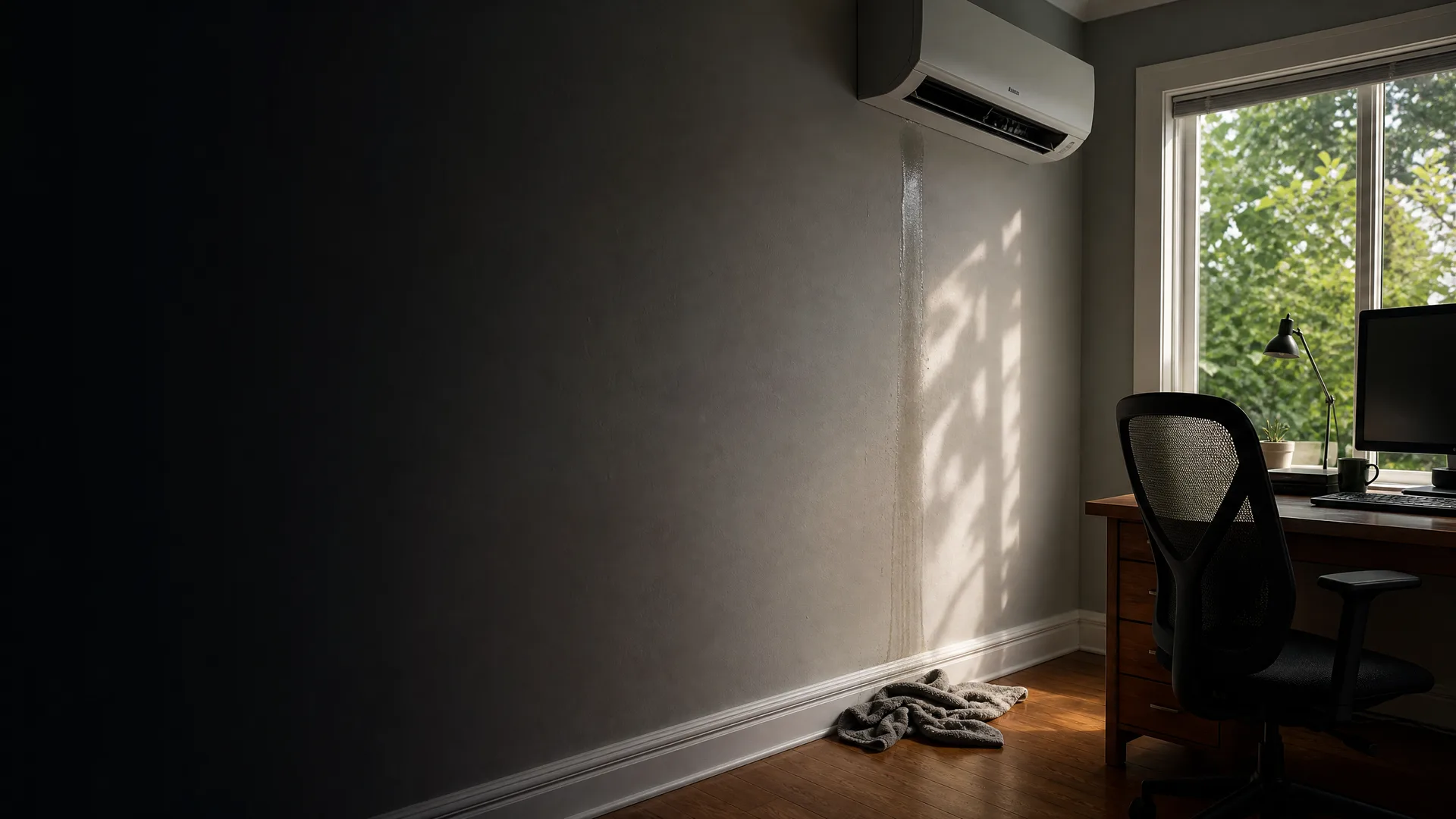
You've been at the desk since lunch, laptop open, the mini split clicking away above the window. By three the air feels thick again, the kind of sticky that New York summers sit on a room. You look up because something's dripping. A wet streak runs down the wall below the indoor unit, dark against the paint, and it's already reached the baseboard. You grab a towel from the hall bathroom and press it against the wall, then lay it on the floor under the drip. The unit is still running, still blowing, but the air coming off it doesn't feel cold anymore. You stand there a second, towel underfoot, trying to remember if it did this last summer too.
Power costs 26.39 cents per kilowatt-hour statewide
A mini split that's low on refrigerant or straining to push air has to run longer to get a room cold, and at 26.39 cents per kilowatt-hour that extra runtime shows up fast on your bill. A unit working right shouldn't need to run all day to keep up.
EIA-861 2025 statewide residential average

A mini split that won't catch up has a reason behind it
Weak cooling almost always traces back to one thing: refrigerant that's lower than it should be, a coil or filter choked with dust, or an outdoor unit that can't get rid of the heat it's pulling out of your room. Each of those has a different fix, and a tech who works on mini splits all summer can tell which one you've got pretty quickly once they're looking at the unit.
If yours has been running long hours without the room ever feeling right, that's worth having checked rather than waited out. Finding someone qualified usually means calling around, explaining the same problem more than once, and sorting through quotes to see who actually knows this equipment. Here you'd be matched with one licensed New York contractor who services mini splits regularly, so you make one call and talk to one person who already knows what tends to go wrong with these systems.



Mini Split Repair
Skip the search
Only one pro gets your request, so you hear from one company.
