How often to clean a mini split in Yonkers, NY

Your mini split tune-up request goes to a pro who covers Westchester County.

Connect with a pro

A mini split should get a professional cleaning once a year, with the filters checked more often than that. In Yonkers, most homeowners run the system for cooling from spring into early fall and switch it over for heat through the cold months, so the indoor coil and filters are working nearly year round. Dust and pollen build up on the filters over the summer, and if they're not rinsed every few weeks, airflow drops and the unit has to work harder to keep up. The outdoor unit collects leaves and grime too, especially once it starts handling heat duty in winter. A yearly cleaning clears what the filters miss, the coil fins and the drain line, so the system keeps pulling the moisture out of the air in summer and the heat out of the cold air in winter without strain. Skip it a couple years running and you'll likely notice weaker airflow or higher bills before anything actually breaks.

A white wall-mounted mini-split air conditioner installed near the ceiling on a light-colored interior wall, with a window and green foliage visible at the left edge.

A clean unit

Air moves through the vents without resistance. The coil stays white, the intake grille is clear, and the room cools or heats evenly from one side to the other. This is what a mini split looks like right after a filter check and a yearly cleaning.

A dusty white wall-mounted mini-split air conditioner indoor unit installed high on a beige interior wall below a white ceiling and trim.

A unit overdue

Dust has built up across the intake grille and into the vents. Airflow is choking down, so the unit runs longer to reach the same temperature. Left this way, the coil underneath collects the same grime and loses its ability to transfer heat.

Why does a mini split need that much upkeep here?

  • Cooling runs June through August

    Three months of cooling still means a season's worth of dust pulled into the filter before the system shuts off for fall.

  • Heat runs October through May

    Eight months of heat means the unit runs more hours a year than it cools, so a dirty coil costs you longer than you'd think.

  • Power here costs 24.45 cents per kilowatt-hour

    At 24.45 cents a kilowatt-hour, a clogged filter or dirty coil making the system work harder shows up fast on the bill.

NOAA nClimDiv 1991-2020 · EIA-861 2025

Inside the Unit, Step by Step

  • Dust and lint settle on the indoor filter first, so airflow drops there before you notice anything else.
  • Behind the filter, the evaporator coil picks up a thin film that insulation-like buildup won't wash off with water alone.
  • The blower wheel inside the indoor head collects grime in its fins, which throws moisture off balance and can cause a musty smell.
  • Outside, the compressor and condenser coil pull in leaves, pollen and grit through the cold months and need clearing before each cooling season.
  • A clogged condensate drain line backs up and drips inside the house instead of outside, often the first sign owners notice something's wrong.
  • Refrigerant lines and electrical connections get checked during a yearly visit, since a loose connection or low charge won't show up from the filter.

Air pulls in through the indoor filter first, so that's where buildup starts. Once the filter loads up with dust and lint, airflow drops before you'd notice any change in temperature. Behind that filter sits the evaporator coil, and what collects there is finer than what the filter catches. It forms a film that insulates the coil, and a damp cloth won't take it off. Past the coil is the blower wheel, the part that actually pushes air into the room. Grime builds up in its fins over time, and once it does, moisture off the coil doesn't move the way it should, which is where a musty smell often starts. Outside, the condenser coil and compressor sit exposed all year, through pollen in spring and leaves come fall, and that debris needs clearing before the unit works hard again. Underneath all of it runs the condensate line, draining water the system pulls out of the air. When that line clogs, water backs up and finds its way inside instead of out, and for a lot of owners that's the first real sign something's off. None of this shows up by looking at the filter alone. A yearly visit also covers the refrigerant line and the electrical connections, since a connection working loose or a charge running low won't show itself until the system's already struggling to keep up.

A white wall-mounted mini-split air conditioner on a light gray wall in an empty room with dark wood flooring, white baseboards, a tray ceiling with recessed lights, and a window at the left.
Air flows freely from the vent and the room reaches temperature without the unit straining to get there.
A wall-mounted mini-split air conditioner indoor unit with a yellowed plastic casing and dark horizontal vent louvers, installed on a plain light-gray wall.
Dust sits thick on the top casing and dark residue rings the vents, a sign the filter and coil are overdue.
An older woman with gray hair in a cream knit sweater sits under a blanket on a sofa by a window, looking outside toward yellow-leaved trees, with a lamp, shelves and an armchair in the room behind her.
A gray-haired woman in a chunky knit sweater sits in an armchair with a blanket, looking out a window at yellow autumn foliage, with bookshelves and a potted plant behind her.
A gray-haired woman in a navy sweater sits in an armchair with a knit blanket beside a window, looking out at yellow autumn foliage, with a dining table and houseplant in the room behind her.
A gray-haired woman in a gray cowl-neck sweater sits in an armchair with a blanket, looking out a dark-framed window toward yellow autumn trees.

Get matched with a mini split pro in Westchester County

A mini split that runs nine or ten months a year in Yonkers doesn't give you much of an off season to fall behind on. By the time you notice the room isn't cooling evenly or the unit is running longer to hit the same temperature, dust has already worked past the filter and onto the coil, and that's a cleaning a filter rinse won't fix. Westchester power rates make a straining unit an expensive thing to ignore, and a coil left dirty through another cooling season only builds on itself. A local contractor who services these systems all year knows which models in this area clog fastest and what tends to fail first when they're overdue. Getting matched with one means you're working with someone who already knows the equipment, not explaining your situation from scratch to whoever picks up. If your filter looks heavy or the airflow feels weaker than it did last spring, that's the sign to stop waiting on it.

A white wall-mounted mini-split air conditioner unit installed high on a light gray interior wall below crown molding, with a bamboo-shaded window at the lower left.

Running clean

This is what a mini split looks like when it's kept up. The casing stays white, the vanes open and close without catching, and the room next to the window reaches temperature without the fan working overtime to get there.

A wall-mounted mini-split air conditioner indoor unit with a dusty, discolored cover, installed near the ceiling on a plain light-colored wall.

Overdue for service

Dust has built up on the casing and darkened around the vents. The unit behind that panel is pulling air through a dirty filter and a coated coil, so it runs longer and moves less air than it did when it looked like the first one.

Why does the room by the window feel off lately

You might notice the air from the vent feels weaker than it used to, or the room takes longer to reach the temperature you set. Some homeowners catch a musty smell when the unit first kicks on, which usually means moisture sitting on a dirty coil. Others see a faint ring of dust around the vents or on the casing near the filter. None of this means the unit is broken. It means air isn't moving through it the way it should. Left alone, the system works harder to do the same job, and in a house that runs this unit most of the year, that adds up on the power bill before anything actually fails.

  1. The filter screen comes out first and gets rinsed clean

  2. The indoor coil gets sprayed with a cleaning solution

  3. The blower wheel gets wiped or brushed free of dust

  4. The condensate drain line gets flushed so it drains freely

Cooling runs June through August

Three months of cooling is only half of what your mini split does each year. It also carries the heat load through a Westchester winter, so most of its hours and most of its dust come from that side, not the summer side.

NOAA nClimDiv 1991-2020

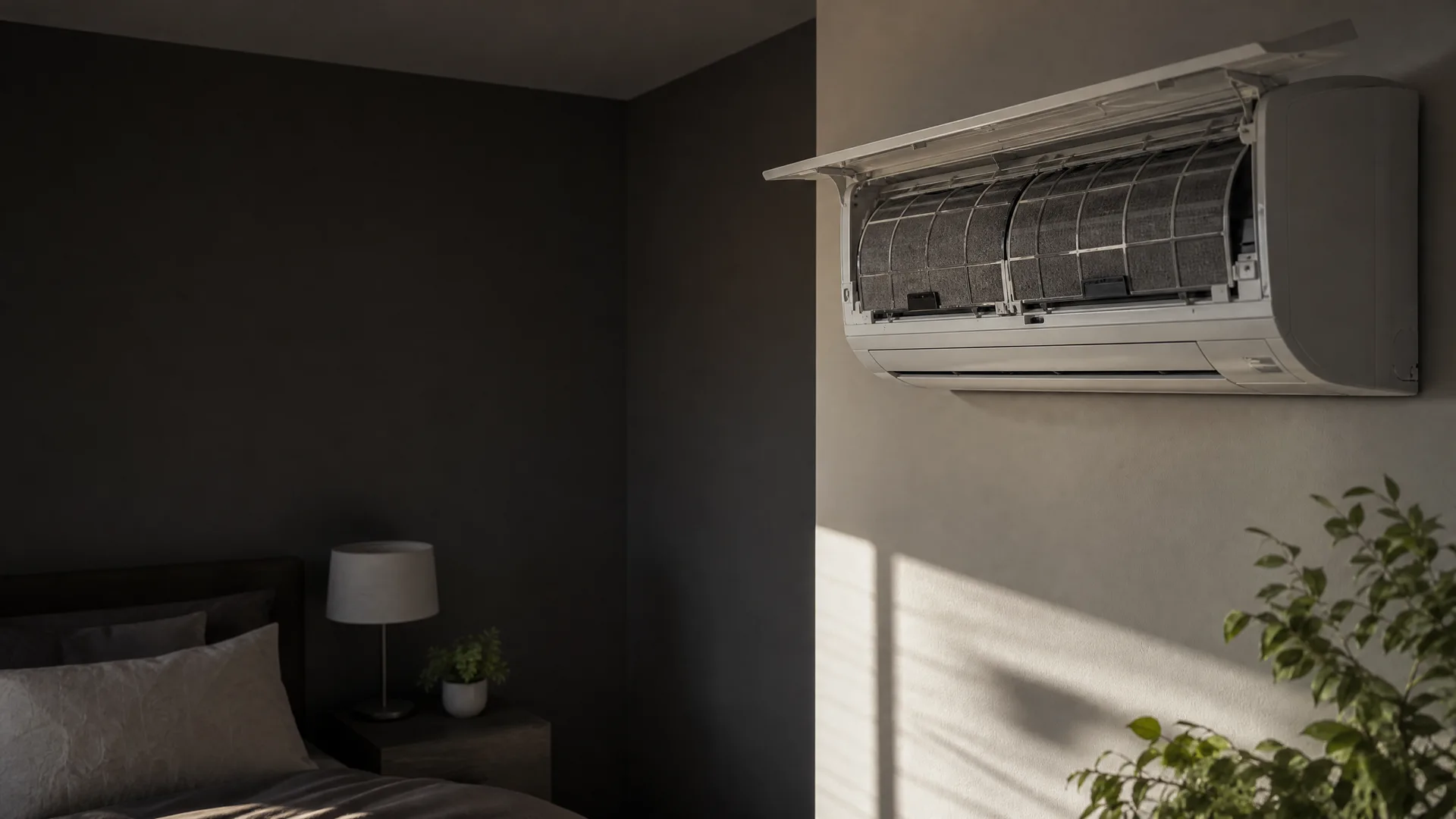
A wall-mounted mini-split air conditioner with its front cover open exposing the filters, in a dim bedroom with a bed, nightstand lamp and a potted plant.

Late April, and the bedroom still holds a chill from the night before. You pull the front cover off the mini split to see why it's been blowing weaker than it should, and the filter screen behind it is gray with dust, matted enough that you can't see through the mesh anymore. The window's cracked an inch, first warm day of the year, and you'd meant to check this back in March before the heat switched over for good. The cover sits propped against the wall. Outside, someone two doors down is already running a mower. You hold the screen up to the light to see how bad it is before you decide whether rinsing it is enough or whether it needs more than that.


A man in a navy polo and khaki pants walks up a curved concrete path toward a stone-faced house where a woman stands in the open front doorway, with shrubs, flowers and potted plants flanking the entry steps under a cloudy sky.

Once a year, before the season that needs it most

A mini split in Yonkers runs long enough each year that once-a-year cleaning isn't a suggestion, it's what keeps the system working the way it did when it was new. Check the filter between visits. Have the coil, blower wheel, and drain line cleaned once a year by someone who does this work. That's the whole answer.

The part worth getting right is who does that cleaning. A system that runs nine or ten months a year in this area needs someone who already knows what shows up in a Westchester unit after a full winter of heat and a full summer of cooling, not a general call center matching you to whoever's free. When you request service through this page, it goes to one licensed local contractor who takes on mini splits in this area as regular work, and that contractor reaches out to you directly about your unit.

A gray upholstered sofa with a beige cushion and knit blanket beside a curtained window, with a white mug and a book on a dark wooden table in the foreground and a lit lamp in the background.
A woman in a cream knit sweater sits with eyes closed in a light upholstered armchair beside a window showing autumn foliage, with a ceramic mug on a side table and a lit lamp and shelves in the background.
An older man with gray hair and a beard, wearing a dark blue fleece zip jacket, leans back in an upholstered chair with his eyes closed in sunlight near large windows, with a potted green plant and bare trees behind him.

Mini Split Maintenance

Find a mini split maintenance pro in Westchester County

A licensed pro who works in Westchester County gets your request.

A black-framed smartphone standing upright against a plain light gray background, its screen filled with solid green.
Tune-up, service, or cleaningMini-splitWestchester County, NY
Step 1 of 2

What ZIP code is the job in?