A row of similar two-story wood-sided houses with gabled roofs and porches behind a white picket fence, with lawns and large shade trees.

AC Maintenance in Staten Island, NY

Tell us about the job

Takes about a minute. No obligation.

Tune-up, service, or cleaningCentral ACRichmond County, NY
Step 1 of 2

What ZIP code is the job in?

A gauge set tells a different story than a glance

A quick visit checks that the unit powers on and blows cold air, then moves on. A thorough one hooks up gauges to check the refrigerant charge, checks the capacitor's readings against what it should be putting out, and pulls the panel to look at the wiring and the contactor for burn marks. Cold air coming out of the vent can still mean a system running low on charge or wearing down a part that is about to fail.


What gets skipped is what causes the breakdown

The coil and the condensate drain almost never get touched in a rushed visit, and both cause real trouble later. A coil caked with dirt makes the whole system work harder to move the same heat, and a clogged drain backs up and shuts the unit down or leaks into the house. Pulling the blower to clean it and flushing the drain line take real time, which is exactly why they're the first things a quick tune-up leaves out.

4 months
June through September, your air conditioner is on duty
84°F
the average summer afternoon it cools against
4 hail events
in ten years, and hail bends the fins on outdoor coils
36 wind events
in ten years, and wind drives debris into outdoor units
Isometric line illustration of a cutaway single-story building showing interior rooms, ceiling ductwork, an indoor air handler, and an outdoor condenser unit connected by a line set.
Your air conditioner works hardest from June through August.

NOAA nClimDiv, 1991–2020 normals

The filter is the one part of this system the homeowner controls.

A filter clogged with dust makes the blower work harder and starves the coil of airflow, so check it every month and swap it when it looks gray.

A system running hard in 84 degree heat costs more here than almost anywhere else

Power here costs 36.97 cents per kilowatt-hour
Cooling runs June through September
Summer afternoons average 84°F
June is when it starts working. May is when to check it.Homes in Richmond County run cooling from June through September.

A system doesn't usually give out all at once. It starts short cycling, shutting off a few minutes after it kicks on, because a dirty coil or a weak capacitor makes it struggle to keep up and it trips off before it finishes a run. It starts running longer than it used to just to hit the same temperature. The air coming out of the vents feels warmer than it should, or weaker, even though the thermostat says it's working. Sometimes there's a smell when it first kicks on, or a new rattle or hum that wasn't there before. Any one of these means something inside is already wearing down, even if the system still turns on and blows air.

A tune-up pays for itself here

A neglected system uses more power, and power costs more here. A tune-up pays for itself.

Find a contractor
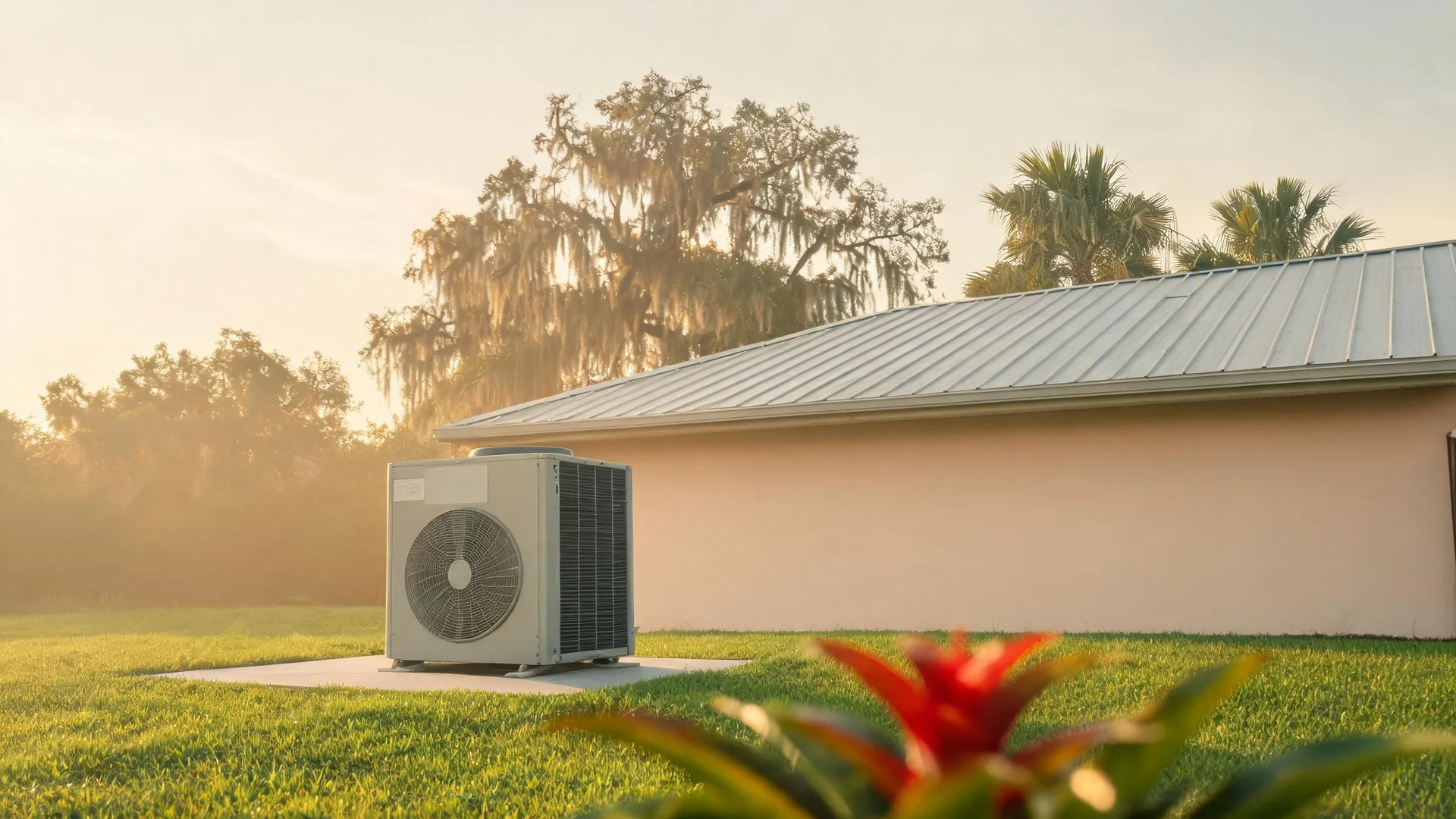
An outdoor residential air conditioning condenser unit mounted on a concrete pad, surrounded by gravel with a blue sky in the background.

Skip enough tune-ups and the system doesn't break. It wears out.

An air conditioner that never gets serviced doesn't fail on day one. It loses ground slowly. Dust builds up on the coil and the system has to run longer to move the same heat. The capacitor weakens and the compressor strains every time it starts. None of that shows up as a breakdown right away. It shows up as a system working harder than it should, for longer than it should, to do the same job it used to do easily. Left alone long enough, that strain is what takes out the compressor, and the compressor is the part that makes a repair into a replacement.

Airflow and heat exchange do all the work

The filter protects the coil, and the coil is where the heat actually leaves the house. Dust that gets past a dirty filter settles on the coil fins and blocks contact between the metal and the air moving past it. A compressor can be in good shape and still deliver a weak result if the coil underneath it can't shed heat the way it was built to.

The drain line decides how a failure shows up

Every AC pulls moisture out of the air, and that water has to go somewhere. The condensate drain carries it out through a line that can clog with algae or sludge over time. When it backs up, the system either shuts itself off on a float switch or the pan overflows and sends water into the house. A clean filter and a clean coil don't matter if the drain is the part that fails.

Aerial view of a square outdoor air conditioning condenser unit on a concrete pad beside a house wall with a sliding glass door.

Book your AC tune-up in May, before homes here start needing cooling in June.

  1. Jan
  2. Feb
  3. Mar
  4. Apr
  5. May
  6. Jun
  7. Jul
  8. Aug
  9. Sep
  10. Oct
  11. Nov
  12. Dec

A tune-up checks the refrigerant charge, cleans the coils, tests the capacitor and tightens the electrical connections.

A proper tune-up starts outside at the condenser, not at the thermostat. The fins on that outdoor unit have to be straight and clear, because bent or packed fins choke off the airflow the whole system depends on to dump heat. From there it's the refrigerant charge, checked against the pressures the system was built to run at, since too little or too much both make the compressor work harder than it should. The electrical side gets checked too: the contactor for pitting, the wiring for loose connections, the capacitor for weak output. A tech also checks that the blower spins freely and the motor isn't drawing more current than it should. None of this is guesswork. Every reading gets compared against a number the manufacturer set, and that's what tells a tech whether the system is fine or just hasn't failed yet.