







White colonial houses with lit windows photographed at dusk along a tree-lined residential street.

AC Maintenance in Glens Falls, NY

Tell us about the job

Takes about a minute. No obligation.

Tune-up, service, or cleaningCentral ACWarren County, NY
Step 1 of 2

What ZIP code is the job in?

Glens Falls asks less of an air conditioner than most places do. July is the only month it really has to work, and even then the afternoon high averages 77 degrees. A system earning its keep for a few weeks a year isn't under the same strain as one running most of the summer. That doesn't mean it takes care of itself. A capacitor weakens, a coil picks up dust, refrigerant seeps out slowly, and none of that depends on how hard the unit ran. A yearly check catches those before they turn into a system that won't start in July.

1 months
July through July, your air conditioner is on duty
77°F
the average summer afternoon it cools against
7 hail events
in ten years, and hail bends the fins on outdoor coils
192 wind events
in ten years, and wind drives debris into outdoor units
Isometric cutaway illustration of a single-story house showing interior rooms with furniture, overhead ductwork, an indoor air handler unit, and an outdoor condenser unit connected by lines at the side of the building.
Your air conditioner works hardest from July through July.

NOAA nClimDiv, 1991–2020 normals

July is the only month cooling really matters here.

Get the check done in June, so nothing's wrong with it when July arrives.

Weather here is hard on power, not on your AC

265 severe weather events from 2015 to 2024
11% of homes statewide lost power a day or more in 2024
192 damaging wind events from 2015 to 2024
One check a year covers it hereNew York ran 24.43 cents a kilowatt-hour in 2024, so a weak capacitor costs you before it fails

Half the homes in Warren County were built in 1973 or earlier. If yours is one of them, your air conditioner may not be the house's first one. Old age in a system rarely shows up as one big failure. It shows up as a part giving out here and there, a weak capacitor, a worn contactor, a coil that isn't pulling heat like it used to. A yearly check is how a contractor catches those before they take the whole system down with them. If your system came with the house, it's worth finding out how old it actually is.

Get it checked before July needs it

A yearly check before June is a small job either way. On a system that only has to work in July, it's an easy one to put off. That's how a weak capacitor or a dirty coil turns into a system that won't start when it's needed.

Find a contractor
A man in a cap, dark jacket and tan work pants carries a worn canvas tool bag up concrete steps toward a dark green paneled front door of a house with horizontal siding and a potted shrub.
A gray residential air conditioning condenser unit mounted on a concrete pad outdoors, surrounded by green grass under a partly cloudy blue sky.

Know its age before the check

Find out how old your system actually is before this year's check. A contractor who knows the age knows what to look for. On a system that's been running for decades, this year's visit is as good a shot as any at catching the part that's about to go.

The filter is doing more than cleaning air

A clogged filter starves the coil of airflow. The coil gets too cold, moisture on it freezes instead of draining, and ice builds up along the refrigerant lines. Once that happens the system can be low on airflow and still look like it has a refrigerant problem. Swapping the filter is the simplest thing anyone can do for this machine, and it's also the thing most likely to get forgotten.

The drain line decides where the water goes

Every bit of humidity the coil pulls out of the air has to leave the house somehow, and that's the condensate drain's job. Algae and dust build up inside that line the same way they would in any drain that stays wet. When it backs up, the water doesn't just sit there, it finds the pan's overflow switch or it finds the ceiling below. Clearing that line during a yearly check is what keeps a clogged drain from becoming a soaked ceiling.

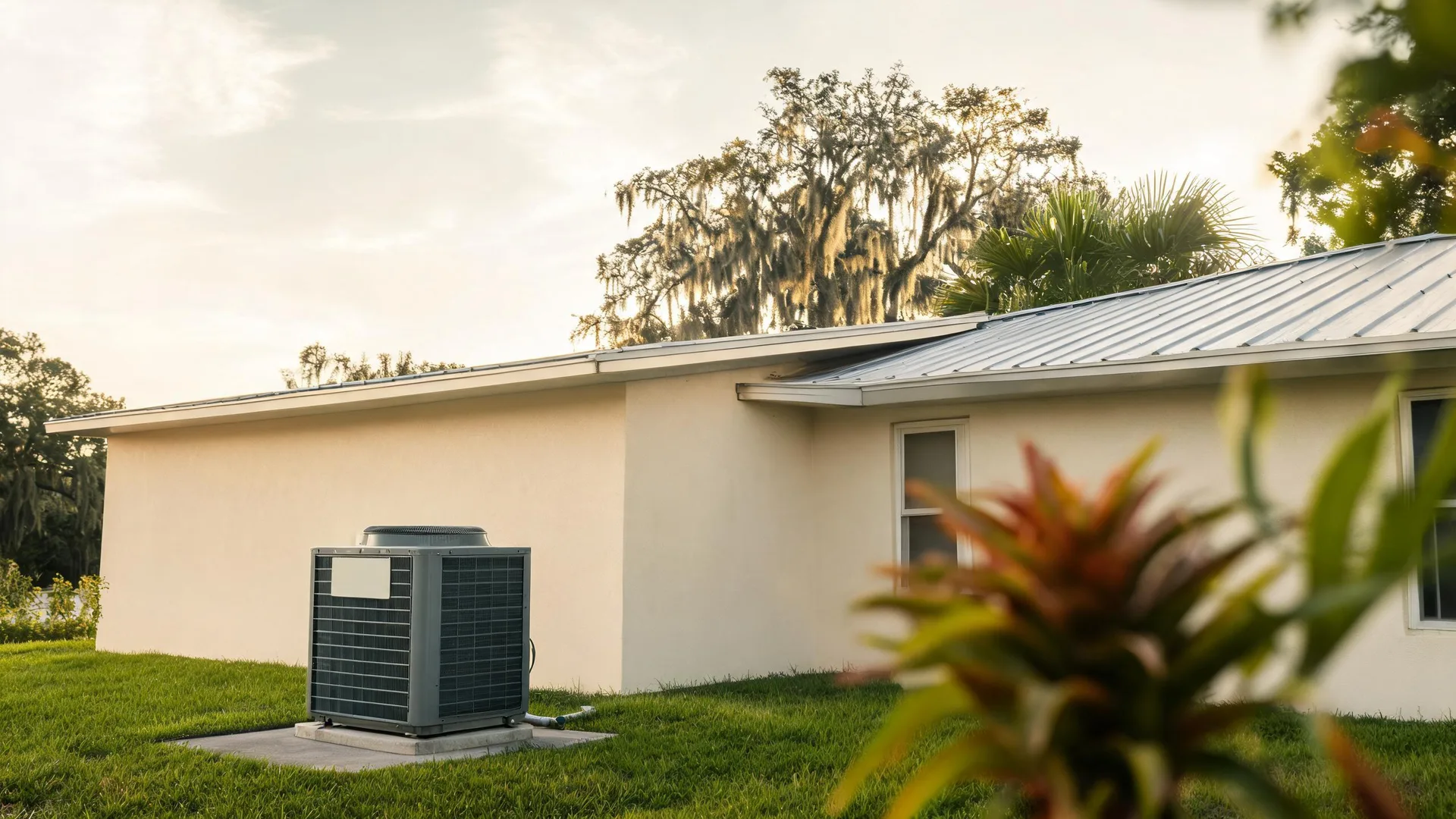
An outdoor central air conditioning unit mounted on a concrete pad beside a blue-sided house at sunset.

Book your AC tune-up in June, before homes here start needing cooling in July.

  1. Jan
  2. Feb
  3. Mar
  4. Apr
  5. May
  6. Jun
  7. Jul
  8. Aug
  9. Sep
  10. Oct
  11. Nov
  12. Dec

A tune-up checks the refrigerant charge, cleans the coils, tests the capacitor and tightens the electrical connections.

A tune-up starts outside at the condenser. A contractor cleans the coil, because dust and cottonwood matted against those fins make the whole system work harder to dump heat. The capacitor gets tested under load, not just looked at, since a capacitor can read fine sitting still and still fail the moment the compressor asks something of it. The contactor gets checked too, the switch that feeds power to the compressor and corrodes a little more every time it closes. Refrigerant charge gets checked against what the system actually calls for, because too little and the coil ices, too much and the compressor runs hotter than it should. Indoors, the blower wheel gets looked at for dust buildup, the filter gets swapped, and the drain line gets cleared so the coil has somewhere to put the water it pulls out of the air. None of these parts fail because the day is hot. They fail because nobody looked at them.