

Profile view of a bearded man wearing a dark baseball cap and a dark gray T-shirt against a plain off-white background.

Why your house is humid with the AC on in New York

RepairCentral ACNew York
Step 1 of 2

What ZIP code is the job in?

Why is my house still humid with the AC running in New York?

You keep the AC on all day, the house feels cool enough, but the air still feels thick and the windows fog up or the floors feel damp. In a New York summer that stays sticky for months, that's not something to live with until fall. An AC that cools but doesn't dry the air out usually has a specific problem behind it, and it's worth running down before it turns into a bigger repair.

An oversized or short-cycling system, or a dirty coil, is leaving the humidity behind

Your air conditioner only pulls moisture out of the air while it runs long, steady cycles. If it's oversized for the space, or short-cycling on and off, it cools the air fast and shuts off before it has time to wring the humidity out. A coil caked with dust does the same thing: it chills the air that passes over it but can't condense the water vapor the way a clean coil does. In New York, where summer humidity sits high for months at a time, that gap between temperature and comfort shows up fast. A system working correctly should leave the air feeling dry, not just cool. If yours isn't, something in the cycle or the coil needs a look before it runs that way all season.

A smiling man in a gray long-sleeved shirt stands in a kitchen looking to the side, with open shelves of dishes, a white mug on the counter, a potted plant, and a view through a doorway into a living room.
A smiling bearded man in a green sweater sits at a white marble kitchen island with a mug, potted plant and bowl of fruit, in a bright white interior with open shelving and an arched doorway.
A smiling man with dark curly hair and a beard, wearing a dark green knit sweater, stands at a white marble kitchen counter with a dark blue mug, with open shelving, pendant lights and a houseplant behind him.
A smiling man in a green ribbed sweater stands behind a wooden table holding a ceramic mug of coffee in a kitchen with white subway tile, shelves of potted plants, and a bowl of fruit.

Two Reasons Your AC Isn't Drying the Air

Oversized or short-cycling AC

  • An AC that's too big for the house cools the air fast and shuts off before it pulls the moisture out.
  • Short cycles mean the system never runs long enough to keep removing water from the air.
  • You'll notice the thermostat hits temperature in a few minutes, then the unit shuts off and starts again soon after.
  • A contractor can check the cycle length and the unit's sizing against the house.
  • This pattern can also wear on the compressor faster than a normal run cycle would.

Low refrigerant or dirty coil

  • A low refrigerant charge means the evaporator coil runs too warm to pull water out of the air passing over it.
  • A coil caked with dust does the same thing, since the air can't make good contact with the cold surface.
  • Either problem lets the AC blow cool air that never got dried out.
  • A refrigerant leak won't fix itself and will keep lowering the charge over time.
  • A contractor can check the charge against the system's specs and inspect the coil directly.
An outdoor air conditioning condenser unit on a concrete pad at the corner of a house, next to vinyl siding and a plain light-colored wall, with grass and a mulch bed in the foreground.

What a working system removes

A central AC pulls water out of the air every time it runs long enough. The coil gets cold, moisture collects on it, and a condensate line carries that water outside. On a muggy New York afternoon that line can carry several gallons over a few hours. If the coil never stays cold long enough, or the line is clogged and backing up, that water has nowhere to go and the air in the house stays wet.

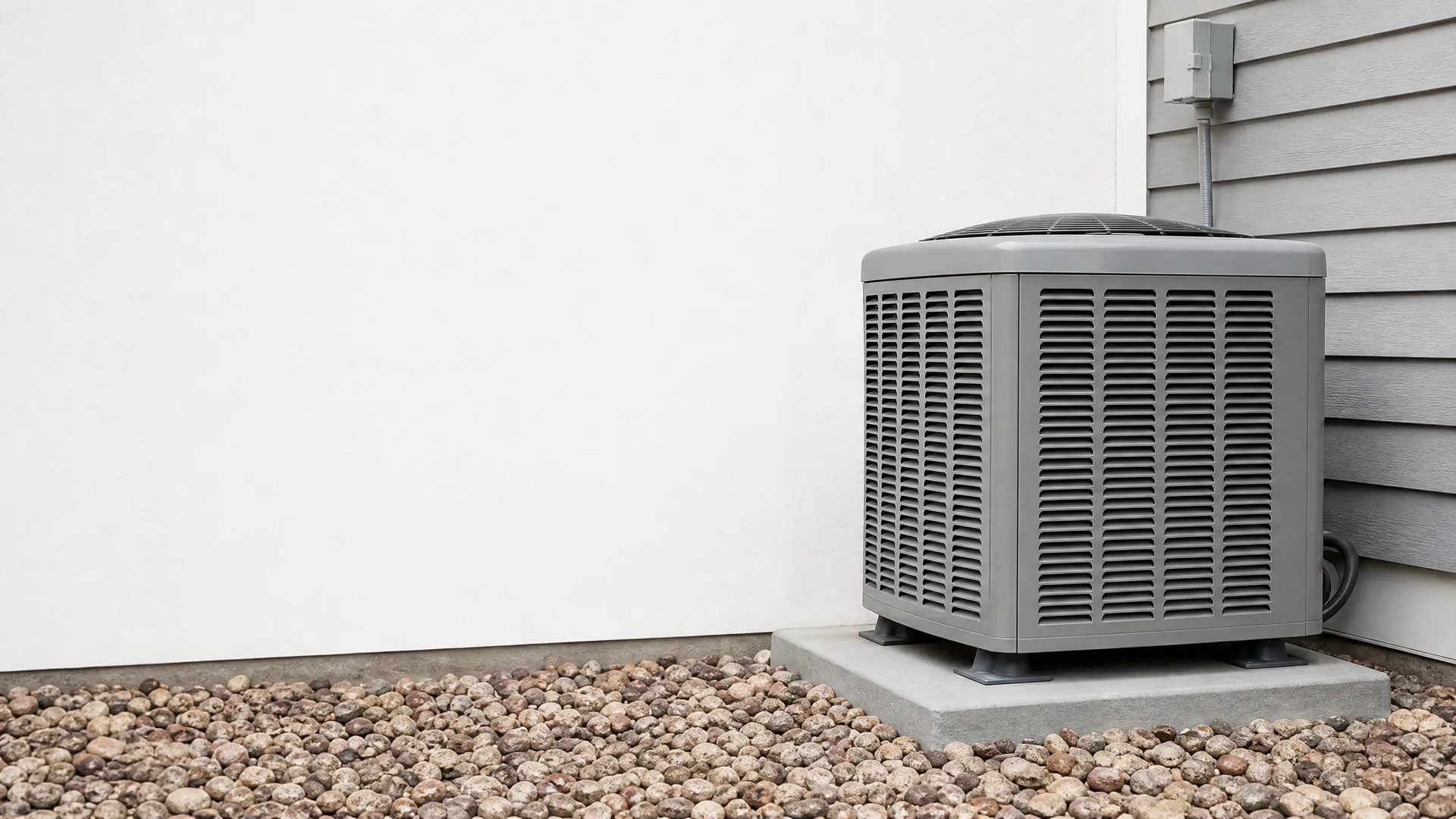
A gray outdoor air conditioning condenser unit sits on a concrete pad beside a white stucco wall and gray horizontal siding, surrounded by rounded landscaping gravel, with an electrical disconnect box mounted on the siding above.

Why the thermostat alone misleads

A thermostat only reads temperature, not moisture. It can say 72 degrees while the air still sits at 60 or 65 percent humidity, which is where sticky and damp start to show up on skin and floors. That's why the house can hit the number on the wall and still feel wrong. The fix isn't a lower setting. It's whatever is stopping the system from running long enough to dry the air it's already cooling.

What are you noticing around the house right now

The air feels heavy even in rooms the thermostat says are cold. Sheets feel damp when you get into bed. Wood floors feel tacky underfoot. Windows fog up on the inside, and mirrors in the bathroom stay clouded long after a shower. Clothes in the closet smell musty even though they're clean. You might notice a faint mildew smell in rooms that don't get much airflow, or see small dark spots starting on a closet wall or around a window frame. None of that means the AC is broken. It means the system is cooling the air without pulling the water out of it, and left alone through a New York summer, that moisture gives mold a place to start.

A gray outdoor air conditioner condenser unit on a concrete pad beside a house with horizontal lap siding, with a flowering shrub at left and a disconnect box with conduit on the wall at right.

The unit working as it should

A clean condenser running right sits level on its pad, lines wrapped, nothing blocking the airflow around it. It runs long enough to pull the moisture out along with the heat, and the house feels dry even when it's muggy out.


An outdoor air conditioner condenser unit on a concrete pad beside a house with light horizontal vinyl siding, surrounded by bare dirt, gravel and dry leaves, with refrigerant lines and conduit running along the wall.

The unit struggling to keep up

Leaves and dirt packed around the base choke off airflow to the coil. A unit working that hard can still cool the air without removing the moisture, and the humidity inside stays no matter how long it runs.

A closed dark laptop and a ceramic mug of coffee on a wooden dining table, with wooden chairs, a dark kitchen cabinet with cutting boards and a potted plant, and a leafy plant by a window in the background.

How the system is supposed to dry the air

Cold refrigerant runs through the indoor coil, and the air moving across it drops below the point where it can hold all its moisture. That water beads on the coil and drips into a pan, then down a condensate line and outside. That only happens if the air stays in contact with the coil long enough. A thermostat set low enough to run short cycles never gives the coil that time, so the water stays in the air and goes right back into the house.

A technician checks this by looking at run time, not just temperature. Low refrigerant charge, a dirty coil, or a blower moving air too fast across it all cut that contact time the same way. Finding that out on your own means pulling apart what you can see, calling around for someone who'll actually look at airflow and not just top off the refrigerant, and explaining the same symptoms twice. Once someone's lined up for you, that part is done.

Interior corner of a dining room with a round wooden table, a ceramic vase holding olive branches, a dark spindle-back chair near a curtained window, and a sideboard with a lamp against beige walls.
A man in a blue T-shirt sits on a light gray sofa, laughing while looking at an open laptop in the foreground, with a framed picture, lamp and potted plant behind him.
A bearded man in a blue and brown plaid flannel shirt stands indoors looking out a window at snow-covered trees, with a ceramic mug on the windowsill.
  1. Thermostat calls for cooling based on temperature, not humidity.

  2. Refrigerant chills the indoor coil below the air's dew point.

  3. Moisture collects on the coil and drips into the drain pan.

  4. The condensate line carries that water outside the house.

An outdoor air conditioner condenser unit sits on a concrete pad beside a stucco wall, with refrigerant lines and conduit running to the wall and a shrub to the left.
Before you get your air conditioner repair
A gray outdoor air conditioner condenser unit on a concrete pad beside a house with dark horizontal siding and a stone base, surrounded by gravel, with a flowering shrub at left and a concrete walkway in front.
After you get your air conditioner repair

Hand off the air conditioner problem

Describe your air conditioner job once, to one pro.

You only hire the pro if you want to.

Two-story house with beige horizontal siding, gray shingled gable roofs and a covered front entry, with an outdoor air conditioning unit beside it and a partly dry grass lawn in front under a clear blue sky.

A dew point is what tells you how heavy the air actually feels, more than the temperature does. Averaged across a New York summer, it sits at 62°F, according to NOAA climate normals. That's the air your AC has to work against every time it runs. At that level, a system that's cutting off too soon or struggling to keep up leaves plenty of moisture behind even while the house reads cold. You'll feel it as a kind of stickiness in rooms the thermostat insists are done cooling, and it won't let up on its own, because the air outside keeps feeding that same moisture back in through June, July and August.

NASA POWER T2MDEW county cells weighted by homes

A gray outdoor air conditioner condenser unit on a concrete pad beside a house with horizontal lap siding, with a wall-mounted disconnect box and conduit, mulch bed, shrub, and lawn nearby.
A properly sized system sits level, lines wrapped, nothing crowding the cabinet, running long enough on each cycle to wring the moisture out with the heat.
An outdoor air conditioner condenser unit sits on a gray pad beside a light vinyl-sided wall, on a concrete slab next to a gravel bed.
Conduit and lines run clean up the wall, but if the unit short cycles the air stays damp no matter how tidy the install looks.

What stops your AC from drying the air

  • A dirty blower wheel or a clogged filter cuts airflow across the coil, so it never gets cold enough to pull water out.
  • Low refrigerant charge keeps the coil from reaching the temperature where moisture actually condenses.
  • A condensate line clogged with algae or sludge backs up and can trip a float switch that shuts the system off.
  • An oversized system cools the air so fast it satisfies the thermostat before it runs long enough to dehumidify.
  • A failing thermostat sensor or bad wiring can cut cycles short even when the house still feels muggy.
  • Duct leaks pull in humid attic or crawlspace air before it ever reaches the supply vents.

A dirty filter chokes off airflow long before most people notice, and the coil can't pull moisture from air that isn't moving across it fast enough. Refrigerant matters just as much. If the charge is low, the coil never drops to the temperature where water actually condenses out of the air, so the system blows cool air that's still wet. Even when the coil is doing its job, the water it collects has to go somewhere. The condensate line can grow algae or fill with sludge over a season, and once it backs up far enough, a float switch is there to shut the whole system down before the pan overflows into the house. Sizing causes a different kind of problem. A system that's too big for the house cools the air fast enough to satisfy the thermostat in a few minutes, then shuts off, and a few minutes isn't long enough for the coil to pull meaningful moisture out, even though the room reads cold. Wiring and sensors can cause the same short-cycling from a different direction. A bad thermostat sensor can tell the system to stop before the house is actually dry, even on a day when the air feels heavy. Ductwork is the last place to check. A leak in a duct that runs through the attic or a crawlspace pulls humid air into the supply side before it ever reaches a vent, no matter how well the equipment itself is working.

Power costs 26.39 cents per kilowatt-hour statewide

At that price, a system that short cycles costs you twice. You pay to run it and you still end up with a damp house, because it never stays on long enough to pull the water out of the air. Letting it run longer isn't the fix if the problem is the unit itself.

EIA-861 2025 statewide residential average

A house that still feels damp with the AC running is telling you something specific: the system is cooling the air but not drying it, and that usually comes down to one part not doing its job, whether that's airflow across the coil, a low charge, or a clogged condensate line. That's a repair, not something a thermostat setting or a dehumidifier fixes for good. Finding someone to look at it is its own chore, searching for a contractor who works on your kind of system, calling around, explaining what the house feels like and what you've already noticed, then sorting through quotes that are hard to compare against each other. Sending the form here means you stop carrying that part. You've already done the harder work of noticing the damp sheets, the tacky floors, the fogged windows, and naming what's off. What's left is getting a licensed contractor to the house to find the part that's failing and fix it, so the air actually comes out dry the way it's supposed to.

A dark wood cabinet with a paneled door and a ceramic pot of green foliage on top stands in a beige-walled room with white baseboard, a window at left, hardwood floor, and a patterned area rug.
A dark wood glass-front cabinet holding folded towels, woven baskets and a ceramic vase stands in a bathroom corner beside a window, with a potted fern and stacked towels on top and a freestanding tub partly visible at left.
A woven basket holding a green cushion and a cream fringed knit throw sits on a wood floor in a room corner beside a window and a dark wooden cabinet.
Corner of a room with a dark wood cabinet topped by a round vase, a linen curtain at a window, white baseboard, oak plank flooring with sunlight patches, and a woven jute rug in the foreground.
A dark wood sideboard against a pale wall holds a shallow stone bowl and a round ceramic vase with leafy branches, with sunlight from a curtained window falling across the wall, wood floor and woven rug.

Finding a pro stops being your job

Fill out one short form instead of calling around.

Send it today

Asking costs nothing, and the choice to hire stays yours.