
14 SEER2
This is close to the federal minimum for New York. It costs less to install, but in a muggy summer running for months, the electric bill carries the difference year after year.
 Connect with a pro
Get in touch with a local installer about a new air conditioner.
Summers in New York get sticky, and your air conditioner has to work through it. If you're replacing it or putting one in for the first time, the SEER2 number on the unit tells you how much electricity it uses to do that job. A higher rating costs more upfront and less to run. With power here among the most expensive in the country, that tradeoff matters more than it does in a lot of other states.
There's a federal minimum for new central air conditioners, and it's higher in the South than it is here in the Northeast. But minimum doesn't mean best fit. The right rating for your house depends on the size of the space, how it's insulated, and whether the ductwork already in place can support a bigger, more efficient system without changes.
That's not something a rating chart on a webpage can tell you. It takes someone looking at your house, your current setup, and what you're trying to spend less of, either on the install or on the bill afterward.
Since most homes here heat with gas, the furnace and the air conditioner usually aren't tied together the way they are in an all-electric system. That gives you more room to choose the cooling side on its own terms, without the choice being boxed in by the heating equipment.
Send in a few details about your home and what you're looking to do, and a contractor who installs systems in New York gets matched to your situation and reaches out. You won't need to track down quotes or figure out which rating pencils out for your house on your own. That part moves to someone else once you submit the form.
You want a straight number, not a lecture on efficiency ratings. You're planning ahead for next summer, and you'd rather know what to ask for now than get talked into something at the last minute. Between the humidity and what you pay for electricity, you want the rating that actually makes sense here, not just the minimum the law allows.
New York requires new central air conditioners to meet a minimum SEER2 of 15.2, and that minimum is a reasonable target here, not just a legal floor. Your summers run humid enough that the unit will log real hours from June through September, and power here costs more than in most of the country, so the electricity it uses to do that work shows up on your bill. Going above 15.2 costs more upfront, and the higher you go, the smaller the gain gets for each extra point. For most homes here, a unit right at or a little above 15.2 covers the sticky months without paying for efficiency you won't use back.
Your old unit's SEER2 number gets checked against today's minimum
A contractor sizes the new system to your home's cooling load
You pick a SEER2 rating based on upfront cost against monthly savings
The installed system gets tested so it runs at its rated efficiency
If your air conditioner is older, you've probably noticed the electric bill climbs faster than it used to once the heat sets in. The unit might run longer to reach the same temperature, or cycle on and off more than it seems like it should. You may hear it straining on the hottest, stickiest days, or notice some rooms stay warmer than others no matter how long it runs. None of that means it's about to fail, but an older, lower-rated unit uses more power to do the same job as a new one, and in New York that difference shows up on the bill every month it runs.

The box fan is doing nothing except pushing hot air across the room. It's past eight and still bright out, that long June light that makes it feel earlier than it is, and the upstairs hasn't cooled off since the sun left it an hour ago. You've got the window open behind the fan and the bedroom door open too, trying to pull some kind of draft through the house, and all it's doing is moving the heat around. Downstairs the air conditioner is running, you can hear it, but it never seems to reach up here. You lie on top of the sheets and think about calling someone before next summer instead of fighting through another one like this.
You already know what New York power costs, and a sticky summer means that air conditioner runs for months straight, not just on the hot days. Every point of SEER2 above the minimum is electricity you're not paying for, month after month, for as long as the unit's in your house. That math only pencils out if the unit's sized right for your place and the install is done correctly, because a high rating on paper doesn't save you anything if the system's oversized or the refrigerant charge is off. That's the part worth getting right the first time rather than guessing at from a spec sheet. A contractor who knows New York homes can look at your cooling load, your current unit, and your budget, and tell you where the rating actually pays for itself versus where you're just spending more for a number. Send the request and let someone who does this for a living work out what fits your house before next summer gets here.
SEER2 is a ratio. It compares the cooling the unit produces over a season to the electricity it draws to produce it. A unit rated 16 puts out more cooling per watt than one rated 14. Nothing about the number tells you how big the unit is or how fast it cools a room. A correctly sized system at 15 SEER2 will keep a house more comfortable than an oversized one at 18, because a unit that's too big short cycles, shutting off before it pulls the moisture out of the air. In a muggy place that shows up as a house that feels cool on the thermostat and damp everywhere else.
The federal minimum for this region went up in recent years, and manufacturers stopped making anything below it. That's the floor a contractor is working from now, not a target. Units sold today start above where the market sat a decade ago, so even a basic replacement comes in more efficient than what it's replacing. Going higher than the floor is a separate decision from meeting it. One is required by what's for sale. The other is weighing a larger check now against a smaller one every month the compressor runs, which in New York is most of the summer.


This is close to the federal minimum for New York. It costs less to install, but in a muggy summer running for months, the electric bill carries the difference year after year.
Costs more to put in. Pulls less power out of the same sticky summer, and with New York electric rates, that gap shows up on the bill every month the unit runs.

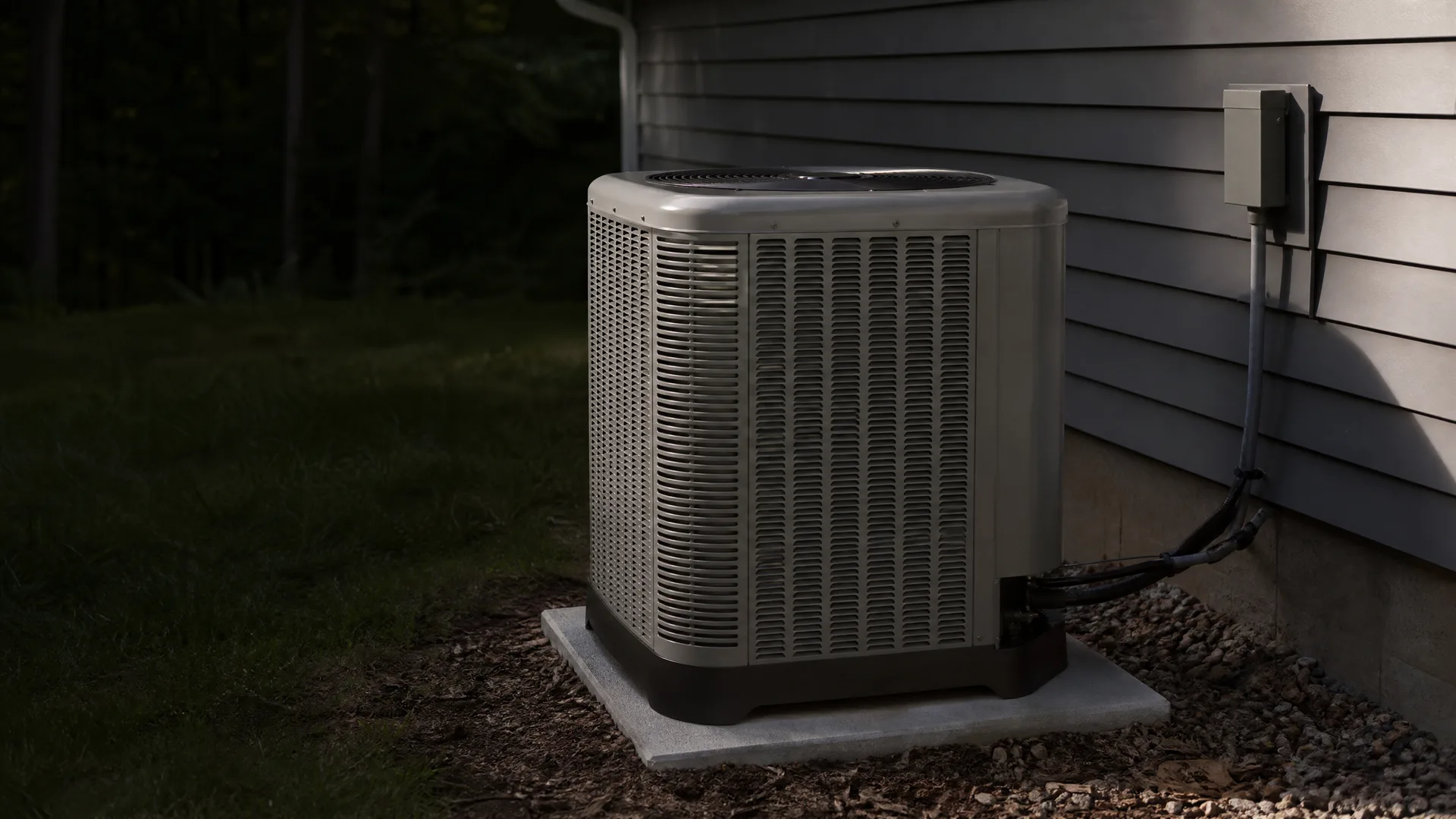
This is a condenser doing its job, tucked beside the siding with the disconnect box wired in and nothing forced about how it sits there. At the right SEER2 rating, it pulls the house down to temperature without strain and the power bill reflects a unit sized and rated for what a New York summer actually asks of it.

Bare shrubs, a quiet pad, a unit that looks fine standing still but isn't keeping up once the heat sets in. An old or undersized system runs longer to hit the same temperature, and in New York that extra runtime shows up on the electric bill every month from June through September.
At that rate, every point of SEER2 you skip paying for upfront shows up on your bill all summer long. A unit that sits a few points above the minimum draws less power to cool the same house, and in New York that difference is worth more than it would be almost anywhere else.
EIA-861 2025 statewide residential average





A dew point is what actually makes air feel heavy, more than the temperature does. Averaged out across New York homes, summer dew points run 62°F from June through August, per NOAA climate data. That's thick air, the kind where sweat doesn't dry and a room feels warm even once the thermostat says it's not. Your air conditioner isn't just cooling that air, it's wringing the moisture out of it too, and that takes more work than dry heat ever would. A unit sized and rated for a drier climate runs longer here just to catch up, and you'll notice it in how often it cycles and how the house feels even when it's running.
NASA POWER T2MDEW county cells weighted by homes

You've got a number now. Stay close to 14-15 SEER2 and you pay less to install, but the electric bill carries that choice every muggy month the unit runs. Go to 18 or higher and you pay more upfront for a unit that pulls less power out of the wall to cool the same house. Either way, the system has to be sized to your home and installed right, or the rating on the box won't mean much.
That's the part a homeowner can't check from a spec sheet. A contractor who works on New York homes can look at yours, size the load, and tell you where the SEER2 number actually pays for itself for a house like yours. Once you send the request, that search is off your plate. Someone who does this work will have what they need to reach you and talk through what your home needs before next summer gets here.

Matched to your air conditioner job