What size AC a New York home needs

New system or replacementCentral ACNew York
Step 1 of 2

What ZIP code is the job in?

What size AC do I need for my house in New York?

Right size matters more than most people think, because an AC that's wrong for the house either runs constantly or shuts off before it pulls the moisture out of the air. In a place where summer is as sticky as it is here, that second problem is the one that catches homeowners off guard when the new unit still feels clammy inside.

It depends on your home's square footage, insulation and layout, not a flat number

There's no single tonnage that fits every New York house. A contractor sizes the unit using a load calculation that accounts for square footage, ceiling height, window placement, insulation and how much shade the house gets. Two homes the same size can need different systems because one holds heat better than the other. Getting this right matters more here than in a dry climate, because the humidity means an oversized unit cools the air fast and shuts off before it has pulled enough moisture out, leaving the house cold but damp. An undersized one runs nonstop through July and August and still can't keep up. With electricity costs what they are in New York, either mistake shows up on the bill every month.

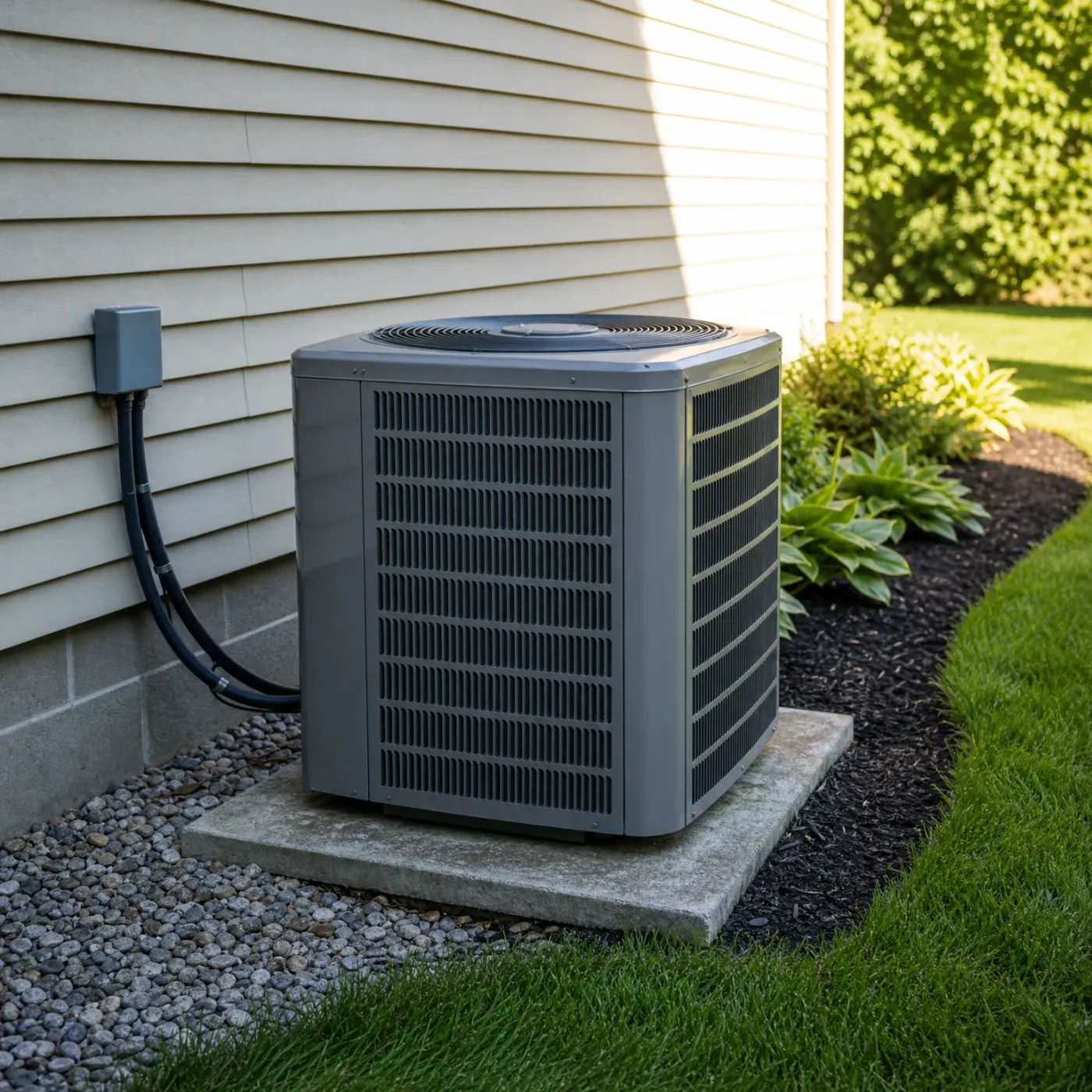
A gray outdoor air conditioner condenser unit on a concrete pad beside a house with horizontal siding and a light stucco wall, with a disconnect box and refrigerant lines on the wall and a shrub and mulch bed at left.

Square footage alone won't tell you

Two houses the same size can need different tonnage. How much sun hits the windows, how many people live there, how high the ceilings run, and how well the attic is insulated all change the load. A contractor sizes the unit with a room by room calculation, not a chart that only asks square feet. Skip that step and you end up guessing at a number that happens to be wrong for your house.

A gray outdoor air conditioning condenser unit on a concrete pad surrounded by gravel, next to a white horizontal-lap-sided house wall with an electrical box and conduit, against a blank white background on the left.

Oversized units struggle with humidity

An AC pulls moisture out of the air during the slow, steady part of the cooling cycle, right before it shuts off. A unit that's too big for the house cools the air fast and shuts off again before that part of the cycle finishes. The room feels cool but damp. That's why a bigger unit isn't a safer bet here. Getting the size right matters as much for how the air feels as for the temperature on the thermostat.

Is your AC running nonstop and the house still feels damp?

If the unit kicks on in the morning and barely shuts off until evening, that's not a sign it's working hard for you. It usually means the system is too small for the house, cycling long but never catching up on a muggy day. You might notice rooms upstairs stay warmer than the rest of the house, or the air feels heavy even with the thermostat set low. An oversized unit shows the opposite signs: it blasts cold air fast, shuts off, then leaves the house cool but clammy, because it never ran long enough to pull the humidity out. Either way, the electric bill reflects it, and in New York that cost adds up fast.

An outdoor air conditioning condenser unit on a concrete pad beside a house with horizontal lap siding, with a gray electrical disconnect box and conduit on the wall, mulch bed and shrub to the right, and mown grass in the foreground.

Sized right and running clean

This unit cycles on, pulls the moisture down, and shuts off. The coil guards are clear, the pad is level, and the disconnect box is easy to reach if a contractor ever needs it. Nothing about it is working harder than it should.


An outdoor air conditioning condenser unit on a concrete pad beside a house with light blue horizontal siding, with a shrub to the left and a conduit and disconnect box on the wall to the right.

Choked and still undersized

Dust and debris have packed into the coil guards here, and a unit that can't breathe loses capacity no matter what tonnage it was rated for. If it was already too small for the house, the buildup just adds to the strain, and the house stays damp longer each day.

A smiling man in a dark navy sweater sits on a light sofa in a living room, with a glass bowl of popcorn on a wooden coffee table and bookshelves behind him.
A smiling man in a dark green sweater sits on a tan leather sofa in a dimly lit living room, with a bowl of popcorn in the foreground and a kitchen area blurred behind him.
A smiling middle-aged man in a dark shirt sits on a gray sofa in a living room, with a bowl of popcorn on a side table and shelves, a window and kitchen area behind him.
A smiling bearded man in a dark gray t-shirt sits on a gray couch in a living room, with a large glass bowl of popcorn on a wooden table in the foreground.

A pro who works on air conditioners

A load calculation accounts for your windows, your attic insulation, and how many people are usually home, things a square footage chart can't see. That's why two neighbors with the same size house can end up with different tonnage recommendations, and why guessing from a chart leaves you with a unit that either short cycles or never catches up. New York summers don't give a wrong-sized system much room to hide. A system that's too big cools the air fast but leaves it damp. One that's too small runs all day and still can't keep up on the muggiest afternoons, and with what electricity costs here, that's a system working against you all season. Getting the size right the first time means a contractor who actually measures your house instead of estimating from the outside. That's the part worth handing off. Send the request and let a contractor who knows New York homes work out what your house actually needs.

Too small for the house

An undersized AC runs long and still leaves the house muggy, because it never gets the chance to cycle off. It's pulling cool air into the rooms the whole time, but it can't move enough of it to catch up on a 90 degree afternoon. The compressor runs harder and longer than it should, which wears on it faster than normal use would. Humidity stays high even with the thermostat satisfied on paper, because the air moving past the coil never slows down long enough to drop its moisture. Rooms farthest from the unit often stay warmer than the one with the thermostat in it.

Too big for the house

An oversized AC cools the air fast and shuts off before it has pulled the moisture out of it. The thermostat reads satisfied in a few minutes, but the house feels clammy anyway, because humidity removal takes sustained airflow across the coil, not a quick blast of cold. This is called short cycling, and it also means the compressor starts and stops more often than it should over a given day. More starts means more wear on the parts that get the compressor going each time. A bigger unit costs more to install than the house needs, too, without buying any real comfort in return.

An outdoor air conditioner condenser unit on a concrete pad beside a house with light gray horizontal siding, with mulch and green shrubs on either side and a concrete walkway in the foreground.
Before you get your air conditioner installation
A gray outdoor air conditioning condenser unit on a concrete pad beside a house with horizontal siding and a stone veneer base, with refrigerant line and electrical disconnect box on the wall and flowering shrubs to the left.
After you get your air conditioner installation

Oversized

A unit too big for the house cools the air fast and shuts off before it pulls the humidity down. The house hits 72 degrees but still feels damp.

Get an air conditioner pro

Sized to the load

A contractor works out tonnage from your windows, your attic, and your layout. The unit runs long enough each cycle to take the moisture out too.

Get an air conditioner pro
A woman with dark hair in a bun reclines on a sofa with her eyes closed, wrapped in a cream fleece blanket, a closed blue hardcover book resting in front of her, with a lit lamp and a vase of dried flowers in the background.
A smiling bearded man in a navy sweater sits at a candlelit dinner table with a glass of red wine, a bowl of salad, and plates of food in the foreground.
  1. A contractor measures every room and window.

  2. Attic insulation and ceiling height get factored into the load.

  3. A Manual J calculation sets the exact tonnage needed.

  4. The matched unit is installed and the ductwork checked.

A gray outdoor air conditioner condenser unit on a concrete pad beside a house with horizontal vinyl siding, surrounded by mulch, flowering shrubs, and lawn.
A clean coil pulls humidity out of the air all summer without straining to do it.
A weathered outdoor air conditioning condenser unit on a concrete pad beside a house with light horizontal siding, an electrical disconnect box and conduit on the wall, and mulched soil on either side.
Dirt packed into the fins makes the unit work past what its tonnage was sized for.

Power costs 26.39 cents per kilowatt-hour statewide

At that rate, an oversized unit short cycling all summer costs you for power it never needed to use. Getting the tonnage right isn't just about comfort. It's what keeps your electric bill from climbing on top of an already high rate.

EIA-861 2025 statewide residential average

A woman in a cream cardigan and jeans stands with one hand raised facing an open front door of a gray horizontal-siding house, with a black lantern wall light, a potted shrub with yellow flowers, and a stone-faced porch column.

The right tonnage is the whole answer

A house in New York needs the AC that matches its own load, not the one a square footage chart points to. That number comes from a contractor working through your windows, your attic, your ceilings, and how many people are usually home. Get that right and the unit cycles the way it should, pulling the sticky air down and shutting off instead of running the whole afternoon or clicking off before the house ever feels dry.

A load calculation isn't something you work out from a chart at the kitchen table. It takes someone measuring the actual house. Once you send in what you need, that part stops being on you. A contractor who handles this sizing reaches out and takes the load calculation from here, so the only thing left for you is deciding if the tonnage they land on fits the house you've been living in.

A living room corner with a light beige sofa holding a textured taupe cushion, a large ceramic vase of olive branches by a window, a framed neutral artwork on the wall, and a dark bowl with stacked books in the foreground.
A gray outdoor air conditioning condenser unit on a concrete pad beside a house with light horizontal siding, with gravel, dark mulch, shrubs and lawn nearby and a conduit box on the wall.

The right pro for this job

Connect with a pro

One request ends the search for an air conditioner installer.

Sending the form costs nothing.