Electricity here runs 24.43 cents a kilowatt-hour
New York households paid that rate in 2024. A mini split's efficiency rating matters more at that price than it would somewhere power costs less.
Takes about a minute. No obligation.
New York households paid that rate in 2024. A mini split's efficiency rating matters more at that price than it would somewhere power costs less.
Two mini splits can cool the same room and draw different amounts of power doing it. At New York rates, that difference shows up month after month, not just on the install bill.
NOAA nClimDiv, 1991–2020 normals
The old system has to come out before the new lines go in, whether that's a window unit, a ducted system, or baseboard heat.
Removing baseboard or ducted heat may mean patching walls or floors where the old equipment ran.



Bronx County sits in climate zone 4A, which asks real work of both heating and cooling through the year. Any mini split installed here, manufactured from 2023 on, has to clear 14.3 SEER2 for cooling and 7.5 HSPF2 for heating. That's the federal minimum for split-system heat pumps, and a ductless system counts as one under that standard. There's no lower bar for ductless just because it skips the ducts. A system that clears the minimum by a wide margin will cost less to run than one that barely meets it, especially at what Bronx households pay per kilowatt-hour. Ask what SEER2 and HSPF2 numbers a unit actually carries before it goes in.
Half the homes in Bronx County were built in 1955 or earlier. A mini split going into a house that age has to work with the walls and rooms already there, not a floor plan from a spec sheet. The lines and indoor units need a layout fitted to this house.
Find a contractorA contractor who has done this work in older Bronx houses will walk the rooms before quoting anything. Where the line set runs, where each indoor unit can mount, how many rooms one outdoor unit can serve, that gets worked out room by room. Ask to see that layout before any lines go in.
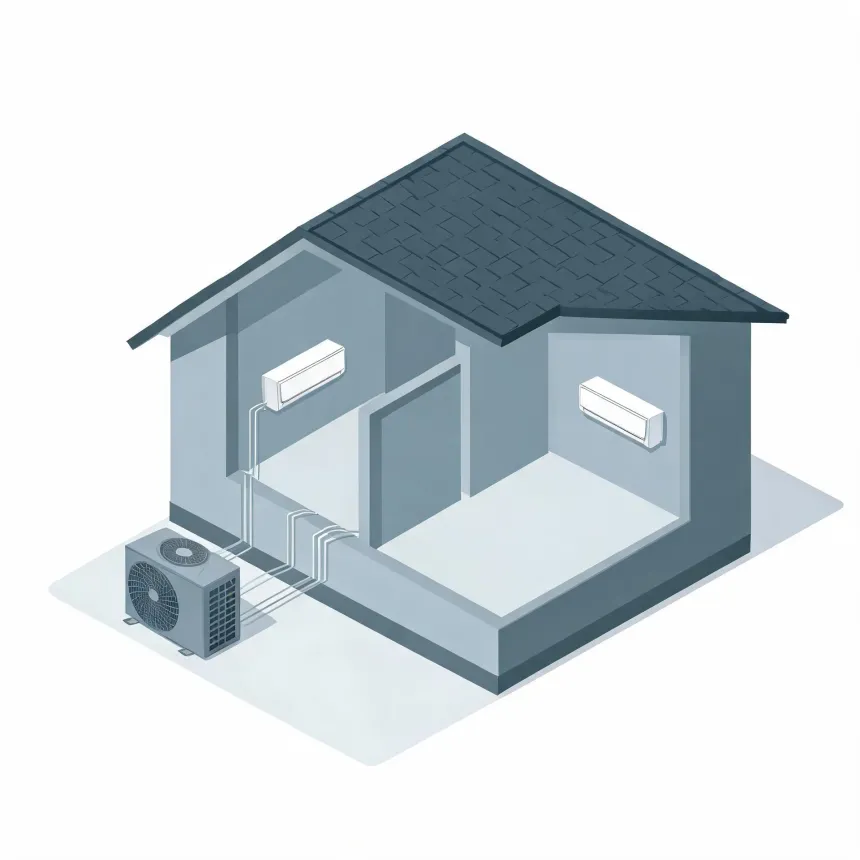
A single outdoor condenser can run more than one indoor head, but each one it carries divides the total capacity between them. Ask how many indoor units a quote puts on one outdoor unit, and whether that outdoor unit can still hit its rated output with all of them running at once.
Every heat pump loses capacity as the outdoor temperature drops, and each model has a point where it can no longer keep up on its own. Ask what that system's output looks like at the coldest days it will face, not just its rating at a mild outdoor temperature, and whether it needs backup heat to cover the gap.
The number of indoor heads is only part of what sets the price. Each one needs its own line set run from the outdoor unit, and the length and path of that line set matters as much as the head itself. A run that goes straight through a wall costs less in labor than one that has to travel up through a chase or across a roof to reach a room on the far side of the house. Mounting height and access play into it too. An outdoor unit set on a bracket off an upper floor takes more time than one set on a pad at ground level. Electrical work can add to it as well, since a new outdoor condenser usually needs its own dedicated circuit, and if the panel doesn't have room for one, that's its own job before the mini split goes in at all.
Install day starts outside, mounting the outdoor condenser on its pad or bracket and running line sets in from there. Those lines carry refrigerant, a power wire and a drain line, so each one gets connected, pressure tested and checked for leaks before anything gets charged. The indoor head goes up next, mounted level so the drain actually drains, with its own line set fished through the wall to meet the outdoor unit. Once everything's connected, the system gets evacuated to pull moisture and air out of the lines before the refrigerant goes in. Charging it right matters as much as anything else done that day. Too little refrigerant and the system struggles to hit its rated output. Too much and it can short cycle or wear the compressor down early. A proper install ends with the tech checking line set connections for leaks, confirming the charge against the manufacturer's spec, and running the system through both heating and cooling before calling it done.