Why your heat pump has ice on it in a New York winter

A local pro who knows heat pumps gets your details and gets in touch.

Connect with a pro

Why does my heat pump have ice on it in winter?

You went outside and found frost or a solid sheet of ice across the outdoor unit. The fan might still be running, or the system might not be heating the house the way it should. In a New York winter, with temperatures dropping well below freezing for stretches, this can look alarming, especially with how much you're already paying to run it through the cold months.

Some ice is normal. A thick coating or ice that doesn't clear on its own is not.

A heat pump pulls heat out of cold outdoor air, and that process cools the outdoor coil below freezing. When there's moisture in the air, frost builds on the coil the same way it builds on a cold window. To deal with this, the system runs a defrost cycle every so often, reversing briefly to melt the ice off. In a New York winter, with nights regularly below freezing, you'll see a light frost most days and that's fine. What's not fine is a thick, solid layer of ice that stays put, or ice that keeps coming back right after a defrost cycle finishes. That points to something not working the way it should, like a stuck reversing valve, a failed defrost sensor, or a fan that isn't moving air across the coil.


A gray outdoor condenser unit on a concrete pad beside a light-colored lap-sided house, with a wall-mounted disconnect box, refrigerant lines, mulch bed and shrubs, and a concrete walkway in the foreground.

A thin, even frost that melts off

A light coating across the coil or the lines, gone within an hour as the unit runs its normal defrost cycle. The fan turns freely, warm air still comes from the vents inside, and the cabinet looks clean, like the one pictured here. This is the heat pump doing what it's built to do in the cold.

An outdoor air conditioner condenser unit with rust spots on its top grille sits on a concrete pad beside a house with light horizontal siding, with conduit lines and an electrical box on the wall and a mulch bed to the right.

A thick sheet that keeps building

Ice packs the fan grille and climbs the cabinet instead of clearing. On a unit that's seen some winters, with rust on top and dirt around the base, that buildup points to a defrost control, a low refrigerant charge, or a fan motor that's given out. The house won't hold heat until it's fixed.

A woman in a cream sweater with her hair in a bun laughs while seated at a stone counter holding a glass of red wine, in a dimly lit interior with a sofa, houseplants and a large window at night.
A woman with long dark hair in a cream knit sweater laughs while looking off to the side, seated in front of a dimly lit kitchen with an island, stools, open shelving and a potted plant, with a glass of red wine in the foreground.
A smiling woman with long dark wavy hair in a light knit sweater sits at a marble counter with a glass of red wine, with a dimly lit living room and kitchen in the background.
A smiling woman with long wavy brown hair in a beige sweater sits at a white marble counter with a glass of red wine, with a living room, dining table and kitchen cabinets behind her.

Defrost is supposed to happen

Your heat pump is built to ice up a little. Cold air holds less moisture than warm air, but outdoor coils in New York winters still pull enough of it to frost over as heat moves through the system. A control board tracks coil temperature and run time, and every so often it reverses the cycle for a few minutes, sends warm refrigerant through the outdoor coil, and melts the frost off. You might see steam rise off the unit during this. That's normal. The problem starts when that cycle doesn't run, doesn't finish, or doesn't clear what built up before the next one starts.

What keeps ice from melting off

A few things stop the defrost cycle from doing its job. A low refrigerant charge means the coil runs colder than it should, so ice forms faster than the system can clear it. A failed defrost control board or a stuck reversing valve means the cycle never kicks in at all. A fan motor running when it should be off during defrost keeps blowing cold air across the coil instead of letting it warm up. Any one of these turns a normal frost pattern into a block of ice that keeps growing instead of melting off on schedule.

A smiling middle-aged man in a dark green sweater sits at a candlelit table with wine glasses and a plate of greens in a dimly lit interior.
A woman in a dark knit turtleneck sweater reclines on a couch under a cream knit blanket, looking down at an open book, with a lit table lamp and framed pictures behind her.
A dark gray outdoor condenser unit on a concrete pad beside a house with horizontal lap siding, with mulch beds, shrubs, and lawn nearby and conduit running to a wall-mounted box.

Get the right pro for your heat pump

Skip searching for a heat pump pro and answer a few questions instead.

Describe your heat pump job, and a local pro who handles it gets in touch.

Answer a few questions

You only hire the pro if you want to.

What is the ice doing to your heat pump right now

Walk past the outdoor unit and listen. If it's buzzing or straining instead of running smooth, the fan blade is likely dragging against ice built up on the housing. Look at the coil fins, the thin metal ridges wrapped around the unit. Ice packed between them blocks the airflow the system needs to pull heat from outside air, so it runs longer to do less. Inside the house, you'll feel it as rooms that won't quite reach the thermostat setting, or a system that seems to run constantly without catching up. Left alone through a cold stretch, a heavy, frozen coil can strain the compressor, the part that's expensive to replace.

Rear view of a single-story gray vinyl-sided house with a dark shingled hip roof, three windows, a center door, an outdoor air conditioning unit, and a patchy green and brown lawn under a clear sky.

That ice outside isn't working alone. New York summers run humid, with a dew point averaging 62°F across June, July and August, according to NOAA climate data. Your heat pump spends those months pulling that moisture out of the air along with the heat, and the same coil doing that job in July is the one icing over in January. A coil that ran wet all summer collects more over time, and in winter that history shows up as a thicker, harder sheet of ice instead of the thin frost a normal defrost cycle clears.

NASA POWER T2MDEW county cells weighted by homes

A thin frost that clears on its own is normal. A thick sheet that stays, especially with the fan straining or the house running cold, means the defrost cycle isn't keeping up and something underneath needs a look: a stuck reversing valve, a low charge, a fan motor losing strength. You don't have to figure out which one from the driveway. Instead of searching through contractors, calling a few, explaining the ice and the noise and the cold rooms to each one, then sitting with quotes trying to compare them, you answer a few questions once and get matched with a contractor who works on heat pumps in New York winters. They'll reach out to you directly. What you do with the ice on your unit tonight still matters, keep the breaker on, keep the area clear, don't chip at it. But figuring out why it's there and what fixing it involves doesn't have to be work you do alone.

A single-story stone-clad house with low-voltage path lights along a gravel bed and lawn at dusk, with a tree line and orange sky on the horizon.

Heat Pump Repair

A pro who works on heat pumps

RepairHeat PumpNew York
Step 1 of 2

What ZIP code is the job in?

  • A living room corner with a beige upholstered armchair holding a green pillow and knitted throw, a ceramic table lamp on a side table, white built-in bookshelves, a framed landscape print, a curtained window, and a round wooden table with a lit candle and bowl in the foreground.
    • Tell a local repair pro what your heat pump is doing.
  • A lit table lamp with a tapered beige fabric shade and a speckled rounded ceramic base sits on a wooden surface beside a potted plant, with curtains and a window in the background.
    • Send the request today and let a heat pump pro reach out to you.
    • Send the request today and stop worrying about who to call.
  • A cream upholstered armchair with a gray pillow and knit throw sits beside a wooden table with a eucalyptus-filled vase, in front of a lit stone fireplace with stacked firewood.
    • Describe what your heat pump is doing once, in one form.
    • Answer a few questions instead of calling shop after shop.
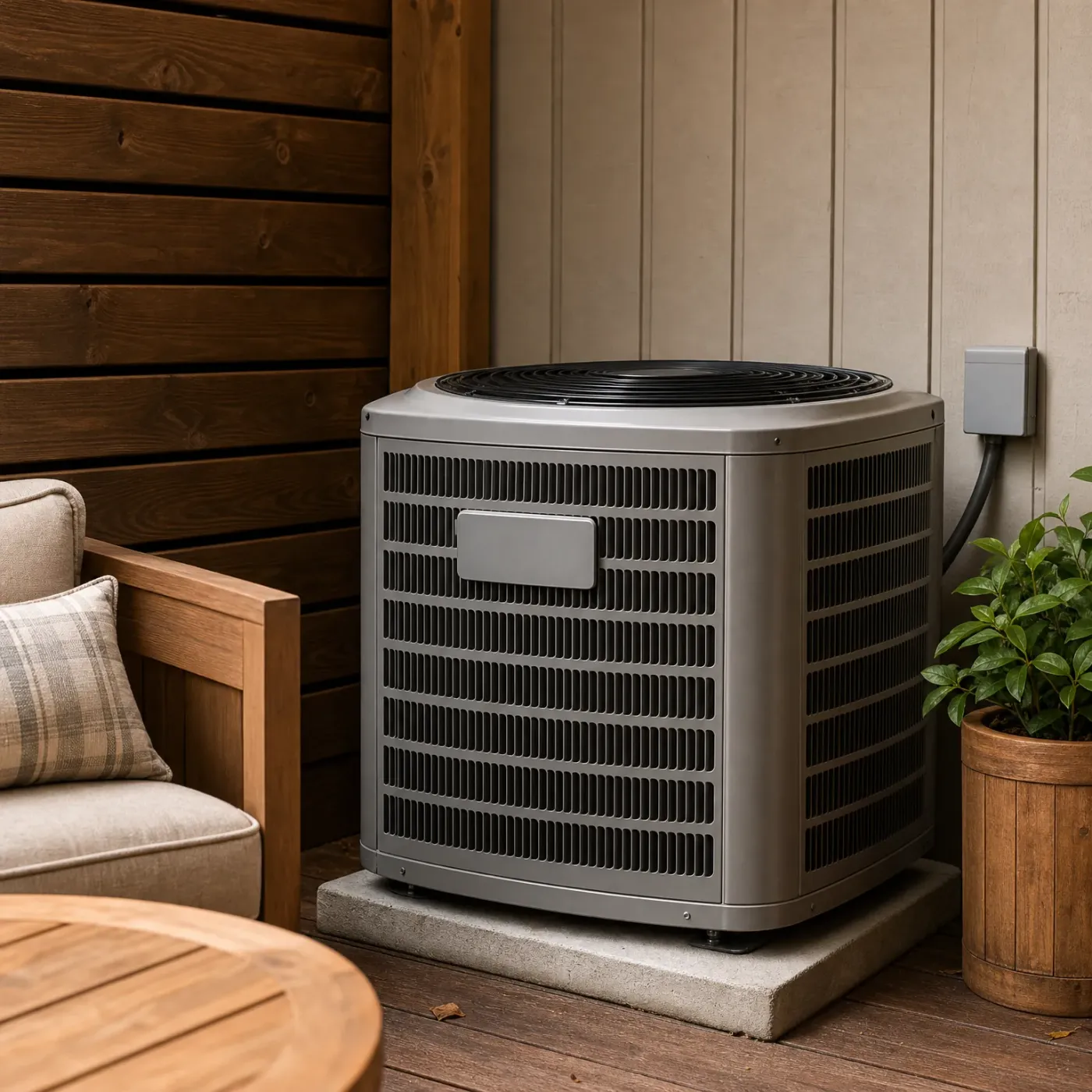
  • A gray outdoor air conditioner condenser unit on a concrete pad beside a wood-sided wall, with a horizontal wood slat fence, a cushioned patio chair, a wooden table, and a potted green plant nearby.
    • The pro who reaches out is licensed in New York.
    • Only one pro gets your request, so you hear from one company.