Two separate circuits
The air handler and the condenser run on different breakers. If only one trips, the indoor fan can run while the outdoor unit sits dead and the house never cools.
Send one request and you're done looking
A dead AC in July is its own kind of emergency, especially with Brooklyn humidity sitting in the house. This page walks through why a unit won't start, from a tripped breaker to a bad capacitor to a thermostat that lost its signal. Send the form and the job of finding someone stops being yours.
Hand it offA few things keep an AC from turning on at all, and most of them trace back to power not reaching the unit. Start with the breaker. Central air pulls hard, especially on a humid day, and a breaker that trips once will trip again if something inside the unit is drawing too much current. If the breaker's fine, the thermostat is next. A dead battery or a thermostat that lost its wiring connection won't send the signal your AC needs to start, even though the display still lights up. Outside, the capacitor is a common failure: it's the part that gives the compressor and fan motor the jolt they need to start spinning, and when it weakens, the unit hums or does nothing at all. None of these are things to guess at by swapping parts. A licensed technician can test the breaker, the thermostat wiring and the capacitor in minutes and tell you which one actually failed.


An AC that won't start usually isn't broken in the way people picture. It's a signal or a circuit that didn't complete somewhere along the line. The indoor handler and the outdoor condenser run on separate circuits, so the thermostat can light up just fine while the compressor outside never gets power. That power has to pass through a disconnect box near the condenser, and if it got bumped or switched off during a storm or yard work, the unit sits dead even though nothing inside it failed. From there it has to close through the contactor, the relay that actually sends power to the compressor and fan. If that contactor is pitted or stuck, the rest of the system can be fine and the unit still won't run. A full condensate pan will shut things down too, on purpose, through a float switch built for exactly that. None of this is random. Each piece either passes the signal along or it doesn't, and tracing it in order is how you find which one quit.




The air handler and the condenser run on different breakers. If only one trips, the indoor fan can run while the outdoor unit sits dead and the house never cools.
The thermostat doesn't power the AC directly. It sends a low-voltage signal through a transformer, and a blown transformer leaves the thermostat lit with nothing happening outside.
You hit the thermostat and nothing happens. No hum from outside, no air moving through the vents, maybe a blank or frozen display. Sometimes the indoor fan runs fine but the air coming out is warm, which means the condenser outside never kicked on. Other times you hear a faint click or buzz from the outdoor unit and then silence, like it tried and gave up. The house holds onto heat fast once this happens, and with Brooklyn humidity sitting in the rooms, it gets uncomfortable within a couple hours, especially upstairs or wherever the sun hits hardest.


The pro who gets in touch is licensed in New York and works in Kings County.
You're not committing to anything by asking.

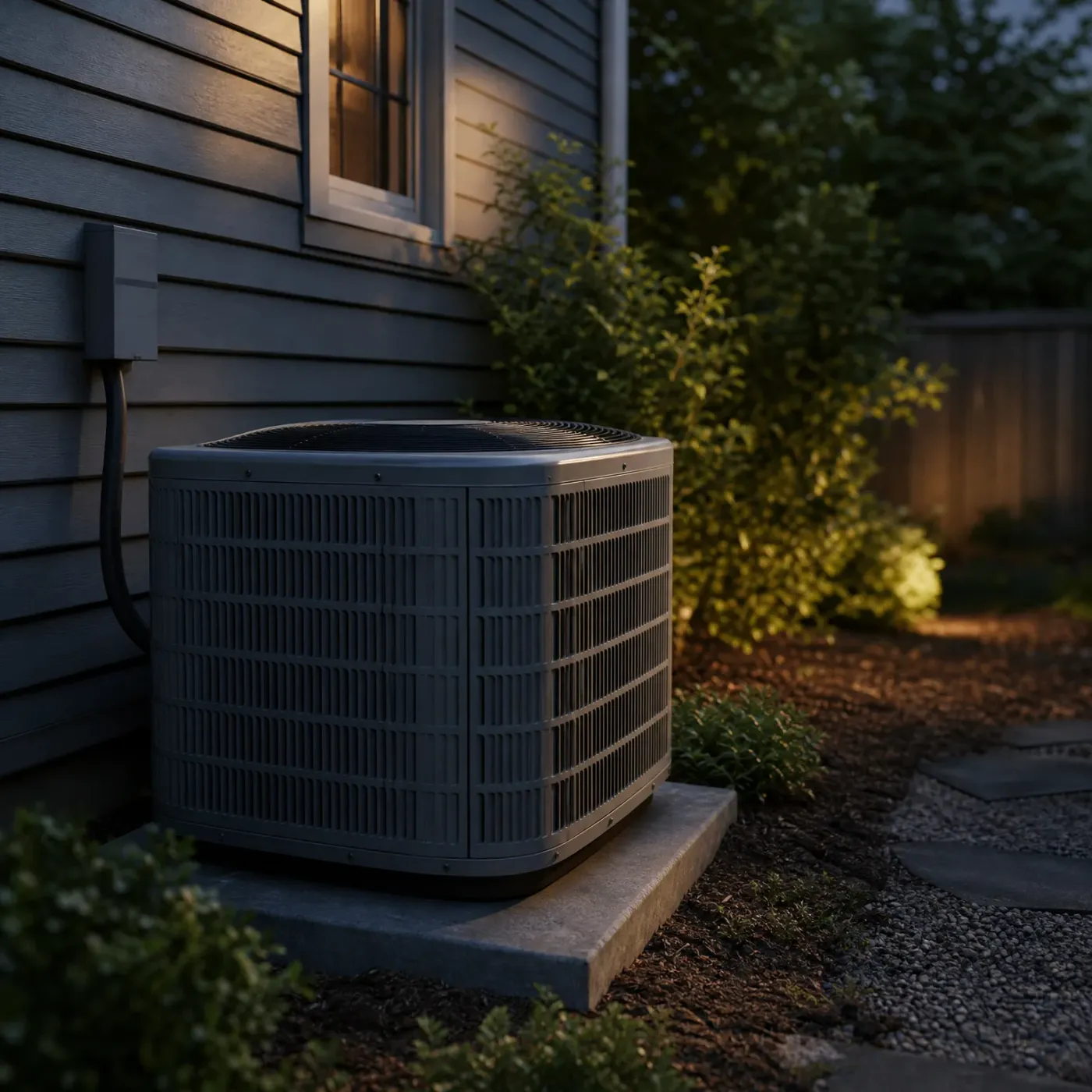
This condenser sits on its pad with the grille clear, pulling air through the coil the way it was built to. Power runs from the disconnect box straight into the unit with nothing in the way. When it gets a call for cooling, it starts and stays running.

Pine needles and mulch have worked into the wire mesh here, and the coil behind it can't pull air through like it should. A condenser running this dirty works harder and runs hotter, and a unit that overheats enough will trip its own breaker or shut itself off.
Four months is all the cooling your AC gets here, June through September, but that's also the stretch where it can't afford a dead day. A unit that sits idle most of the year sometimes needs a push to wake up right when you need it most.
NOAA nClimDiv 1991-2020
A dead AC usually comes down to one thing: power isn't getting where it needs to go. That can be the breaker, the disconnect box outside, or the low-voltage wiring that runs the thermostat. Each one fails for its own reason, and each one points to a different fix. A breaker that trips once might be nothing. A breaker that trips every time you reset it is telling you something inside the unit is drawing too much current, and resetting it again won't change that. A blank thermostat often means the transformer behind it stopped sending signal, not that the thermostat itself is broken. And if the indoor fan is running but the air is warm, the problem isn't inside the house at all. It's the condenser outside, sitting dead on its pad while the rest of the system thinks it's working. None of these are things to diagnose by trial and error in July heat. A licensed contractor working in Kings County sees these same failures every summer and knows which part tends to go first, whether that's a capacitor, a contactor, or a transformer, and checks it directly instead of swapping parts to see what sticks. You send the details once, and one local contractor who works on this equipment all season takes it from there. That's the shortest path from a dead unit to cold air again.


One request and it's handed off
A licensed pro who works in Kings County gets your request.

