






Aerial view of a gray central air conditioning condenser unit on a concrete pad next to a house with vinyl siding.

AC Repair in Rochester, NY

Tell us about the job

Takes about a minute. No obligation.

RepairCentral ACMonroe County, NY
Step 1 of 2

What ZIP code is the job in?

Warm air coming out of the vents is the one that gets attention fast. It usually means the compressor has quit or the refrigerant charge is low, and neither fixes itself. A unit that runs and runs without the house cooling down is losing the battle somewhere, often a weak capacitor or a coil that can't shed heat because it's caked with dirt. Listen for it too. A hard clunk at startup, a steady rattle, or a hiss near the lines are all the system telling you a part is failing before it fails all the way. Water pooling near the indoor unit means the condensate drain is clogged, and left alone that backs up into the house. None of these get better on their own, and waiting usually turns a repair into a bigger one.

2 months
July through August, your air conditioner is on duty
79°F
the average summer afternoon it cools against
15 hail events
in ten years, and hail bends the fins on outdoor coils
154 wind events
in ten years, and wind drives debris into outdoor units
Isometric grayscale illustration of a cutaway house with the roof lifted, showing interior rooms, ductwork, an indoor air handler, and an outdoor condenser unit beside the building.
Your air conditioner works hardest from July through August.

NOAA nClimDiv, 1991–2020 normals

Rochester air conditioners run about two months a year, July and August, with afternoon highs around 79°F.

A system that only sees real work two months a year tends to have a lot of life left in it, so repair is usually worth doing.

At 24.43 cents a kilowatt-hour, a struggling AC gets expensive fast

Power costs 24.43 cents a kWh statewide
Cooling runs July through August
Summer afternoons average 79°F
Rochester weather doesn't break air conditioners154 damaging wind events hit Monroe County between 2015 and 2024, and most AC trouble still comes down to a worn part.

June is worth paying attention to here, since cooling starts up in July. That gives a system a chance to get looked at before it has to work. Most breakdowns show up in the first stretch of real heat, when a part that was already weak gets asked to run for hours straight and can't keep up. A capacitor that was marginal last August doesn't get better sitting idle all winter. If the AC struggled at all last summer, or you noticed a warning sign late in the season, that same issue is still there waiting for the first hot day.

Get it repaired, not replaced

Two months of real work a year doesn't wear a system out. If yours is acting up, the problem is more likely a part that's failed or worn down than one that's been run into the ground. That's usually worth fixing.

Find a contractor
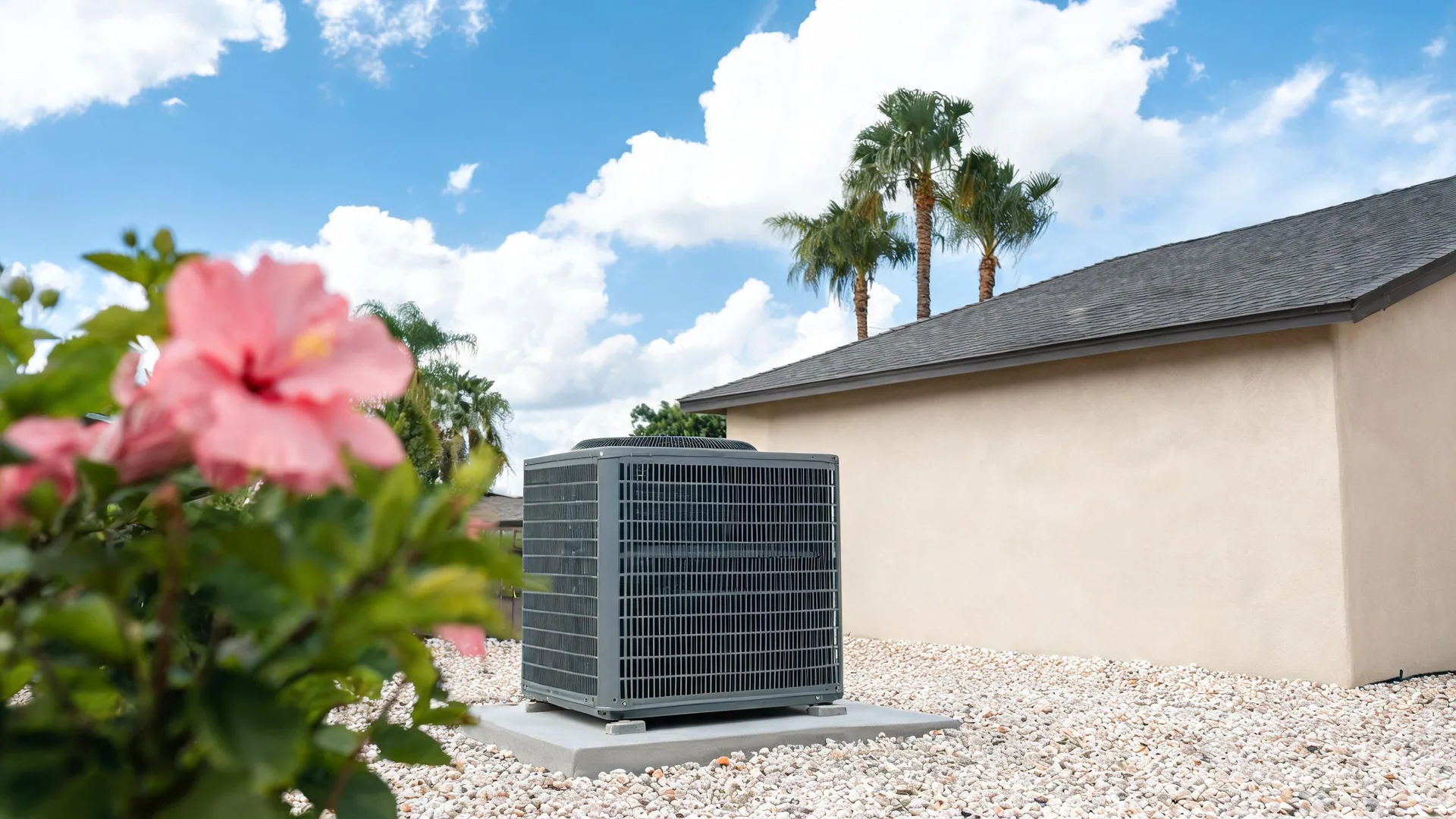
An outdoor air conditioning condenser unit mounted on a concrete pad beside a house, with electrical conduit running to a wall-mounted disconnect box.

Ask what the repair buys you

If your AC came with the house and the house dates back a while, ask the contractor straight out how much life the unit has left. A repair makes sense on a system with years ahead of it. It makes less sense on one already near the end, where the next failure might be the compressor itself. Get that answer before you pay for the repair, not after.

Most failures start with dirt, not age

The outdoor coil needs airflow to dump heat, and the indoor coil needs airflow to pull it from the house. Dirt, grass clippings and a clogged filter choke both of those off. The system then runs longer to do the same job, and that extra strain is what wears out a capacitor or a contactor years before it should.

The small parts fail long before the compressor does

Capacitors, contactors and fan motors take the daily wear of starting and stopping, and they tend to give out first. The compressor is built to outlast them. A technician who checks those small parts early usually catches the failure before it has a chance to take the compressor down with it.

An overhead view of a residential air conditioning condenser unit mounted on a concrete pad next to a house with vinyl siding.

A new air conditioner would save little on running costs in Monroe County, so the repair decision comes down to the unit's condition.

  • A new one at the federal minimum, 13.4 SEER2$200 a year
  • An older air conditioner$220 a year

Estimates for a typical Monroe County home, compared with an older unit built to the previous federal minimum, from EIA household energy data, New York fuel prices and NOAA climate normals. Your home will differ.

Repair makes sense when a part like a capacitor or contactor has failed.

Replacement makes sense when the compressor has failed or the system uses R-22 refrigerant, which is no longer made.

A repair decision really comes down to what's failing and what else is riding on it. A capacitor, a contactor, a fan motor, a drain line, those are wear parts, and swapping one out doesn't put the rest of the system at risk. They're built to be replaced on their own without touching anything around them. The compressor is a different question, since it's not really repaired so much as it's the heart of the system working or not. If a contractor traces the problem back to the compressor itself, that's the point to ask hard questions, because everything else on the unit was built around that one part lasting. Most service calls never get there. They end at a part that failed on its own schedule, got replaced, and the system runs like it did before.