






Aerial view of a gray outdoor air conditioning condenser unit mounted on a concrete pad next to a house with vinyl siding.

AC Repair in Plattsburgh, NY

Tell us about the job

Takes about a minute. No obligation.

RepairCentral ACClinton County, NY
Step 1 of 2

What ZIP code is the job in?

Cooling in Clinton County only really runs in July. June is when the system turns on for the first time in almost a year, and whatever was already weak, a tired capacitor or a charge that's been slowly leaking, shows up under that first real load. If your AC struggled last summer, that same part is still sitting there, no better than it was. Getting it checked in June means it's sorted out before July asks anything of it.

1 months
July through July, your air conditioner is on duty
76°F
the average summer afternoon it cools against
11 hail events
in ten years, and hail bends the fins on outdoor coils
75 wind events
in ten years, and wind drives debris into outdoor units
Isometric cutaway illustration of a single-story house showing interior rooms with furniture, attic ductwork connected to an indoor air handler, and an outdoor condenser unit on a pad linked by refrigerant lines.
Your air conditioner works hardest from July through July.

NOAA nClimDiv, 1991–2020 normals

Clinton County asks for cooling in one month, July, with afternoon highs averaging only 76 degrees.

A system working that few days a year has less wear behind it, so a repair is usually worth doing instead of a full replacement.

76°F afternoons don't strain a system. A weak part does.

Power costs 24.43 cents a kWh statewide
Cooling runs July through July
Summer afternoons average 76°F

Half the houses in Clinton County were built in 1974 or earlier, half in 1974 or later. That split doesn't point to one kind of problem over another. An older house might have the original ductwork or a system that's been replaced since. A newer house isn't automatically trouble free either. What actually fails in an AC doesn't come from the age of the house around it. It comes from a capacitor, a contactor, a refrigerant charge, parts that wear out on their own schedule no matter when the place was built. There's no shortcut to guessing what's wrong based on the house. Someone has to look at the unit itself.

A system that coasts most of the year is usually worth repairing

Get the unit looked at now and there's a good chance what's wrong is one worn part, not the whole system. That's the kind of fix worth making before July.

Find a contractor
A man in a worn dark jacket and tan pants, seen from behind, climbs porch steps toward a dark green paneled front door while carrying a canvas tool bag holding a hammer and other tools, with a potted conifer shrub to the right.
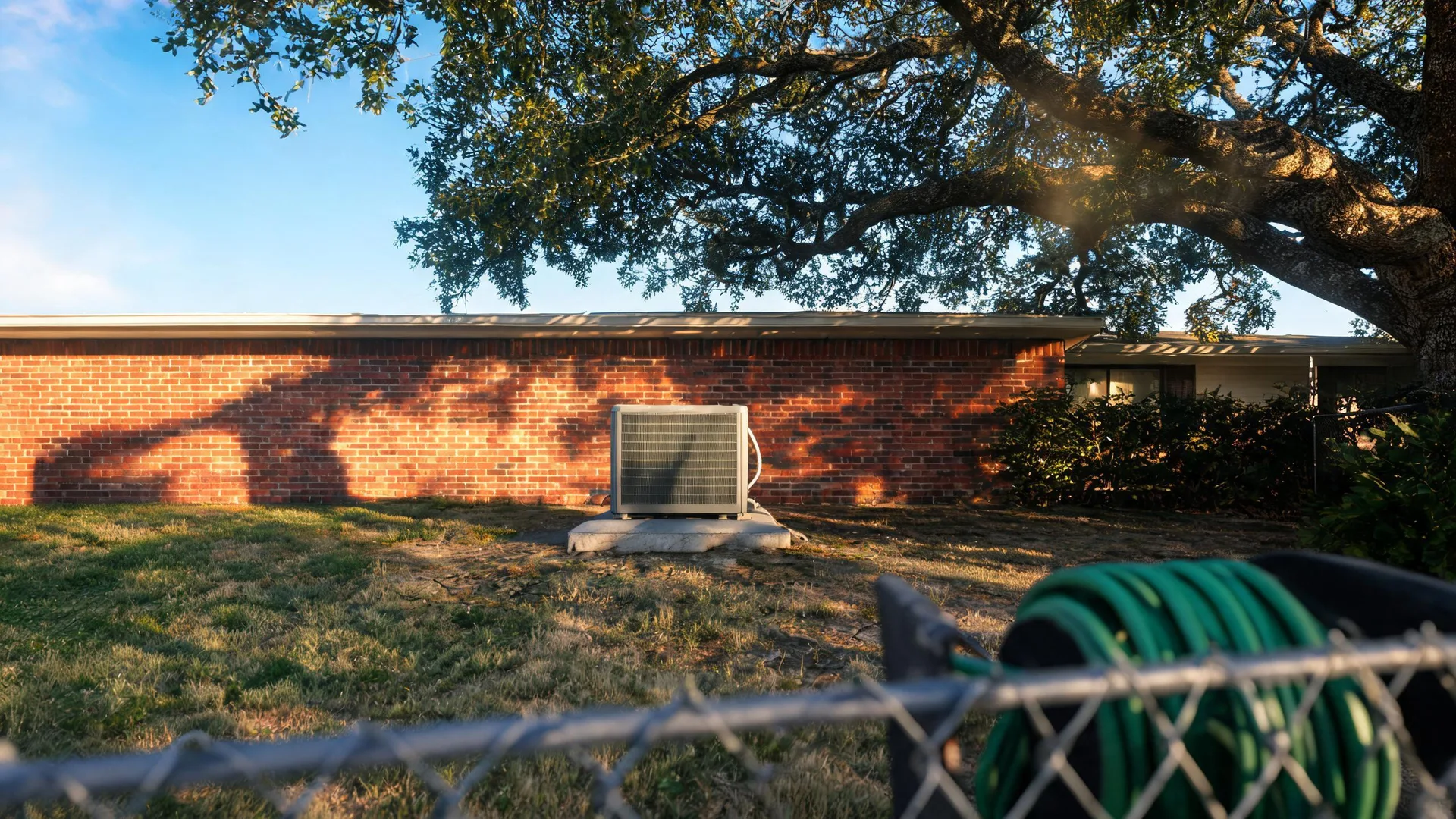
A gray cylindrical air conditioning condenser unit mounted on a concrete pad next to a light-colored vinyl-sided house exterior.

The parts that fail were already worn before the season started

A capacitor wears out from the ordinary cycle of charging and discharging every time the compressor and fan start up, season after season. It doesn't always announce itself ahead of time. One cooling run it kicks the fan a little slower than it should, and under a harder pull it doesn't kick the fan at all. A contactor wears a different way, from arcing every time it closes, until the contacts pit and stop making a clean connection, and the outdoor unit won't start even though the thermostat is calling for it. Refrigerant doesn't get used up by running. A low charge means a leak, usually in the coil or at a fitting, and that leak is there whether the system is idle or working hard. What changes when the system finally runs is that a part already worn thin gets asked to do its job, and that's when it stops being able to.

A weak capacitor pulls more current to do the same job

Once a capacitor starts to go, the compressor motor has to draw harder to start and run. That extra draw heats the motor windings past what they're built for. Keep running it that way and the damage moves from the capacitor to the motor itself.

A low charge gets lower while it's running

A refrigerant leak doesn't pause when the system cycles on. The compressor keeps pumping what's left through the same crack or bad fitting, so the charge keeps dropping. A compressor running low on refrigerant also runs hotter than it should, and that heat is what wears it out for good.

Aerial view of a gray central air conditioning condenser unit on a concrete pad next to a house with vinyl siding.

A new air conditioner would save little on running costs in Clinton County, so the repair decision comes down to the unit's condition.

  • A new one at the federal minimum, 13.4 SEER2$100 a year
  • An older air conditioner$110 a year

Estimates for a typical Clinton County home, compared with an older unit built to the previous federal minimum, from EIA household energy data, New York fuel prices and NOAA climate normals. Your home will differ.

Repair makes sense when a part like a capacitor or contactor has failed.

Replacement makes sense when the compressor has failed or the system uses R-22 refrigerant, which is no longer made.

Not every call ends in a repair, and a tech who's honest will tell you when it doesn't. A system that's lost its charge once usually loses it again, because the leak that caused it the first time is still in the coil somewhere, and chasing it down again stops making sense after a point. The same goes for a compressor that's already run hot for a stretch. Once the windings are damaged, a new capacitor won't bring it back. The parts worth replacing are the ones that fail on their own, a capacitor, a contactor, a fan motor, without taking anything else down with them. If the diagnosis comes back as one of those, fixing it is the right call. If it comes back as the compressor itself, that's a different conversation.