







Aerial view of a gray central air conditioning condenser unit on a concrete pad next to a house with vinyl siding.

AC Repair in Oneida, NY

Tell us about the job

Takes about a minute. No obligation.

RepairCentral ACMadison County, NY
Step 1 of 2

What ZIP code is the job in?

Cooling only runs two months here, July and August. An AC that sits that long tests any weak part the moment it starts back up. A capacitor or a connection that was already marginal last August doesn't improve over the winter months. So the first hot stretch of July is when it gives out, right when the house needs it most. If the system struggled at all last summer, that same issue is still sitting there. June, the month before cooling starts, is the time to have it checked, before the load finds the weak spot for you.

2 months
July through August, your air conditioner is on duty
77°F
the average summer afternoon it cools against
13 hail events
in ten years, and hail bends the fins on outdoor coils
87 wind events
in ten years, and wind drives debris into outdoor units
Isometric line illustration of a cutaway house showing interior rooms with furniture, ductwork leading to an indoor air handler, and an outdoor condenser unit connected by a line set.
Your air conditioner works hardest from July through August.

NOAA nClimDiv, 1991–2020 normals

Two months of cooling a year, with afternoons averaging 77 degrees, is a light load for an air conditioner.

A system here is usually worn by time, not by work, so a repair is more likely to bring it back for good.

Two months of light cooling and statewide power near a quarter a kilowatt-hour. Nothing here overworks an AC.

Power costs 24.43 cents a kWh statewide
Cooling runs July through August
Summer afternoons average 77°F
An older house usually means an older ACHalf the homes in Madison County were built in 1964 or earlier.

Before you call anyone, check the thermostat first. Set it below room temperature and listen for the system to kick on. If the screen is blank, check the breaker, AC units trip them more than people expect. Next, look at the outdoor unit. The fan on top should be spinning when the system is running. If it's not moving, or it's making a grinding sound, turn the system off and leave it off until someone looks at it, a seized fan motor can burn out fast if it keeps getting power. While you're outside, check that nothing is blocking the unit, leaves or a trimmed hedge pressed up against the side can choke airflow enough to cause real problems. Last, go inside and pull the air filter. If you can't see light through it, that's your problem or a big part of it, and it's one you can fix yourself.

Know what you're repairing before you pay for it

If your AC came with the house, it may be older than you think. A repair makes sense when the system has more years left in it. Ask the contractor how much life is left in yours before deciding how much to put into fixing it.

Find a contractor
A man in a dark jacket, tan work pants and cap, seen from behind, carries a canvas tool bag up concrete steps toward a dark green front door beside a potted shrub.
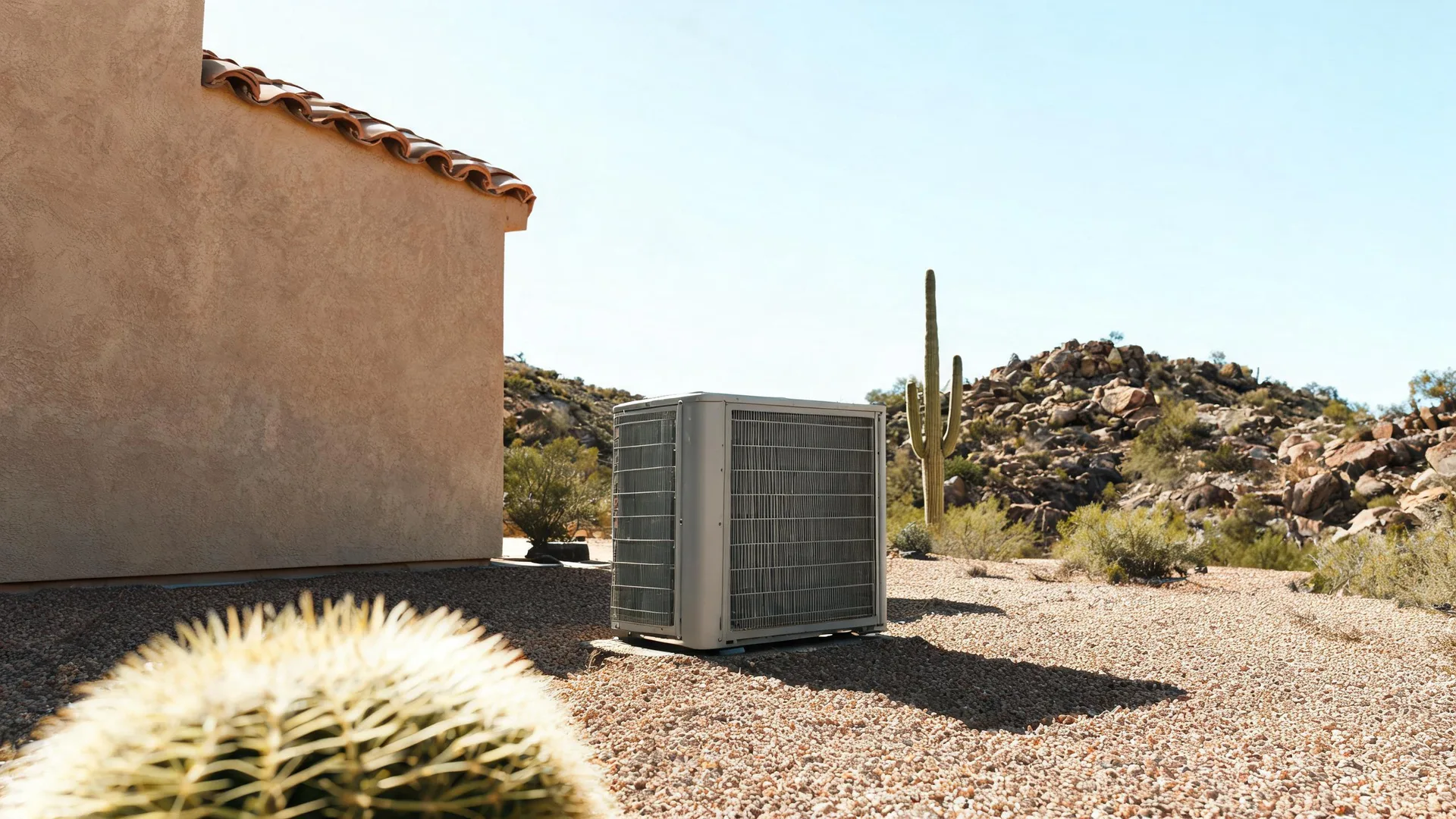
A gray residential air conditioner condenser unit mounted on a concrete pad in an open grass field.

What a diagnostic visit actually checks

A diagnostic visit starts outside at the unit, not inside with the thermostat. A contractor checks the capacitor first, since it's the most common point of failure, then watches the fan and compressor kick on together when the system is told to cool. From there it's gauges on the line to check refrigerant pressure, because that reading tells a contractor whether the charge is right, low from a leak, or fine, which rules out several possible problems in one step. The coil gets checked for frost or buildup, the filter gets pulled if it hasn't been already, and the electrical connections get tested under load, since a connection can look fine sitting still and fail the moment current runs through it. None of this takes guesswork. Every reading points to a part, and the part points to whether this is a contained fix or something that's been building for a while.

A frosted coil can freeze solid

Once the evaporator coil starts icing over, airflow gets worse, which makes more ice form. Left running, the whole coil can turn into a solid block, and water starts shedding off it as it thaws. Shut the system off as soon as you see frost, not after.

A struggling compressor doesn't recover on its own

When a compressor is low on charge or fighting a dirty coil, it runs hotter than it should every time it cycles. Heat breaks down the windings a little more each run. A compressor that would have lasted years under normal load can burn out in weeks under strain.

An overhead view of a residential air conditioning condenser unit mounted on a concrete pad next to a house with vinyl siding.

A new air conditioner would save little on running costs in Madison County, so the repair decision comes down to the unit's condition.

  • A new one at the federal minimum, 13.4 SEER2$120 a year
  • An older air conditioner$130 a year

Estimates for a typical Madison County home, compared with an older unit built to the previous federal minimum, from EIA household energy data, New York fuel prices and NOAA climate normals. Your home will differ.

Repair makes sense when a part like a capacitor or contactor has failed.

Replacement makes sense when the compressor has failed or the system uses R-22 refrigerant, which is no longer made.

A repair decision really comes down to what part failed and what it's connected to. A capacitor, a contactor, a fan motor on its own, those are contained jobs. The part owes nothing to the rest of the system, so replacing it brings the unit back to where it was. The compressor is different. It sits at the center of the refrigerant circuit, and if it's failing, something usually drove it there, a leak, a dirty coil, years of running low on charge. Replacing a compressor without finding that cause just repeats the failure. So the question isn't only what broke, it's whether that part failing is the whole story or a symptom of something upstream still working against it.