







Two white multi-story colonial houses with lit windows and black shutters photographed at night, fronted by a stone wall.

AC Repair in Olean, NY

Tell us about the job

Takes about a minute. No obligation.

RepairCentral ACCattaraugus County, NY
Step 1 of 2

What ZIP code is the job in?

July is the only month cooling runs here, and June is when a weak part usually gets found out. A unit that sat all year will get pushed hard the first hot stretch, and that's when a capacitor on its way out or a low charge finally gives. If your AC struggled last July, the same issue is probably still sitting there unless it got fixed. Getting it looked at before the first real heat means whoever comes out is diagnosing a quiet system instead of chasing a breakdown during the one month you need it most.

1 months
July through July, your air conditioner is on duty
77°F
the average summer afternoon it cools against
6 hail events
in ten years, and hail bends the fins on outdoor coils
219 wind events
in ten years, and wind drives debris into outdoor units
Isometric line illustration of a cutaway single-story building showing interior rooms, ceiling ductwork and an air handler, connected by lines to an outdoor condenser unit beside the exterior wall.
Your air conditioner works hardest from July through July.

NOAA nClimDiv, 1991–2020 normals

Olean summers top out around 77 degrees on average, and the AC only runs in July.

A unit that short on strain is usually still sound, so most repairs are worth making.

Half the homes in Olean were built by 1960, and the AC in them is probably not original

Half the homes here were built by 1960
Climate zone 5A
Power costs 24.43 cents a kWh statewide
Weather here isn't the problemCattaraugus County sees its share of storms, but that's a power issue, not an AC issue

Electricity in New York ran 24.43 cents per kilowatt-hour in 2024, higher than most states pay. That makes a struggling AC more expensive to ignore, since a unit low on charge or running on a weak capacitor pulls more power to do the same job. A system that's actually failed will tell you fast. One that's just losing efficiency will keep running, costing more than it should, without ever stopping long enough for you to notice. The fix is usually simple either way. The cost of waiting is the part that's easy to miss.

An AC that only works one month a year is usually worth fixing

One month of real work a year is not much to ask of a compressor. Most of what fails on a lightly used AC is a single part, not the whole system, which is why repair is usually the right call here. If yours is struggling, get it diagnosed before July puts the rest of it to the test.

Find a contractor
A man in a cap, dark work jacket and tan pants climbs porch steps toward a green front door, carrying a worn tool bag in his right hand, with a potted shrub beside the entry.
A gray metal air conditioning condenser unit mounted on a concrete pad in a flat grassy field under a partly cloudy sky.

How old the house is isn't how old the AC is

If the AC came with the house and the house dates back to 1960 or earlier, ask the technician how old the unit itself is before paying for a major repair. A house that old may have had the system replaced once already, or it may not have. That answer decides whether this repair is worth making or whether you're better off planning for a new system instead of sinking money into this one.

Check the thermostat and the breaker first

Set the thermostat below room temperature and listen for the system to kick on. If nothing happens, check the breaker box for a tripped switch and the condenser's own disconnect box outside. A breaker that trips once might be nothing. One that trips again as soon as you reset it means a short or a motor drawing too much power, and that's a call for a technician, not another reset.

Look at the outdoor unit and the vents

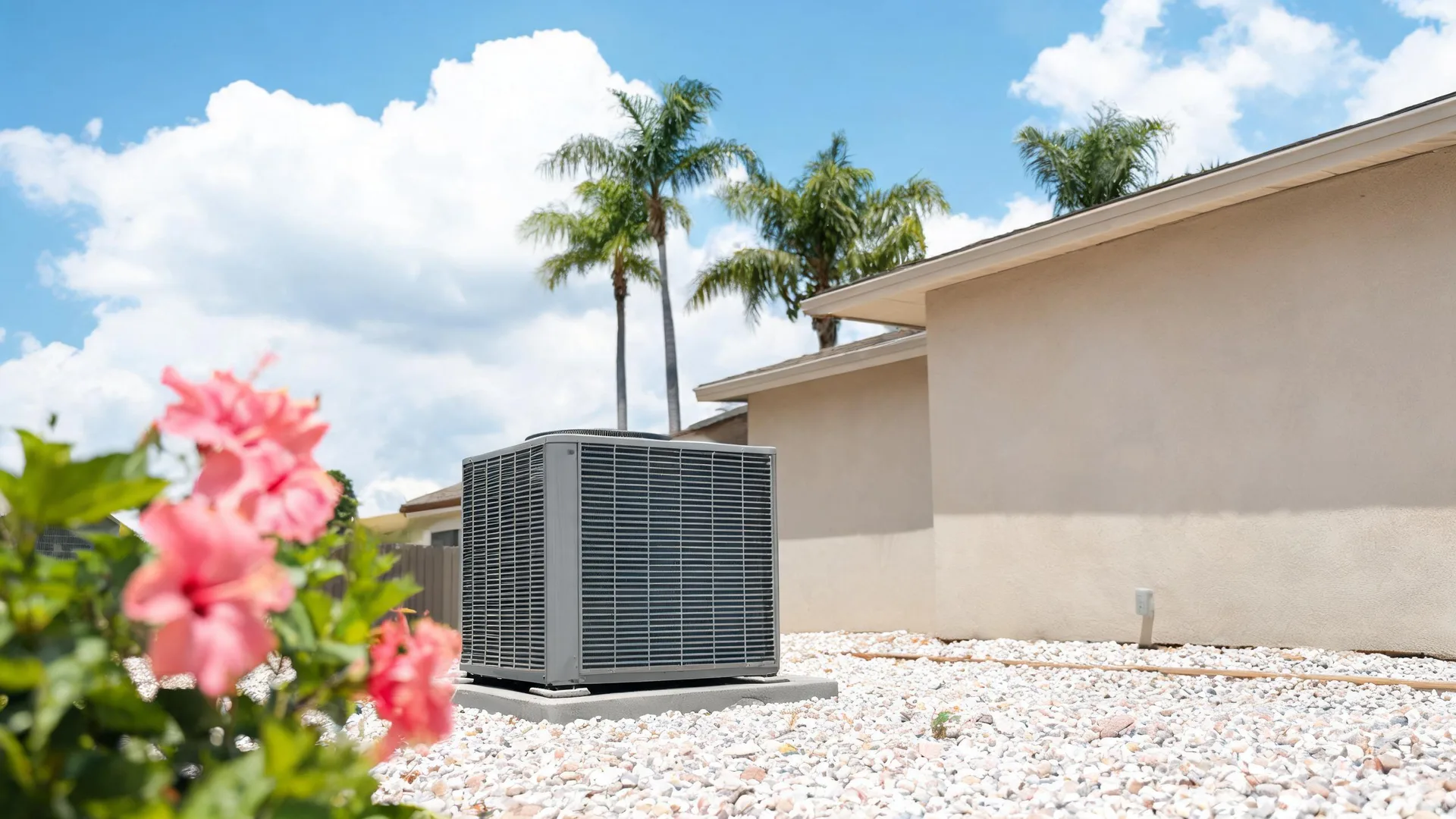
Walk outside and see if the condenser fan is spinning and the unit isn't coated in grass clippings or hemmed in by overgrown bushes. Inside, check that supply vents are open and nothing is blocking them, and swap the filter if it's gray or clogged. None of this fixes a bad capacitor or a low charge, but it rules out the easy causes before you pay someone to find them.

An outdoor air conditioning condenser unit positioned on a concrete pad next to a blue-sided house, surrounded by green shrubs and flowering hydrangeas at sunset.

A new air conditioner would save little on running costs in Cattaraugus County, so the repair decision comes down to the unit's condition.

  • An older air conditioner$110 a year
  • A new one at the federal minimum, 13.4 SEER2$110 a year

Estimates for a typical Cattaraugus County home, compared with an older unit built to the previous federal minimum, from EIA household energy data, New York fuel prices and NOAA climate normals. Your home will differ.

Repair makes sense when a part like a capacitor or contactor has failed.

Replacement makes sense when the compressor has failed or the system uses R-22 refrigerant, which is no longer made.

A diagnostic visit starts outside at the condenser, checking that the fan spins freely and the compressor kicks on without hesitating or tripping the breaker again. The technician checks the capacitor next, since that part fails often and is easy to test. From there it's refrigerant pressure, checked with gauges at the service valves, since a system low on charge will run long and cool poorly without ever fully quitting. Inside, they'll check the evaporator coil for ice and the blower for proper airflow, since a coil that's frozen over is usually a symptom of a problem elsewhere, not the cause. Most of this gets done in one visit, and most of the time the problem turns out to be one part, not the whole system.