An outdoor central air conditioning unit mounted on a concrete pad beside a blue-sided house at sunset.

AC Repair in Hempstead, NY

Tell us about the job

Takes about a minute. No obligation.

RepairCentral ACNassau County, NY
Step 1 of 2

What ZIP code is the job in?

Summers here aren't extreme

Hempstead gets about four months of cooling weather, June through September. Afternoons average around 82°F in June, July and August. That's a normal mixed-climate load. It's not the kind of heat that wears a system out early.


So look for the common cause

An AC here that's short cycling, blowing warm air, or tripping its breaker usually has an ordinary reason behind it. A weak capacitor. A low refrigerant charge. A dirty coil. A clogged filter. The job is finding which one it is and fixing that part.

4 months
June through September, your air conditioner is on duty
82°F
the average summer afternoon it cools against
10 hail events
in ten years, and hail bends the fins on outdoor coils
143 wind events
in ten years, and wind drives debris into outdoor units
Isometric grayscale illustration of a cutaway house with the roof lifted, showing interior rooms, ductwork, an indoor air handler, and an outdoor condenser unit beside the building.
Your air conditioner works hardest from July through August.

NOAA nClimDiv, 1991–2020 normals

AC units in Hempstead switch on in June and run through September.

A system with a weak part often makes it through May fine and fails in the first hot week of June.

Power runs 24.43 cents a kilowatt-hour here, so a struggling AC costs you more every month it runs

Power costs 24.43 cents a kWh statewide
Climate zone 4A
Cooling runs June through September

Weather here isn't the reason an AC fails. Nassau County logged 206 severe weather events over the past ten years, and most of them were wind, not the kind of heat or storm that breaks a compressor. Wind can still knock out power. When that happens, the AC just needs to cycle back on once power is back. Ice and hail are rare enough here that they're not worth planning around. If your AC is struggling, look at the unit itself first. The capacitor, the charge, the coil. That's where the answer usually is.

Get the usual fix

Nothing about this area is especially hard on it. It's most likely the usual problem with the usual fix.

Find a contractor
A man in a dark shirt and tan work pants, seen from behind, carries a canvas duffel bag up wooden porch steps toward a dark green front door.
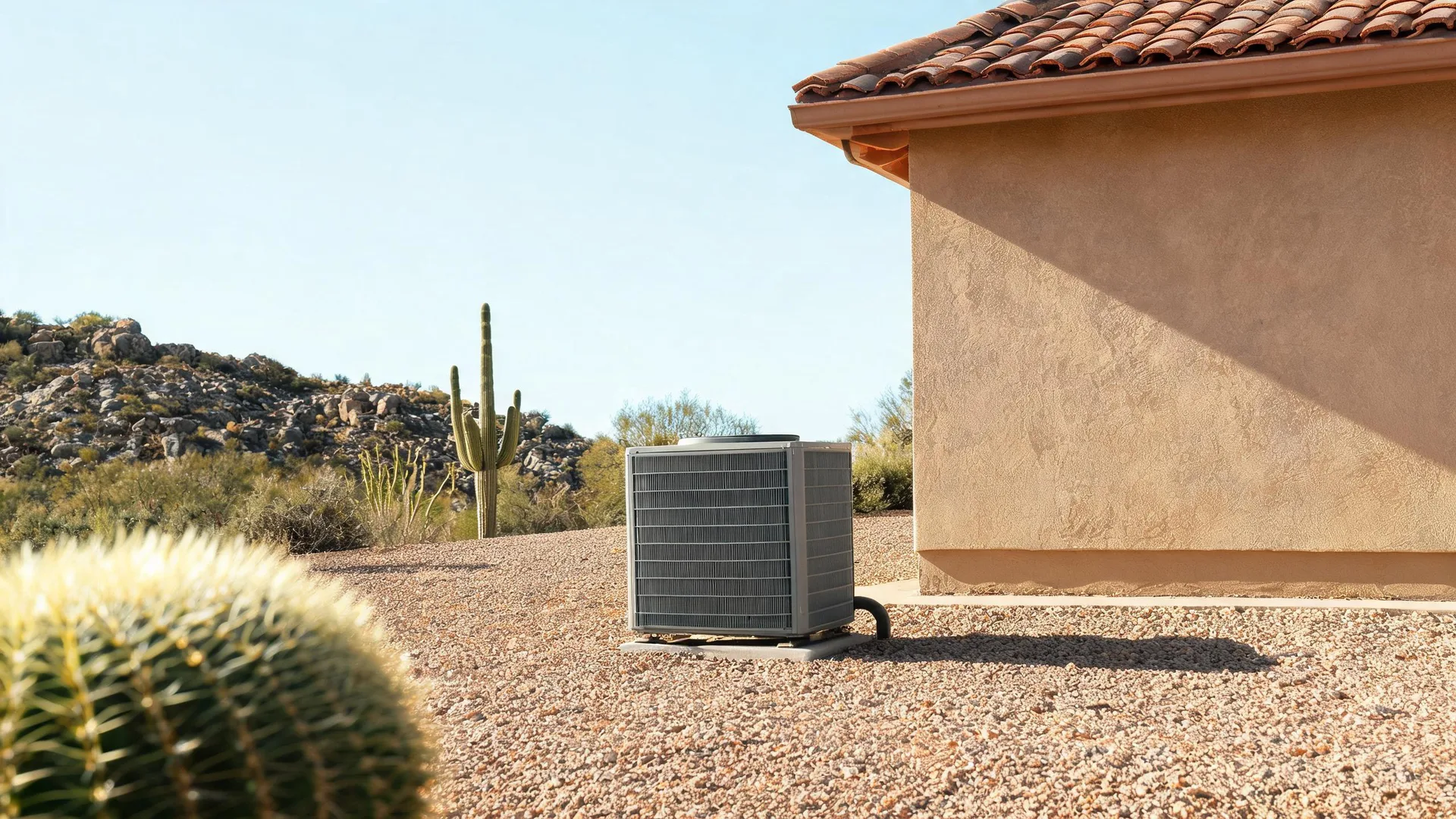
An outdoor residential air conditioning condenser unit mounted on a concrete pad, surrounded by gravel with a blue sky in the background.

Before you approve a repair, ask what it's worth fixing

If a repair quote comes in high, ask the tech how old the system is before you say yes. A compressor or coil job on a system that's already old may not be worth doing at all. Ask what they'd do in your place. A tech who's been in a lot of these older Hempstead homes will have a straight answer.

What you'll actually notice first

An AC that needs repair usually tells you before it quits outright. It runs longer than it used to without reaching the set temperature. It cycles on and off in short bursts instead of settling into a steady run. The air coming out of the vents feels less cold than it should. Sometimes there's a new sound, a hum from the outdoor unit, a click that repeats, or a hiss near the lines. None of these mean the system is done. They mean something specific inside it is failing and still worth naming.

Why the same problem gets worse left alone

A weak capacitor still starts the compressor, just slower and with more strain, until the day it doesn't start at all. A low refrigerant charge doesn't correct itself, and running the system low makes the compressor work harder to move the same amount of heat. A dirty coil blocks airflow, so the system runs longer to do less, which puts more strain on the same parts that are already struggling. Catching one of these early usually means fixing that part alone, not whatever it eventually drags down with it.

Aerial view of a square outdoor air conditioning condenser unit on a concrete pad beside a house wall with a sliding glass door.

A new air conditioner would cut about $30 a year off cooling for a typical Nassau County home.

  • A new one at the federal minimum, 13.4 SEER2$350 a year
  • An older air conditioner$380 a year

Estimates for a typical Nassau County home, compared with an older unit built to the previous federal minimum, from EIA household energy data, New York fuel prices and NOAA climate normals. Your home will differ.

Repair makes sense when a part like a capacitor or contactor has failed.

Replacement makes sense when the compressor has failed or the system uses R-22 refrigerant, which is no longer made.

A diagnostic visit starts outside at the condenser, listening to how it starts and runs. A tech will check the capacitor first, since a weak one is the most common reason a compressor struggles to start or a system short cycles. From there it's refrigerant pressure, checked with gauges at the service valves, not guessed at. Airflow gets checked too, the coil, the filter, and whether the blower is moving enough air across it. Electrical connections get a look, since a loose or corroded connection can mimic a bad part that's actually fine. Most of the time the cause turns out to be one of these, not something buried deep in the system.